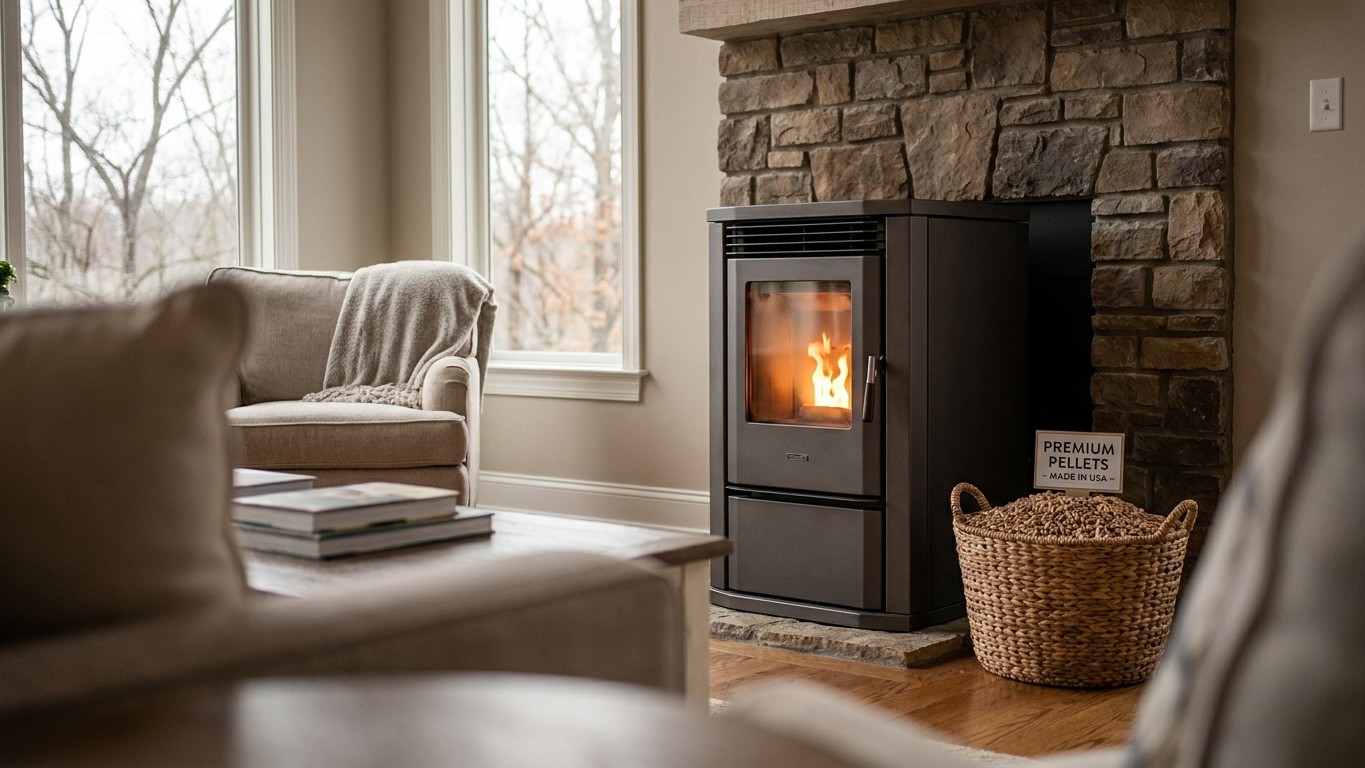

Heating With Pellets in central Indiana means feeding a stove for roughly eight months a year, with the coldest stretch landing in January. That’s the honest starting point: this isn’t a climate where a pellet stove is optional decoration for a few chilly nights. It’s a real workload, tied directly to how far below 65°F the air sits, day after day, from October through May.
How hard the winter works here

Indianapolis averages about 5,250 heating degree days a year, according to NOAA’s 1991-2020 Climate Normals. That figure is the whole story in one number: it adds up, for every day of the year, how far the mean temperature fell below 65°F. A place with 2,500 degree days needs roughly half the fuel of a place with 5,000, assuming similar houses. At 5,250, Indianapolis sits well into the “real heating load” range, closer to the northern Midwest than to the mild Southeast.
Pair that with the season’s length. Heating demand here starts in October, when the monthly normal temperature first drops below the 65°F baseline, and doesn’t fully let go until June. That’s an eight-month window, not a quick snap of cold. January carries the heaviest load, 1,131 degree days in that month alone, more than a third of some entire mild-climate winters. December and February aren’t far behind, at 983 and 910. This matters for planning, because a long, moderately cold season burns through pellets differently than a short, brutal one would, even if the annual totals looked similar on paper.
What this means for the stove’s role
With degree days this high, a pellet stove in central Indiana isn’t just ambiance. For a lot of households it functions as genuine supplemental heat, sometimes carrying a well-insulated single room or open floor plan through most of the season with the furnace dialed back. It’s rarely a full replacement for central heat here, the load is too sustained for that in most homes, but it’s not a decorative fireplace stand-in either.
One caution worth repeating: Indianapolis is the reference station, and Indiana is a big state. Counties in the far north near Lake Michigan run colder and see lake-effect snow add to the load. Southern Indiana counties along the Ohio River run milder. If you’re not near Indianapolis, treat this 5,250 figure as a starting benchmark and expect some drift in either direction depending on where you sit in the state.
How many tons a winter takes here
Nobody can hand you a tons-per-winter number that fits your house, and any source claiming to publish one for “Indiana” specifically is guessing. What you can do is work the math yourself, using the degree-day figure above as the demand side of the equation.
Start with the units. A standard bag of wood pellets weighs 40 pounds. A ton is 2,000 pounds, so 50 bags make a ton. From there, consumption tracks the heat your house actually needs to shed, which is exactly what those 5,250 annual degree days are measuring. More degree days, more fuel, for the same house and the same stove setting. That’s the physics. The specific number of bags, though, depends on three things that vary house to house far more than they vary county to county.
- How well the house holds heat. A tight, well-insulated home with newer windows can burn noticeably less than a drafty older farmhouse in the same town, even with the same degree-day exposure.
- Whether the stove is the only heat source or a supplement. A stove running as the primary heat for the whole house works far harder, and burns far more, than one warming a single family room while the furnace covers the rest.
- The setting it runs at. A stove left on a low or medium burn overnight and cranked up during the day uses meaningfully less than one run wide open around the clock.
Because of those three variables, two houses on the same Indianapolis street, under the identical 5,250 degree days, can land a full ton apart over a season. That’s not a rounding error, that’s a doubling in some cases. So the useful method isn’t finding a published average. It’s counting your own first winter: track the bags you buy, note how the stove was set and how much of the house it was heating, and use that number as your personal baseline going forward. One measured season on your own meter beats any estimate built from someone else’s house. For the national breakdown of how the math works across different climates, see our guide on how many pellets a winter takes.
Buying and storing them in this climate
Timing matters more than people expect. Since heating demand here starts building in October and holds through the winter, the smart window to buy is before that stretch, in late summer, when demand is low and supply is steady. Wait until a cold snap hits in November or December and you’re competing with every other pellet-stove household in the region for whatever’s left on the shelf. Regional cold snaps in the Midwest have a way of emptying stock fast, and dealers don’t always restock overnight.
Storage is where a lot of otherwise careful buyers lose money without realizing it. Wood pellets are compressed sawdust, held together by the natural lignin in the wood itself, with no glue or binder added. That means moisture is the enemy, full stop. Damp air causes pellets to swell, soften, and eventually crumble back into sawdust, which won’t feed properly through a stove’s auger and burns poorly if it does.
Indiana’s climate cuts both ways on this. Summers here run humid, which is exactly the wrong condition for a stack of pellet bags sitting in an open garage or an uninsulated shed for months before the season starts. Winters bring their own moisture risk too, wet snow and slush tracked near stored bags, or a garage floor that sweats when temperatures swing. Bags stored directly on a concrete floor, especially one prone to condensation, are at real risk of wicking moisture up from below even if the air above them looks dry. Raising bags off the floor on a pallet or shelving, and keeping them under a roof rather than a tarp alone, solves most of this.
On cost, skip chasing a per-bag price and compare per ton instead, that’s the only number that lets you weigh one supplier or one delivery against another honestly. For more detail on keeping pellets dry and testing quality before you commit to a large purchase, see our national pages on pellet storage and pellet quality.
What a winter outage means here
This is the constraint that separates a pellet stove from a traditional wood stove, and it matters more the colder the climate gets. A pellet stove needs electricity to run the auger that feeds fuel into the firebox and the fan that pushes heated air into the room. Cut the power, and the stove goes cold no matter how full the hopper sits. A wood stove doesn’t have that problem. A pellet stove does.
Cross that limitation with the degree-day figure from earlier. At 5,250 heating degree days, an outage during a January cold snap in Indiana isn’t an inconvenience, it’s a real heating emergency for any household leaning on that stove for meaningful warmth. In a milder climate, losing the stove for an evening might just mean skipping the ambiance and turning up the thermostat. Here, in the depth of winter, it can mean losing the one supplemental heat source carrying part of the house.
What households fall back on matters too. EIA survey data for Indiana shows 82% of homes here run a furnace as their main heating equipment, with natural gas as the dominant fuel at 65% and electricity at 26%. Central heat pumps cover another 7%, and steam or hot-water boilers 3%. So for most Indiana households, an outage that knocks out the pellet stove doesn’t necessarily knock out the whole heating system, since the furnace is the primary equipment in the large majority of homes anyway. The stove going dark in a power cut is a loss of supplemental comfort for most, not a total loss of heat, though for the smaller share of households using the stove as their main source, it’s a bigger problem.
Rather than guessing at a generator size or a battery backup capacity, check your specific stove’s electrical draw on its appliance label, that number varies by model and blower size. For a fuller look at backup options and what actually keeps a pellet stove running through an outage, see our national guide on power cuts and pellet stoves.