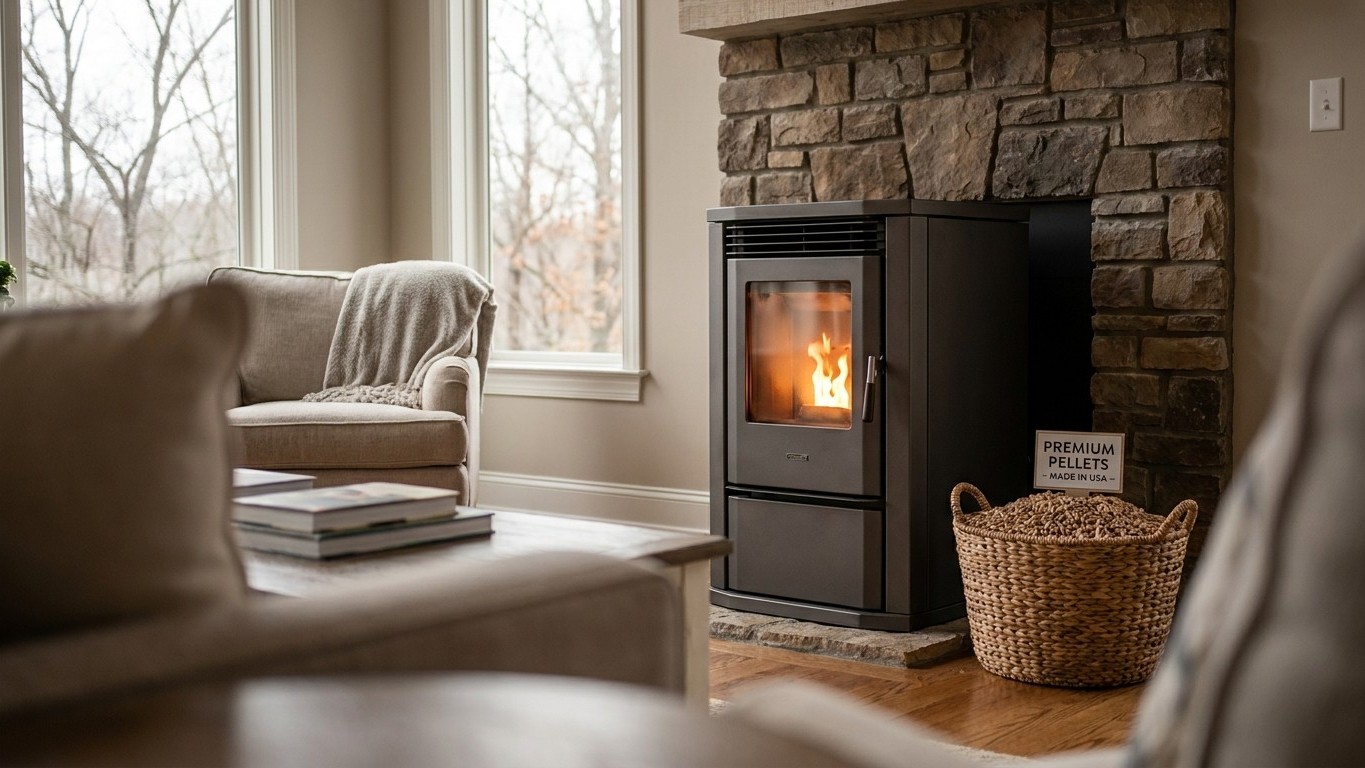

Kentucky sits in that in-between zone where a pellet stove earns its keep without needing to carry the whole house. Louisville averages about 3,936 heating degree days a year, a season that runs roughly seven months, October through April. That’s enough cold to make a stove a genuine source of heat, not just a cozy corner, but not so brutal that a single unit has to fight through a Minnesota-style winter. What it actually takes, in tons, dollars, and backup planning, depends on the house and the plan below.
How hard the winter works here

The number that matters is 3,936 heating degree days a year, measured at Louisville International Airport under the NOAA 1991-2020 climate normals. Heating degree days aren’t a temperature reading. They’re a running tally of how far below 65 F the average daily temperature falls, added up across the entire year. A house in a 3,936-degree-day climate needs roughly half the fuel of one sitting in an 8,000-degree-day climate in Minnesota, for the same square footage and the same insulation. That’s the scale Kentucky sits at: moderate. Not mild, not severe.
Pair that with the length of the season and a clearer picture forms. Heating demand starts in October, once the monthly mean temperature drops below the 65 F baseline, and it doesn’t fully let go until May. January carries the load, with 908 degree days on its own, nearly a quarter of the annual total packed into one month. February and December aren’t far behind. So the Kentucky heating season is neither short nor razor-sharp. It’s a long, moderate grind rather than a brief deep freeze, and that distinction changes how a stove gets used: less about surviving a few brutal weeks, more about running steadily for the better part of half a year.
What that means for a stove owner is straightforward. At 3,936 degree days, a pellet stove in a reasonably tight Kentucky home can plausibly serve as the main source of heat for much of the season, especially in a smaller or open-plan house, with a furnace or heat pump picking up the coldest snaps and the far corners of the floor plan. In a larger or leakier house, it settles into a supplemental role, taking pressure off the central system and cutting the fuel bill without replacing it outright. Either way, this is not a climate where a stove is purely decorative.
One more thing worth saying plainly: Louisville is one station, and Kentucky is not one climate. The hill counties of eastern Kentucky, up in the Appalachian foothills, run colder and longer than the Bluegrass region around Louisville and Lexington. Western Kentucky, closer to the Mississippi, tends to run a touch milder. Anyone near the Virginia or West Virginia border should expect a heavier season than the Louisville figure suggests, and should budget accordingly rather than assuming the state number applies at their exact address.
How many tons a winter takes here
Nobody can hand you a tons-per-winter number for your specific house, and any source that claims to is guessing. What you can do is work the chain that actually determines the answer. A bag of pellets weighs 40 pounds. Fifty bags make a ton. From there, consumption tracks the heat the house actually loses to the outside air, which is exactly what the degree-day figure above measures. More degree days, more fuel burned to hold the same indoor temperature. Fewer degree days, less fuel. Kentucky’s 3,936 puts most households somewhere in a moderate middle range compared to the rest of the country, but “moderate” still spans a wide gap between a tight, well-sealed ranch house and a drafty two-story farmhouse with a crawlspace.
Three things move the number more than anything else:
- How well the house holds heat — insulation, air sealing, window quality, and even how open the floor plan is around the stove all change how much fuel it takes to keep the same rooms warm.
- Whether the stove is the only heat or a supplement — a stove carrying the whole house through a Kentucky winter burns far more fuel than one that only kicks in on cold evenings while the furnace handles the baseline.
- The setting it runs at — a stove dialed up to a high, steady burn for months eats through pellets at a different rate than one cycling on a low or moderate setting, and thermostat habits matter as much as the equipment itself.
Given how much those three variables can shift the outcome, the only estimate worth trusting is the one you generate yourself. Buy pellets in manageable batches through the first season, keep a simple tally of bags burned by month, and use that as your baseline going forward. One measured winter in your own house, with your own habits and your own square footage, beats any published average, because no published average was built for your walls, your windows, or your thermostat setting. For the national math on how consumption scales with degree days and house size more broadly, the site’s guide on how many pellets a winter takes walks through the full calculation.
Buying and storing them in this climate
Timing matters here because Kentucky’s heating season starts in October, and that’s the deadline that counts, not the calendar year. Buying ahead means buying before October, ideally over the spring and summer months when demand is low and dealers aren’t scrambling to restock. Once a regional cold snap hits in November or January, shelves at hardware stores and fuel dealers can empty fast, and prices tend to firm up right when demand spikes. Pellets bought in June or July, out of season, are typically the cheapest they’ll be all year. Waiting until the first cold week of fall to think about supply is the single most common mistake among first-year stove owners.
Storage is where Kentucky’s climate creates its own complication, separate from the cold. Wood pellets are compressed sawdust, held together by the natural lignin in the wood rather than any added glue, which means they have zero tolerance for moisture. Kentucky’s summers run humid, classic humid subtropical territory, and that humidity doesn’t disappear just because pellets are indoors. A garage or basement that sweats in July, or a shed with poor ventilation, can let ambient moisture creep into bags long before winter even starts. Once pellets absorb water, they swell, lose their bond, and crumble into sawdust that won’t feed properly through a stove’s auger. A single humid summer stored wrong can ruin a season’s supply before it’s ever burned.
The fix is unglamorous but effective: raised pallets instead of a bare concrete floor, sealed or wrapped bags rather than open storage, and a dry, ventilated space rather than a damp corner of the basement. When comparing where to buy, the only number worth comparing is price per ton, since bag sizes and per-bag pricing can make two nearly identical deals look different on paper. For the deeper mechanics of moisture damage and long-term storage setups, the national storage and pellet-quality guides on this site cover the specifics in more detail than a state-level page needs to repeat.
What a winter outage means here
A pellet stove is not a wood stove, and the difference shows up exactly when it matters most. Feeding pellets from the hopper into the firebox, and pushing warm air out into the room, both depend on small electric motors and a control board. Cut the power, and the stove stops working within minutes, regardless of how many pellets sit in the hopper. That’s a fundamentally different risk profile than a wood-burning stove, which keeps producing heat through a blackout with no electrical input at all.
How much that risk matters depends on when the outage happens. At Kentucky’s 3,936 degree days, a January outage, right in the season’s peak month with 908 degree days on its own, during an ice storm that’s also knocked out the grid, is a real heating emergency, not an inconvenience. An outage in October or April, on the shoulders of the season, is closer to an evening without the stove and a few extra blankets. The stakes track the calendar.
What households actually fall back on in Kentucky is worth being precise about. State survey data shows furnaces as the dominant primary heating equipment, used in 66% of homes, with central heat pumps a distant but real second at 22%. On fuel, natural gas covers 43% of households and electricity 49%, while propane trails at just 4%. the survey doesn’t publish reliable figures for boiler systems or fuel oil and kerosene in Kentucky homes, meaning those setups exist but too rarely to generate a solid state estimate, not that they’re absent. The practical takeaway: most Kentucky households already lean on equipment that itself needs electricity to run, whether that’s a gas furnace’s blower motor or an electric heat pump outright, so a power outage tends to hit the whole heating system at once, pellet stove included, rather than leaving one obvious backup standing. Sizing a generator or battery setup for that scenario depends entirely on the specific stove’s electrical draw, printed on its appliance label, and the site’s national guide on power-cut planning for pellet stoves covers how to work from that number.