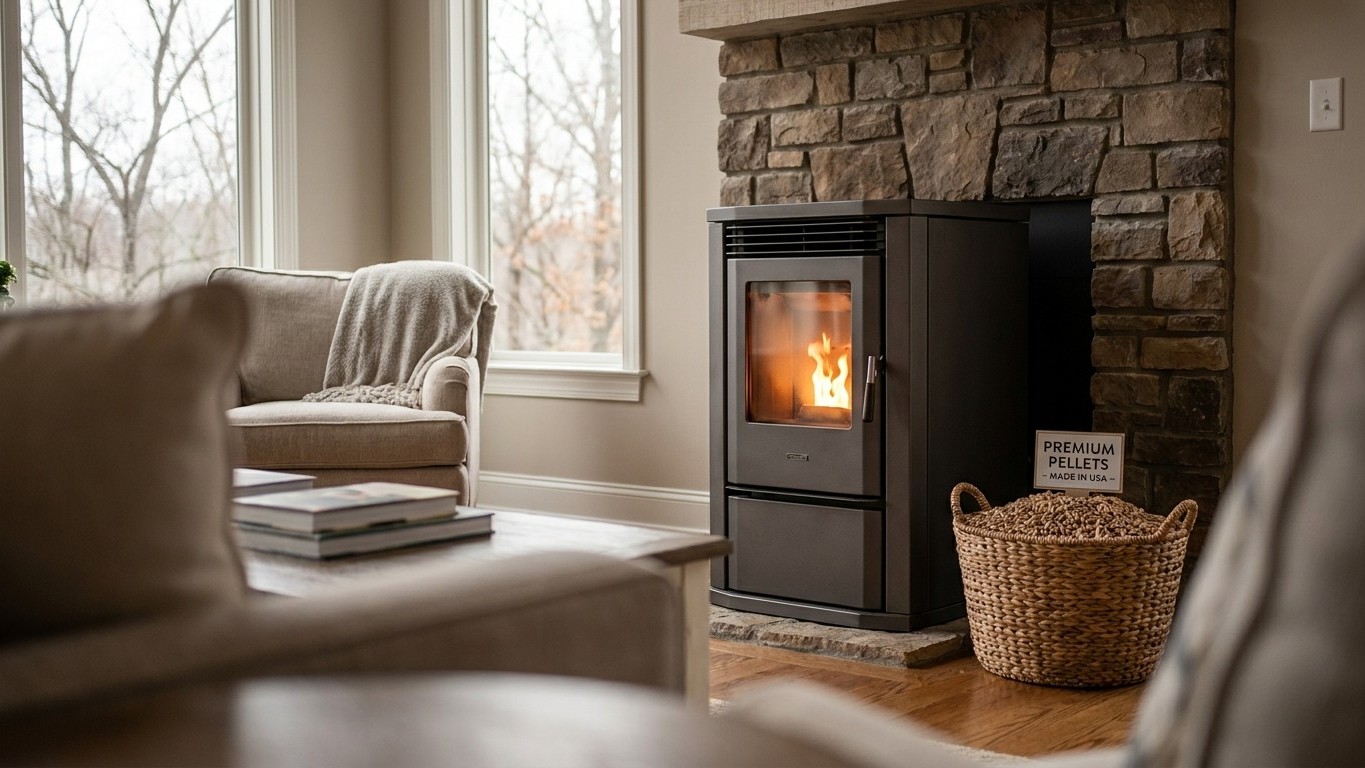

Charleston, West Virginia averages about 4,353 heating degree days a year, and that single number tells most of the story: a pellet stove here isn’t a decorative extra, it’s working hard for roughly eight months running. Expect a heating season that stretches from October into June’s edges, peaking hard in January, and a hopper that needs refilling far more often than in milder parts of the country.
How hard the winter works here

Charleston Yeager Airport, the National Weather Service station that anchors these figures, logs about 4,353 heating degree days a year against just 1,162 cooling degree days. That ratio (nearly four to one) means West Virginia homes spend far more energy staying warm than staying cool, and it puts the state solidly in the category where a pellet stove earns its keep as a real heat source, not a fireplace substitute.
Degree days measure something specific: every day of the year, how far the average temperature fell below 65 F, added up. Twice the degree days means roughly twice the fuel burned to hold a house at the same comfort level. At 4,353, Charleston sits in a middle-heavy zone, colder than the mid-Atlantic coast but nowhere near the brutal totals of the northern Rockies or interior Alaska. It’s a winter that asks a lot without being extreme.
Depth versus length
Here’s where it gets interesting. The degree-day total describes depth, how cold on average, but the season length tells you something different. Charleston’s heating demand runs from October through May, with June barely dipping below the 65 F threshold. That’s an eight-month season. A shorter, colder winter somewhere else could rack up a similar degree-day total in half the time. West Virginia’s winter is long and moderately hard rather than short and brutal, which matters for how you plan fuel purchases and how long your stove needs to run reliably without a break.
One caution worth repeating: this is a Charleston figure. A household in Pocahontas County or up in the higher ridges of the Allegheny Highlands is heating a noticeably colder house than one in the Kanawha Valley. If you’re at the northern or mountainous edge of the state, treat Charleston’s numbers as a floor, not a ceiling, and expect your own season to run longer and colder.
How many tons a winter takes here
Nobody can hand you a tons-per-winter number that fits your house, and any source claiming otherwise is guessing. What you can do is work the math yourself, using the same degree-day logic that drives everything above.
Start with the units. A standard bag of pellets weighs 40 pounds. A ton holds 50 bags. From there, consumption tracks the heat your house actually needs, which is exactly what those 4,353 annual degree days are measuring. A tightly built, well-insulated home in Charleston burning pellets as supplemental heat next to a furnace will use a fraction of what an older, drafty farmhouse running the stove as its only heat source will burn through in the same winter.
Three variables move that number more than anything else:
- How well the house holds heat, meaning insulation, air sealing, and window quality
- Whether the stove is the sole heat source or backs up a furnace or heat pump
- The burn setting the stove runs at day to day, since a unit set to maximum output around the clock eats through pellets far faster than one cycling on a thermostat
Two houses on the same West Virginia street, built the same decade, can differ by a factor of two in seasonal pellet use depending on those three factors alone. That’s why the only honest method is to count your own bags. Track what you burn through your first full winter, from the October start of heating demand through the tail end in May, and that number becomes your real baseline going forward. One measured season on your own thermostat beats every published estimate, because no estimate accounts for your walls, your windows, or how you like your living room to feel at 9 p.m. in January. For the national math behind this, see our guide on how many pellets a winter takes.
Buying and storing them in this climate
Timing matters more than most buyers realize. West Virginia’s heating demand starts climbing in October, so the smart window to buy is before that, ideally over the summer months when demand is low and supply is steady. Wait until a cold snap rolls through the Ohio Valley or the mountains in November and shelves can empty fast, leaving you paying more for less selection right when you need it most.
Buying off-season isn’t just about avoiding a shortage. Pellet pricing tends to soften when demand is low, and comparing offers by price per ton, rather than per bag or per pallet, is the only way to see what you’re actually paying across different sellers.
Storage against a humid climate
West Virginia’s summers run humid, and that’s the real storage challenge here, more than the cold itself. Pellets are compressed sawdust held together by natural lignin, with no glue or binder, which means they’re vulnerable to moisture in a specific way: damp air swells the wood fibers, and the pellets crumble back into sawdust, losing their burn quality and clogging feed systems in the process.
A garage floor that sweats in July, a basement with any lingering dampness, or an outbuilding without a vapor barrier all put a winter’s supply at risk before the cold even arrives. Pellets stored on pallets, off concrete, in a dry interior space hold up far better through a humid Appalachian summer than bags stacked directly on a slab. For the full rundown on stacking, sealing, and moisture control, our pellet storage guide and quality guide cover the details that apply regardless of state.
What a winter outage means here
A pellet stove needs electricity to run, full stop. An auger motor feeds pellets into the burn pot on a timer, and a blower moves warm air into the room; kill the power and both stop, even with a full hopper sitting right there. That’s the fundamental difference from a wood stove, and it matters more in a state where the heating season runs eight months and winter storms regularly knock out lines in the hills and hollows.
Cross that reality with Charleston’s 4,353 degree days, and the stakes come into focus. In a hard, long West Virginia winter, a multi-day outage during a January cold snap isn’t an inconvenience, it’s a heating emergency for a household relying on the stove as primary heat. In a milder stretch, or for a household running pellets as backup, the same outage just means an evening without stove heat while the furnace or heat pump keeps working, if that other system doesn’t also need grid power to run its blower.
That fallback question matters in West Virginia specifically. State survey data shows furnaces as the dominant main heating equipment at 54% of households, with central heat pumps at 20%. Natural gas fuels 43% of homes and electricity 45%, and neither fuel oil nor propane numbers were reliable enough to publish for the state. That mix means most West Virginia households pairing a pellet stove with a furnace are pairing it with equipment that, in many cases, also needs electricity to run its blower or ignition system, so a whole-house outage plan matters here more than in a state with a lot of gravity-fed gas heat. Don’t guess at generator size or battery capacity; check the wattage rating on your stove’s data label and work from there, and see our guide to pellet stoves and power outages for the full breakdown.