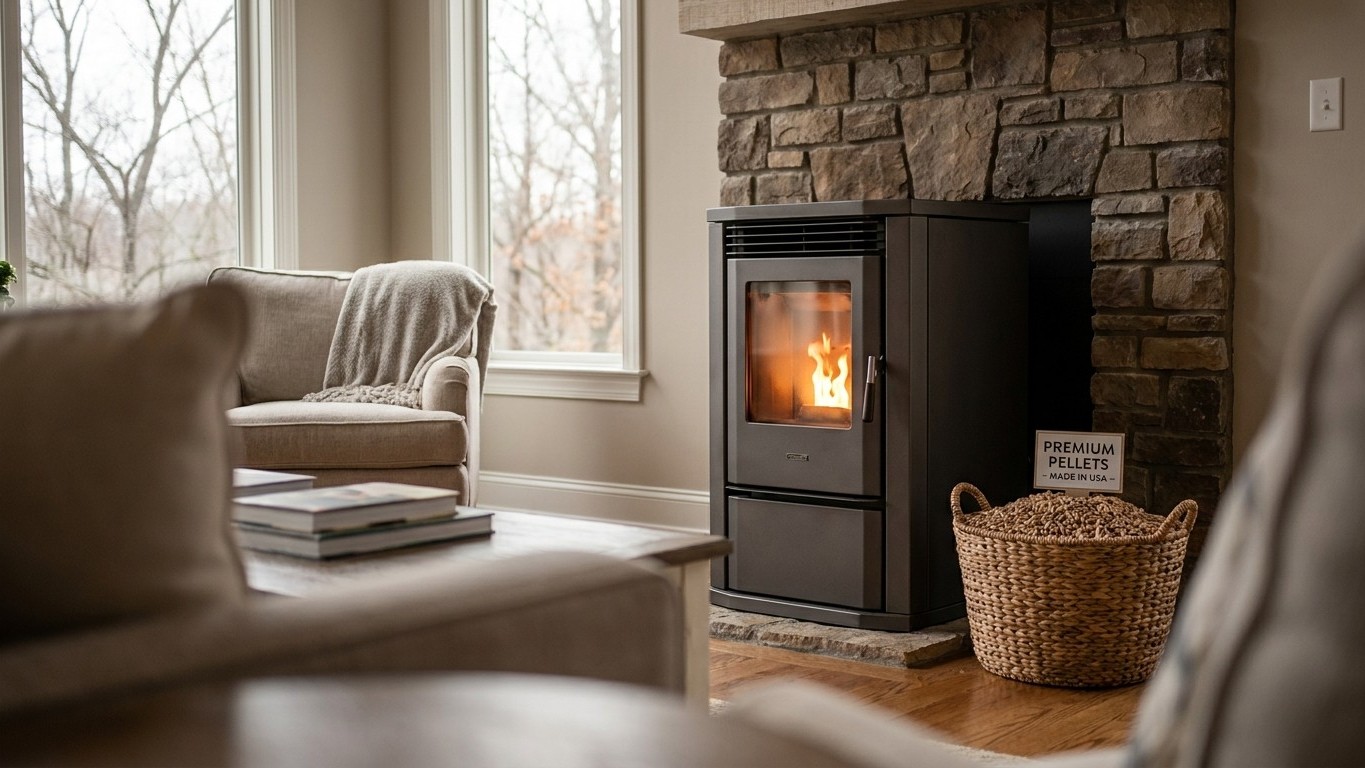

Maine burns through nearly 6,800 heating degree days a year at the Portland reference station, one of the highest totals in the Northeast. That number is what decides whether a pellet stove here is a supplemental comfort or a serious piece of the heating budget, how many tons a household actually burns, and how exposed a home is when the power goes out in January.
How hard the winter works here

The Portland Jetport station logs about 6,795 heating degree days a year, measured against the 65 F baseline NOAA uses for every station in the country. For comparison, a mild coastal city in the South might see under 2,000. Maine’s number puts it in the same range as inland Minnesota or northern Vermont. That is not a state for treating a pellet stove as background ambiance. At this level of degree days, a stove sized and fed properly can carry a well-insulated home through most of the season, or take a real bite out of an oil or propane bill for a house that leans on it as a supplement.
The degree days measure depth, how far below 65 F the average day sits and for how long, but Maine’s winter also has length on its side. Heating demand starts in September, when the monthly mean temperature (61.6 F) first dips under the 65 F line, and it doesn’t reliably climb back above that threshold until July. That’s a 10-month heating season on paper, even though the coldest stretch, January, accounts for 1,271 of those degree days on its own, more than triple what April sees. February isn’t far behind at 1,088. A homeowner running a stove needs to plan for both things at once: a long shoulder season of light, occasional use in September, October, and again in May and June, bookended by a brutal four-month core from November through February where the stove may run nearly around the clock.
All of this comes from one station, Portland Intl Jetport, sitting near sea level on the coast. Inland Maine, the western mountains, and the northern counties up toward Aroostook run colder and longer than this. A homeowner in Rangeley or Presque Isle should treat the Portland figure as a floor, not a match, and expect a heavier and longer burn than what’s described here.
How many tons a winter takes here
Nobody can hand a Maine homeowner a single number for how many tons their house will burn, because no source publishes one by state or county, and two houses on the same street can differ by close to a factor of two. What’s useful instead is the arithmetic that connects fuel to heat, since that’s the only thing that scales reliably.
A standard bag of pellets weighs 40 pounds. Fifty bags make a ton. From there, consumption tracks the heat the house actually needs to replace, which is exactly what the degree-day figure above is measuring. A house that needs to fight off 6,795 degree days of cold over a season burns through fuel at a rate tied to that number, whether the fuel is pellets, oil, or wood. The degree days don’t convert directly into tons on their own, because too much else about the house and the stove changes the equation.
Three variables do most of the work in moving that number up or down:
- How well the house holds heat — an older farmhouse with single-pane windows and no basement insulation asks far more of a stove than a tight, recently insulated build, even under the same degree days.
- Whether the stove is the only heat source or a supplement — a household running a stove alongside a fuel-oil furnace (common in Maine, where fuel oil and kerosene heat about 49% of homes) uses it on a lighter schedule than one relying on it as the primary source.
- The setting it runs at — a stove left on a low or medium burn through the shoulder months uses far less than one run at high output straight through January and February.
The most honest method available to any Maine household is to skip the search for a published average and just count. Buy in known quantities (by the pallet or by the ton), track how much gets burned through a full season, and use that as the household’s own baseline. One measured winter beats every estimate built from a state average, because it accounts for the specific house, the specific stove, and the specific way it gets used. For the general math behind bag counts and ton estimates, the national page on how many pellets a winter takes walks through the calculation in more detail.
Buying and storing them in this climate
Timing the purchase
Heating demand in Maine starts creeping in as early as September, based on the point where the monthly mean temperature drops under 65 F. That means the window for buying ahead closes before fall really arrives. Waiting until the first hard frost to stock up puts a household in line with everyone else in the region, right when a cold snap or an early nor’easter can empty local supply fast. Pellets also tend to run cheaper outside the active heating months, so buying in late spring or summer, before the September ramp-up, tends to serve both the wallet and the supply chain better than a scramble in November.
Storing them against Maine’s weather
Pellets are compressed sawdust, held together by the natural lignin in the wood rather than any glue or binder. That construction is exactly why moisture is the enemy: dampness swells the wood fibers, breaks the compression, and turns a solid pellet back into a heap of sawdust with none of the burn efficiency. Maine’s climate cuts both ways here. Summers along the coast run humid enough to matter, and a garage or shed that isn’t sealed against outside air can let that humidity creep into stacked bags over months of storage. Winters bring their own version of the same problem: wet snow, freeze-thaw cycles, and a concrete garage floor that sweats when temperatures swing, all of which can wick moisture up into bags stored directly on the ground.
The fix isn’t complicated, but it does need to be deliberate. Pallets, a plastic barrier under the stack, and a dry, sealed storage space matter more in a climate like Maine’s than they would somewhere drier. Since price varies by dealer and by season, the only number worth comparing across suppliers is the cost per ton. That’s covered along with humidity and quality specifics on the national storage guide and the pellet quality page, both of which go deeper into what separates a pellet that holds up from one that doesn’t.
What a winter outage means here
A pellet stove isn’t a wood stove with a hopper bolted on. It’s an electrical appliance that happens to burn wood fuel. The auger that feeds pellets into the firebox, the fan that pushes heat into the room, and the control board that runs the whole cycle all need power to function. Cut the electricity, and the stove goes cold no matter how full the hopper is. That’s a meaningful difference from a wood stove or a fireplace, which will keep burning through a blackout as long as someone keeps feeding it.
In a state carrying nearly 6,800 heating degree days a year, that distinction matters more than it would somewhere mild. An outage during a July evening in a low-degree-day state is an inconvenience. An outage during a January cold snap in Maine, with the reference station logging 1,271 degree days for that month alone, is a heating emergency for any household counting on the stove to carry real load. Ice storms are not rare here, and Maine winters have a track record of knocking out power to large stretches of the state for days at a stretch.
What a household falls back on during that outage depends on what’s already installed. In Maine, the numbers from the federal residential energy survey show fuel oil or kerosene as the single most common heating fuel, used in about 49% of homes, alongside furnaces as the leading equipment type at 46% and steam or hot-water boilers at 31%. Natural gas heats about 17% of homes, electric heat around 10%, and propane about 16%. Central heat pumps don’t have a reliable published figure for the state, the estimate was suppressed rather than reported as zero, so it would be wrong to say heat pumps are absent, only that the survey doesn’t offer a solid number. Practically, that data means most Maine households leaning on a pellet stove have an oil- or gas-fired furnace or boiler as the backstop, though many of those systems also need electricity to run their own blowers and igniters, which is worth checking rather than assuming.
Sizing a generator or a battery backup for that gap depends on the specific stove’s power draw, listed on its data label, not on a rule of thumb. The national guide to heating through a power cut covers how to size a backup against that label and what to plan for when the grid goes down for more than a few hours.