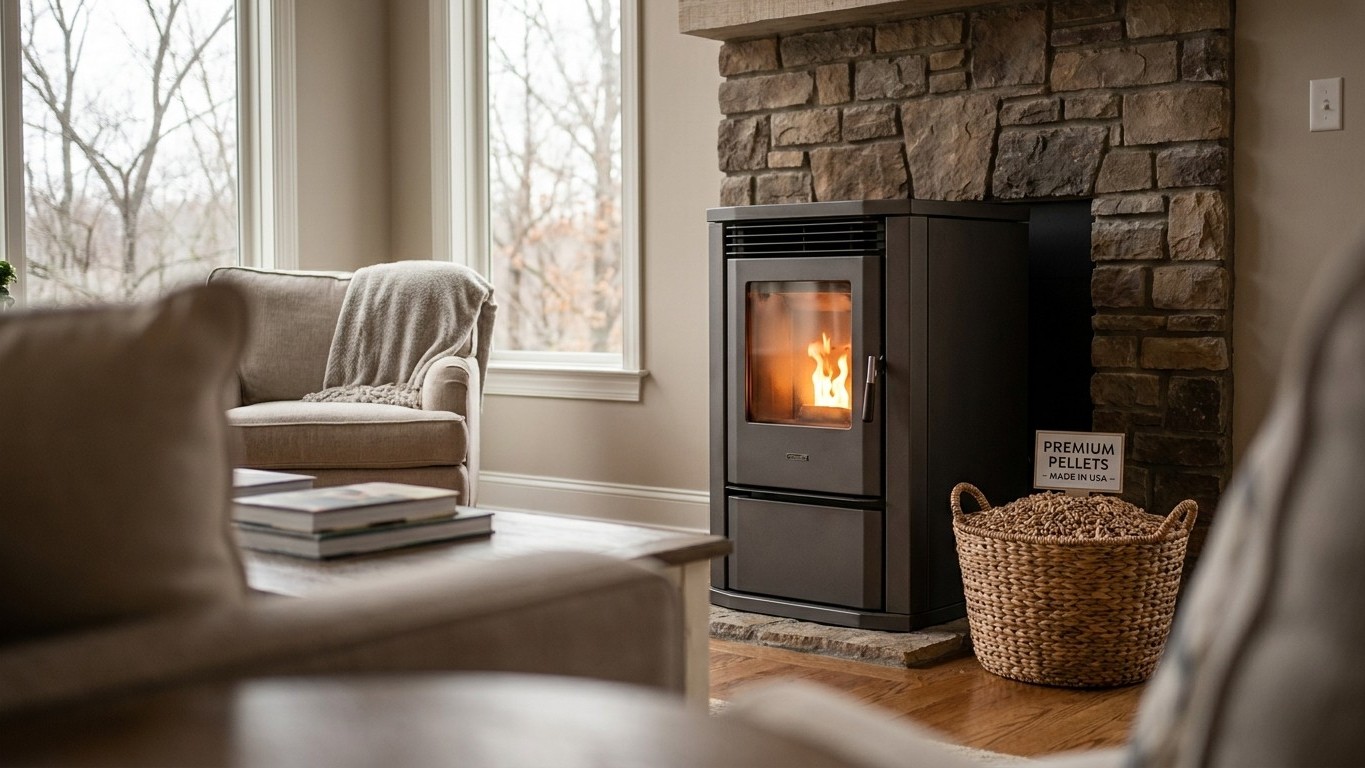

New Jersey burns through roughly 4,701 heating degree days a year at the Newark reference station, and that number does the real work of answering how much a pellet stove costs to run here. It’s a genuinely cold climate, not a mild one where a stove is decoration, and the heating season stretches across eight months. Before tons or budgets, that’s the fact that shapes everything else.
How hard the winter works here

Newark Liberty International Airport, the National Weather Service’s long-term reference station for the northern part of the state, logs about 4,701 heating degree days a year on the 65 F base NOAA uses for its official climate normals. That figure isn’t an abstraction. Every degree the daily mean sits below 65 F gets added to the tally, day after day, for the whole year. A house that needs twice the degree days of another needs roughly twice the fuel to stay comfortable, all else equal. At close to 4,700, New Jersey sits well above the mild end of the national range: this is a state where a pellet stove earns its keep as real heat, not just ambiance on a cold evening.
Length matters as much as depth, and the two aren’t the same thing. New Jersey’s heating season effectively starts in October, the first month whose normal mean temperature (57.5 F) drops below the 65 F threshold, and it doesn’t let go until June, when the mean climbs back above that line. That’s eight months of heating demand. The season isn’t a short brutal freeze, it’s a long grind: January brings the sharpest month at 1,000 degree days, but November and December aren’t far behind at 542 and 837, and even October is already contributing 253. A homeowner used to thinking of “winter” as December through February will underestimate how early the stove needs to be ready and how late it keeps working.
The 4,701 figure and the eight-month window both belong to Newark. That’s fine for most of the state’s population centers, but New Jersey isn’t uniform. The Highlands and the northwestern counties run colder than the reference station, with a heating season that likely starts weeks earlier and pushes the annual degree-day count higher. The Jersey Shore and the southern coastal plain tend to run milder. If you’re in Sussex or Warren County, or down near Cape May, treat the Newark numbers as a starting point and expect your actual heating load to sit somewhat above or below it accordingly.
How many tons a winter takes here
No source publishes a tons-per-winter figure for New Jersey, and any number that claims to would be misleading anyway, since two houses on the same street can burn twice as much fuel as each other depending on how they’re built and how they’re run. What you can do instead is work the math with your own house and treat the degree-day figure above as the variable that drives it.
Start with the units. A standard bag of wood pellets weighs 40 pounds. A ton is 2,000 pounds, which works out to 50 bags per ton. From there, consumption tracks the heat your house actually needs to lose to the outside, which is exactly what heating degree days measure. A well-sealed 1,800-square-foot house in Newark’s climate, running the stove as supplemental heat in the evenings, burns a fraction of what a drafty older farmhouse running the stove as its only heat source burns over the same eight months.
Three things move that number more than anything else:
- How well the house holds heat — insulation, air sealing, window quality, and even how exposed the house is to wind all change how much fuel is needed to hit the same indoor temperature.
- Whether the stove is the only heat or a supplement — a stove backing up a furnace in the coldest rooms burns far less than one asked to carry the whole house through January and February.
- The setting it runs at — a stove left on a low or medium feed rate for comfort burns noticeably less than one run wide open to hold 72 F through a stretch of single-digit nights.
The honest approach, and the one that actually works, is to stop guessing after the first season. Count every bag bought and burned from October through the following spring, and that number becomes your household’s real baseline, tied to your specific house and how you actually run the stove. It will tell you more than any published average, because it already accounts for your insulation, your habits, and your local microclimate. For the national math behind this estimate and typical ranges by house size, see our guide on how many pellets a winter takes.
Buying and storing them in this climate
Timing the purchase matters more in a state with an eight-month heating season than in one with a short mild winter. Since demand here starts building in October, the smart window to buy is late summer, before that ramp-up begins. Wait until the first real cold snap hits the Northeast corridor and dealers across the region see the same rush at once: shelves empty fast, and pellets bought in a hurry in November typically cost more per ton than the same fuel bought in July or August. Whatever the price, compare it per ton rather than per bag, since that’s the only figure that lets you compare one supplier or one season to another honestly.
Storage is where New Jersey’s climate creates its own problem, separate from the buying window. Wood pellets are compressed sawdust, held together by the natural lignin in the wood rather than any added glue, which means they have no tolerance for moisture. A humid mid-Atlantic summer, the kind New Jersey gets every year with its share of muggy stretches off the coast, can let bags absorb enough ambient moisture to swell and start crumbling before they’re ever burned. A garage floor that sweats with condensation, common in older homes without a vapor barrier under the slab, will ruin the bottom layer of a stacked pallet even if the top bags look fine.
The practical fix is keeping pellets off the floor, on pallets or shelving, in a dry interior space rather than an unheated garage or a damp basement corner, and checking bags periodically through a humid summer rather than assuming a sealed plastic wrapper handles it alone. For the fuller breakdown of storage setups and how to judge pellet quality before you buy, see our national guides on storing pellets properly and what separates good pellets from bad ones.
What a winter outage means here
A pellet stove isn’t a wood stove, and the difference shows up exactly when it matters most. Feeding the auger, running the combustion blower, moving heated air into the room: all of it depends on household electricity. Cut the power and the stove goes cold within minutes, no matter how full the hopper is. That’s a fundamentally different risk profile than an open wood-burning stove, which keeps producing heat through a blackout with nothing but the wood already in the firebox.
In a climate running close to 4,701 heating degree days a year, an outage during a January cold snap isn’t an inconvenience, it’s a real emergency, since the house has genuine heating load to cover and the temperature swing outside can be severe. Compare that to a milder territory where the same outage just means a colder evening without the stove’s ambiance, and the stakes here are plainly higher. New Jersey’s ice storms and nor’easters are exactly the kind of weather that knocks out power and drops temperatures at the same time, which is the worst combination for a household relying on an electric-dependent appliance.
Federal survey data shows what New Jersey households actually fall back on. Natural gas is the dominant heating fuel in the state, reported by 75% of homes, and furnaces are the leading equipment type at 61%, with steam or hot-water boilers close behind at 25% (common in the state’s older housing stock with radiators). Electricity as a primary heating fuel sits at 16%, fuel oil or kerosene at 7%, and the survey doesn’t publish a reliable estimate for propane in the state. Practically, that means most New Jersey households pairing a pellet stove with a gas furnace or a boiler have a fallback that doesn’t depend on the same failure point as the stove, at least for the furnace’s ignition and thermostat control, though many gas furnaces still need electricity to run their blowers. Rather than guessing at a generator size or a battery capacity to bridge that gap, check the wattage rating printed on your stove’s data label and see our national guide on what to do when the power goes out on a pellet stove.