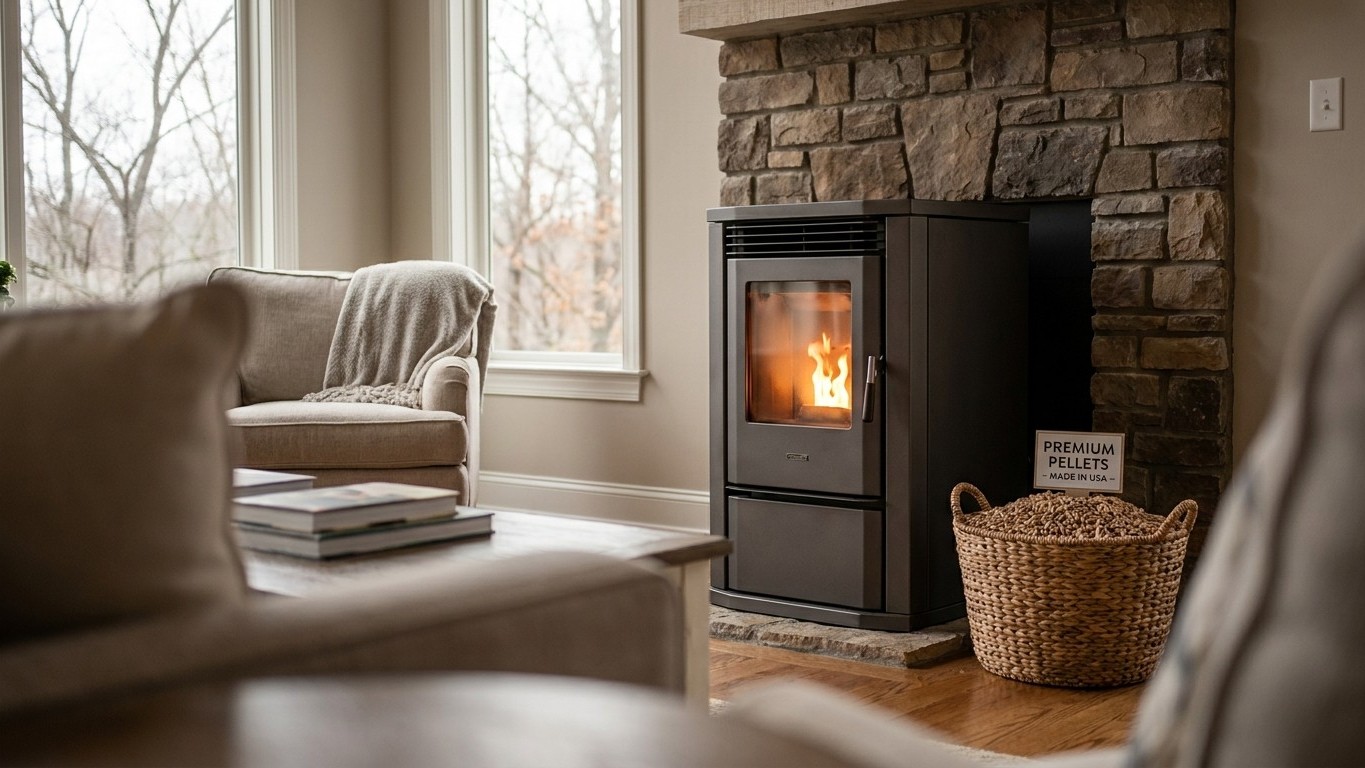

Running a pellet stove in Alberta means planning around a heating season that barely lets up and a home-heating culture built on forced-air furnaces, not stoves. The stove itself is straightforward: what changes here is how much fuel it burns, when to buy it, and what happens the day the power goes out. Those three things depend on where you live, how your house holds heat, and what else is keeping you warm when the stove isn’t running.
How hard the winter works here

At Calgary Int’l A, the reference station for climate normals in this part of the province, the annual total sits at about 4,979 heating degree days below 18 C. That single number is the whole story for fuel planning: it measures how much and how long a house has to fight the cold, and it’s the figure every ton estimate downstream traces back to. Twice the degree days means roughly twice the fuel burned to hold the same indoor temperature, all else equal.
What makes Alberta’s number unusual isn’t just its size. It’s the shape of the year behind it. At this station, the mean daily temperature stays below the 18 C base in every single month, including July, the warmest month, which still averages only 16.5 C. There is no month where heating demand drops to zero. Degree days build modestly through summer (67 in July, 84 in August), then climb fast: 213 in September, 398 in October, 612 in November, before peaking at 778 in January. December isn’t far behind at 769. That’s a season with no real off-switch, just a long trough and a sharp winter peak.
For a homeowner, that distinction between depth and length matters. A winter can be brutally cold but short, or milder but stretched across ten months of low-grade demand. Calgary’s profile is both: a genuinely hard winter by degree-day count, and one that never fully releases its grip on the thermostat. With numbers like these, a pellet stove in this climate is doing real heating work, not just adding ambiance to a living room. It’s reasonable to lean on one as a serious secondary heat source, or even a primary source in a well-sealed home, rather than treating it as a decorative extra.
One caution worth repeating: this is one station’s data, not a province-wide constant. Calgary sits in the southern half of Alberta. A home near Fort McMurray or Peace River will see colder totals and a longer, harder season; a home near Lethbridge or in a chinook-prone pocket may see noticeably milder swings even at similar latitude. Anyone serious about sizing a stove or a fuel budget should look up the normals for the station closest to their own town rather than assuming Calgary’s numbers apply directly.
How many tons a winter takes here
Nobody can hand you a tons-per-winter figure for your specific house, and no source publishes one for Alberta as a territory. Two homes on the same street, built the same year, can burn twice as much or half as much as each other depending on insulation, air sealing, and how the stove gets used. What you can do is work the math yourself, using the same logic that produces the degree-day figure above.
Start with the units. A standard bag of pellets weighs 40 pounds. A ton is 2,000 pounds, which works out to 50 bags per ton. From there, consumption tracks the heat your house actually needs to lose to the outdoors and replace, which is exactly what heating degree days measure. More degree days in a given month (January’s 778, say, versus July’s 67) means more heat lost, more fuel burned, more bags emptied from the hopper.
Three things move that number more than anything else:
- How well the house holds heat: air sealing, insulation levels, window quality, and even how exposed the house is to wind all change how much fuel is needed to hold the same indoor temperature.
- Whether the stove is the only heat source or a supplement: a stove backing up a furnace in the coldest months burns far less than one asked to carry the whole load through a Calgary January.
- The setting it runs at: a stove left on a low or medium setting through the shoulder months, then pushed to high only during the January-December peak, uses noticeably less than one run flat-out all season.
Given how much those three variables can swing the total, the only honest answer is to measure your own house. Count the bags you burn through your first winter, keep the receipts or a simple tally by the hopper, and use that number as your baseline going forward. One measured season in your own home beats every estimate anyone, including this page, could hand you. For the general math behind that estimate and how it scales with degree days nationally, see our guide on how many pellets a winter actually takes.
Buying and storing them in this climate
Timing the purchase matters more in Alberta than the raw cold suggests, because the season doesn’t announce itself with a clean start date. Degree days are still modest through July and August, but they nearly triple by September and keep climbing fast through October and November on the way to the January peak. That means the practical window to stock up is before that fall climb, not after it. Once a cold snap hits in October or November, demand across the province spikes at once, and local stock can run thin fast. Pellets are also generally cheaper in the off-season, when demand is low and suppliers are moving stock rather than racing to restock it.
Storage is where this climate asks for real attention, not because Alberta is unusually wet overall, but because of how sharply conditions swing. Pellets are compressed sawdust, held together by the natural lignin in the wood and nothing else, no added glue. That makes them vulnerable to any moisture: a damp pellet swells, loses its shape, and can crumble into sawdust and dust before it ever reaches the hopper, burning poorly or not at all.
Alberta’s chinook winds are the specific risk worth planning for. A rapid temperature swing, sometimes 20 degrees Celsius or more in a matter of hours, can leave a cold garage floor or basement slab sweating with condensation as warm, moist air moves in over cold concrete. Pellets stored directly on that floor, or in a bag that isn’t sealed against ambient humidity, can absorb enough moisture during one of those swings to be ruined by spring. Off the floor, on a pallet or shelf, in a dry, ventilated space, is the safer bet through a winter that includes those swings.
On cost, compare offers by price per ton rather than per bag or per pallet, since bag counts and pallet sizes aren’t standardized. For the fuller rundown on moisture protection and grading standards, see our national pages on pellet storage and pellet quality.
What a winter outage means here
A pellet stove needs electricity to run, full stop. The auger that feeds pellets into the firebox and the fan that pushes heat into the room both depend on a live outlet. A wood stove keeps burning through a blackout; a pellet stove goes cold within minutes of losing power, no matter how full the hopper is.
Cross that limitation with Calgary’s degree-day profile and the stakes come into focus. During the January peak, with 778 degree days packed into one month, a prolonged outage isn’t an inconvenience, it’s a real heating emergency, especially in a home leaning on the stove as a primary or major secondary heat source. In the shoulder months, when degree-day totals are lower, an outage means a colder evening rather than a crisis, but given how few months in this climate actually qualify as low-demand, that’s the exception rather than the rule.
The complication specific to Alberta is that a power failure here often takes down more than the stove. Statistics Canada’s most recent survey puts the forced-air furnace as the primary heating system in 78 percent of Alberta homes, with hot-water or steam boiler systems covering another 7 percent. Both of those systems typically rely on electricity too, for the blower motor on a furnace or the circulator pump on a boiler system, even when the actual heat source is natural gas. That means an outage in a typical Alberta home can knock out the furnace and the pellet stove at the same time, not one as backup for the other. Figures for heat pumps, electric baseboard heaters, and dedicated heating stoves as primary systems weren’t reported reliably enough to publish for this province, which means the survey doesn’t show them as a meaningful share, not that no household uses them.
Given that overlap, don’t guess at a generator size or battery capacity based on general advice. Check the wattage and starting-current requirements printed on your stove’s appliance label, and do the same for your furnace or boiler if you’re planning backup power for the whole system rather than just the stove. Our national page on planning for power outages with a pellet stove walks through how to size that backup properly.