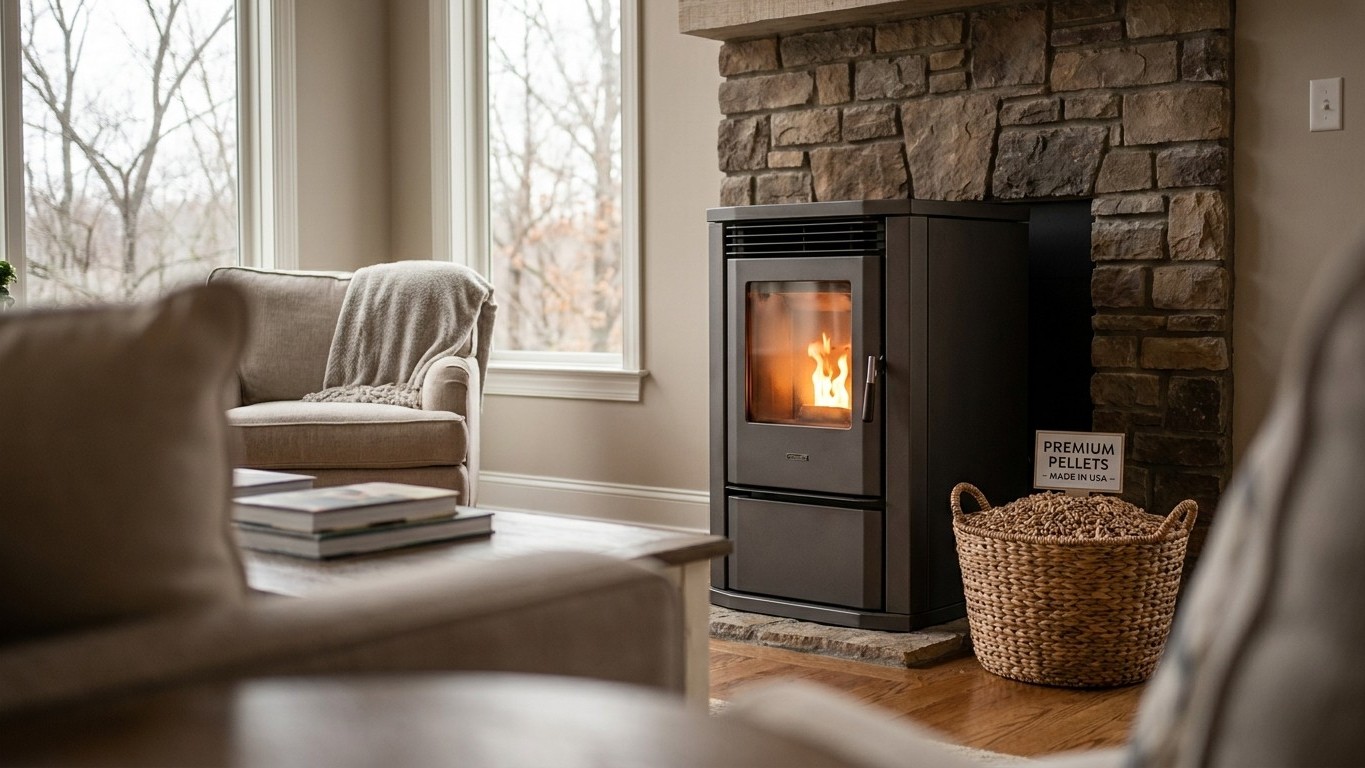

A New York winter asks a lot of a pellet stove. At the reference station in Central Park, the heating season runs about eight months and adds up to roughly 4,553 heating degree days a year, a load heavy enough that a stove here is real heating, not background warmth. That number decides how many tons a season burns, how far ahead to buy, how to store bags against a humid summer, and what happens the day the power goes out.
How hard the winter works here

Start with the number that carries the whole page: about 4,553 heating degree days a year at NEW YORK CNTRL PK TWR, the NOAA station that anchors the 1991-2020 climate normals for the city. Heating degree days aren’t a temperature, they’re a running total of how far the daily mean sits below 65 F, added up across the year. A house that needs 4,553 of them needs roughly twice the fuel of a house in a 2,200-degree-day climate. That’s the scale we’re working with in New York City, and it’s substantial enough that a pellet stove here is doing real work, not just adding ambiance to a mild fall evening.
The length of the season matters as much as its depth, and the two aren’t the same thing. Heating demand starts in October, the first month whose normal mean temperature (57.9 F) drops below the 65 F baseline NOAA uses to count degree days. It climbs through the fall, peaks hard in January at 970 degree days for that month alone, stays heavy through February (816) and March (688), then tapers into a mild stretch before the mean climbs back above 65 F in June. Add it up: about eight months where a house is losing heat to the outside air on most days. That’s a long season with a sharp, cold peak right in the middle of it, not a short brutal snap or a long gentle one. Both patterns can average out to similar annual totals, but they burn through a hopper very differently.
One caution matters more here than almost anywhere else in the state: this figure comes from one station in Manhattan, at sea level, buffered by the urban heat island effect that keeps the city measurably warmer than its surroundings. A homeowner in the Adirondacks, the Southern Tier, or the Tug Hill Plateau (one of the snowiest inhabited places east of the Rockies) is looking at a colder, longer season than these numbers describe. The Central Park figure is a reasonable stand-in for the city and its immediate suburbs. Anyone farther north or at higher elevation should treat it as a floor, not a ceiling, and check normals for a station closer to home before budgeting fuel around it.
How many tons a winter takes here
Nobody can hand a New York homeowner a tons-per-winter number and have it mean much, because no source publishes one for this state and because two houses on the same block can burn twice as much as each other. What works instead is a chain of reasoning built from the numbers already on the table. A standard bag of pellets weighs 40 pounds. A ton is fifty of those bags. How many tons a given house burns follows the heat that house actually loses to the outside, which is exactly what the degree-day figure above measures. More degree days, more fuel, all else equal. Since New York’s roughly 4,553 annual degree days sit well above a mild-climate state, a stove working through a full New York winter is carrying real load for the better part of eight months.
Three variables push that consumption up or down for any given address:
- How well the house holds heat — an older balloon-framed home with single-pane windows loses heat far faster than a tightly air-sealed newer build, even next door to it.
- Whether the stove is the only heat source or a supplement — a stove carrying the whole house through January burns far more than one topping off a furnace on the coldest nights, per the equipment mix below.
- The setting it runs at — a stove left on a high or continuous setting through the peak months (January’s 970 degree days, February’s 816) eats through pellets at a different rate than one dialed back and used mainly in the evenings.
The honest answer, and the only one that actually fits a specific house, is to weigh or count the bags burned through one full winter and use that as a personal baseline. A pallet delivery, a garage full of bags, whatever the format, keep a running tally from October through the last cold night in spring. One measured season beats any estimate a website or a dealer can offer, because it already accounts for that house’s insulation, that household’s habits, and that particular stove’s setting. For the national math on how consumption scales with house size and climate, see our guide on how many pellets a winter takes.
Buying and storing them in this climate
Timing the purchase around New York’s own calendar matters more than chasing a sale price. Heating demand starts building in October here, so buying ahead means buying before that month, ideally over the summer when demand is low and supply is steady. Wait until a cold snap sweeps down from Canada in November or December and shelves at local dealers and big-box stores can empty fast, especially in years when an early Arctic blast catches suppliers off guard. Buying in July or August, when nobody else is thinking about heating, is the quiet way to avoid that scramble.
Storage is where New York’s own weather works against the bags. Pellets are just compressed sawdust, held together by the wood’s natural lignin rather than any added glue, which means they’re only as stable as they are dry. New York summers bring real humidity, the kind that leaves a basement or garage feeling damp for weeks at a stretch, and that moisture is exactly what swells pellets and breaks them back down into sawdust and fines. A garage floor that sweats in July, a basement with a musty corner, an uninsulated shed near the coast where salt air adds its own dampness: all of these are the wrong place for a stack of bags to sit through the off-season. Pellets bought in summer for winter use need to sit somewhere genuinely dry, off a concrete floor that can wick up moisture, and ideally with some airflow around the stack rather than sealed against a damp wall.
Skip the price comparisons between bags, brands, or specific dealers, since those numbers shift by the month and by the region. The only comparison that means anything is price per ton, because bag sizes, pallet counts, and delivery fees all vary enough to make a per-bag price misleading on its own. For more on what separates a well-stored pellet from a ruined one, and on reading a bag’s ash content and moisture spec before buying, see our guides on pellet storage and pellet quality.
What a winter outage means here
A pellet stove runs on electricity as much as it runs on wood. The auger that feeds pellets into the firebox, the fan that pushes heated air into the room, the control board that manages both: all of it needs a wall outlet working. Cut the power and the stove goes cold within minutes, hopper full or not. That’s the one thing a wood stove never asks for and a pellet stove always does, and it’s the detail that separates the two appliances more than anything else about how they burn.
Cross that dependency with how hard New York winters actually run, and the stakes come into focus. During the January-February stretch, when the state is racking up nearly 1,800 degree days across those two months combined, a multi-day outage during an ice storm or a nor’easter is a genuine heating emergency, not an inconvenience. During the shoulder months, October or April, the same outage just means an evening without the stove and a blanket instead. The degree-day curve above is the guide to how much an outage actually costs a household in comfort and, in a bad case, in safety.
What most New York households fall back on if the stove goes dark tracks the state’s own equipment mix: 44% of homes run a furnace as their main heat, another 35% run a steam or hot-water boiler (common in the state’s older housing stock and its radiator-heated apartment buildings), and natural gas is the dominant fuel behind both at 61% of households. Fuel oil or kerosene backs another 17%, electricity itself 16%, and propane a smaller 4%. The catch is that a gas furnace or an oil-fired boiler still needs an electric igniter and a blower or circulator pump to move heat through the house, so a whole-house power outage doesn’t spare most of these systems either. Don’t guess at a generator size or a battery capacity from a rule of thumb. Check the wattage draw printed on the pellet stove’s own data plate, check what the furnace or boiler needs to run, and see our guide on what a power cut means for a pellet stove for how to plan around it.