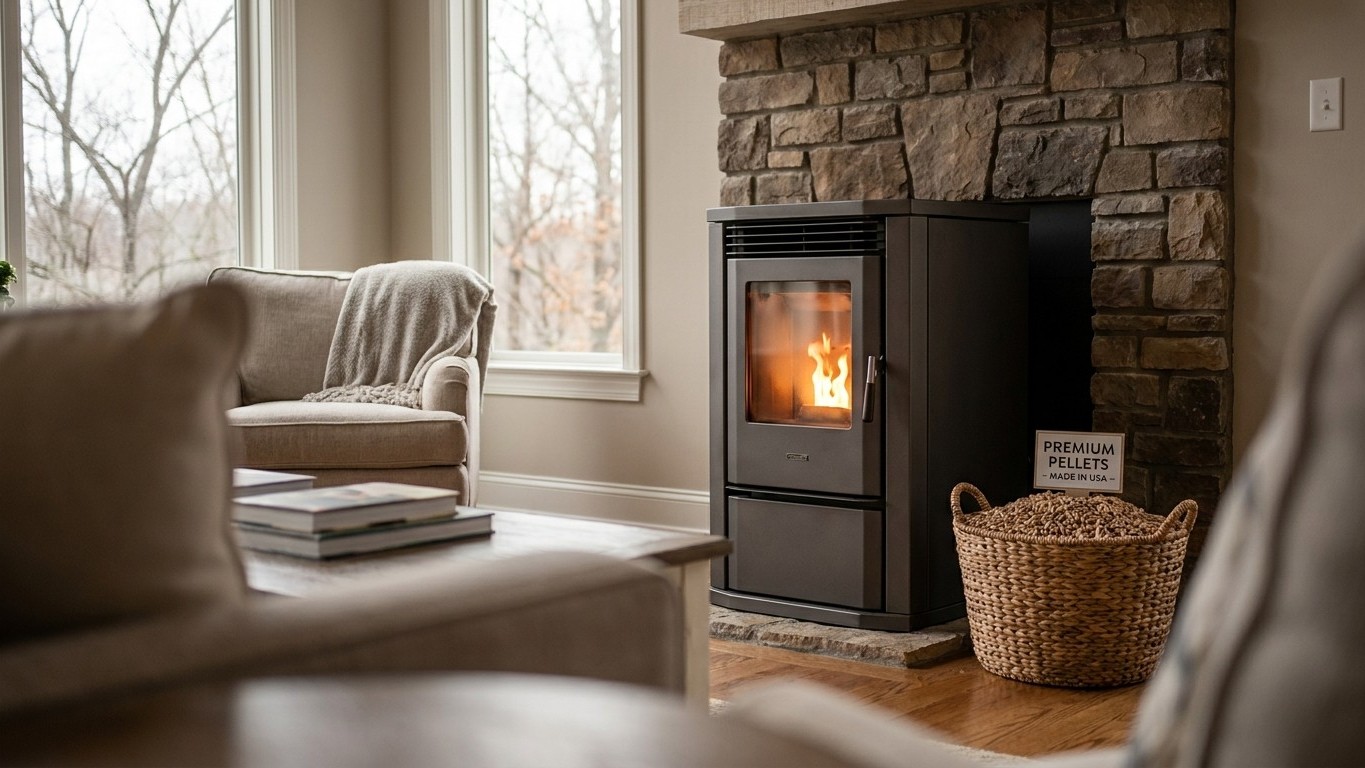

A pellet stove in Saskatchewan works through one of the longest, coldest heating seasons in the country. Saskatoon logs about 5,743 heating degree days a year, and demand for heat stretches from August into July. That means more tons burned per season than almost anywhere the pellet stove market usually reaches, a stove running at higher settings for weeks on end, and a household that treats the appliance as one heat source among several, since forced-air furnaces still supply the overwhelming majority of homes across the province.
How hard the winter works here

The number that matters is 5,743, the total heating degree days below 18°C recorded at Saskatoon Diefenbaker Int’l A, under Environment and Climate Change Canada’s 1981-2010 Canadian Climate Normals. That figure is the whole story in a single line: it is what turns a Saskatchewan winter into a fuel bill, and it is roughly double what a milder climate would produce for the same house. Twice the degree days means roughly twice the wood pellets burned to hold the same indoor temperature.
Depth and length are two different questions
Degree days measure how cold it gets and for how long, added together. Saskatchewan’s number is high because both halves of that equation run hard: January alone racks up 1,037 degree-days, the coldest month by a wide margin, while February (861) and March (724) keep piling on before the province gets any real relief. But the length matters just as much as the depth. Monthly normals show heating demand starting in August, when the mean daily temperature first drops below the 18°C base, and it does not let up until July. That is a heating season of roughly 11 months out of 12, not the four or five months a lot of pellet stove buyers picture when they imagine “winter.”
One station, not one province
Every figure above comes from a single weather station in Saskatoon, near the middle of the province. Saskatchewan runs about 630 miles north to south, and a farm near Uranium City sees a noticeably harder winter than a house in Estevan near the U.S. border. Anyone outside the Saskatoon area should treat 5,743 as a working reference point, not a personal forecast, and check normals for a station closer to home before sizing an appliance or a fuel budget. For a number this high, a pellet stove is not decoration. It is realistically doing serious heating work, and in many homes it will need to carry a meaningful share of the season rather than just take the edge off a few cold evenings.
How many tons a winter takes here
Nobody publishes a tons-per-winter figure for Saskatchewan, and no one honestly can. Two houses on the same street, built the same year, can burn twice as much fuel as each other depending on insulation, air sealing, and how the stove gets used. What is knowable is the arithmetic underneath the question, and working through it gives a homeowner something more useful than a made-up average.
The math behind the bag count
A standard bag of wood pellets weighs 40 pounds. Fifty of those bags make a ton. From there, consumption tracks the heat the house actually needs to replace, which is exactly what the degree-day figure above is measuring. A home in a 5,743-degree-day climate is losing heat to the outside air, and needs to replace it, for close to eleven months of the year, which is why the bag count in a place like Saskatoon tends to run well above what the same house would burn somewhere milder.
What changes the number
- How well the house holds heat: insulation, air sealing, window quality, and how many rooms the stove is expected to reach all shift consumption independent of the outdoor climate.
- Whether the stove is primary or supplemental: a stove backing up a furnace burns far fewer bags than one asked to carry the whole heating load through a Saskatchewan winter.
- The setting it runs at: a stove left on a high or continuous setting through January and February burns through fuel much faster than one cycling on low overnight.
Given all that, the one method that actually works is to count bags through a first winter and use that number as a personal baseline going forward. A single measured season, in a specific house, with a specific routine, beats any estimate borrowed from a neighbor or a forum post. The national page on how many pellets a winter takes walks through that counting method in more detail, with the same bag-and-ton math applied to other climates for comparison.
Buying and storing them in this climate
Timing the purchase matters more in Saskatchewan than in places with a shorter, milder heating window. Since demand starts climbing as early as August and stays elevated into the following summer, the smart move is buying before that window opens, not during the first real cold snap. Once a hard freeze settles in across the prairies, local demand spikes fast, shelves empty, and buyers scrambling in December pay more for whatever is left. Pellets are also simply cheaper in the off-season, when suppliers are moving product from the previous production run rather than racing to keep up with weather-driven demand.
Timing the purchase
Buying in late spring or early summer, well ahead of the August uptick, gives a household first pick of supply and the best pricing of the year. It also means storage space needs to be ready sooner than a lot of buyers expect, since a full winter’s worth of pellets bought in June has to sit somewhere dry for months before the stove starts working hard.
Storing pellets through prairie extremes
Wood pellets are compressed sawdust held together by natural lignin, with no glue or binder. That construction is efficient and clean-burning, but it is also fragile around moisture. Damp air swells the wood fibers, and once that happens the pellets crumble and lose the density that makes them burn evenly. Saskatchewan’s climate brings its own version of that risk: a garage or shed floor that sweats during spring thaw, humidity that spikes with summer storms, or a basement corner that stays cooler and damper than the rest of the house. None of those conditions need to be dramatic to ruin a pallet of pellets; a few weeks of ground moisture wicking up through bags stacked directly on concrete is enough.
Skip pricing comparisons between bags and go straight to per-ton cost, since that is the only figure that actually compares one supplier to another fairly. For the details on keeping pellets dry and judging quality once they arrive, the national storage guide and the pellet quality page cover both in depth.
What a winter outage means here
A pellet stove is not a wood stove, and the difference shows up hardest during a power outage. Feeding pellets from the hopper into the burn pot, running the combustion fan, and moving heated air into the room all depend on an electrical supply. Cut the power, and the stove stops working within minutes, no matter how full the hopper is or how cold it gets outside.
When the power stays on
Cross that mechanical fact with the degree-day number from earlier, and the stakes become clear. In a climate logging 5,743 heating degree days a year, with demand running from August into July, an outage during a January cold snap is not an inconvenience. It is a heating emergency, especially in a house where the stove is doing serious work rather than sitting in as a supplement. In a milder climate, the same outage might just mean a cold evening without the stove’s ambience. In Saskatchewan, it can mean a house losing heat fast while the outdoor temperature sits well below freezing for days at a stretch.
What most Saskatchewan homes fall back on
Statistics Canada’s 2023 figures on primary heating systems show forced-air furnaces heating 79% of Saskatchewan homes, with boiler systems using hot-water or steam radiators covering another 10%. Heat pumps, electric baseboards, and heating stoves as a primary system were not reported in that survey, meaning the estimate was judged too unreliable to publish, not that no one uses them. For most households, that furnace or boiler is the real backup during an outage that also happens to knock out the pellet stove’s blower fan, since a gas or oil furnace typically still needs some electricity to run its own controls and igniter. Checking the appliance’s power draw against a household’s actual backup plan matters more than guessing at generator size from general advice. The national page on pellet stoves and power outages covers how to read that label and plan around it.