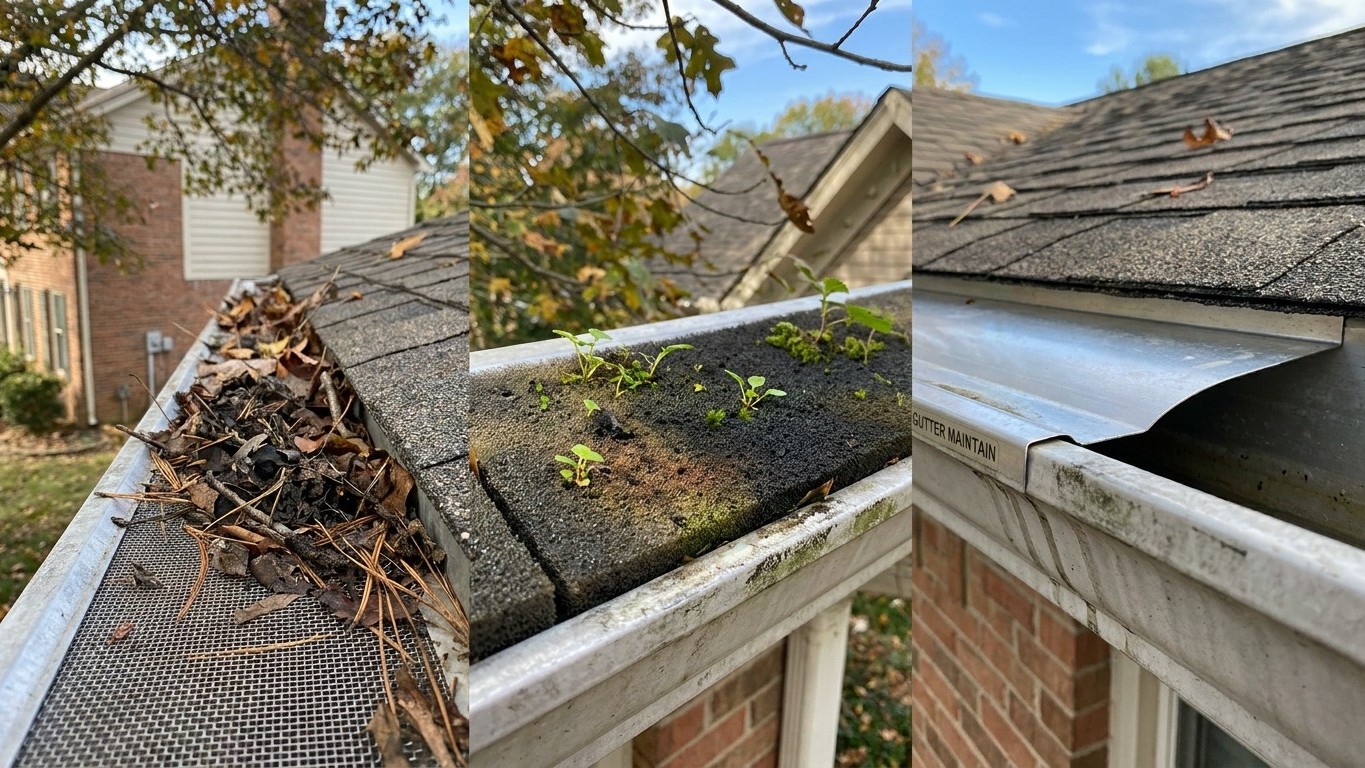

Gutter guards cut down on debris buildup, but they don’t stop cleaning altogether, and they don’t stop water damage on their own. What they solve depends entirely on which mechanism they use and how well it matches your trees, your roof pitch, and your climate. What they don’t solve is the need for eyes on the system at least twice a year.
What is actually happening

Every gutter guard on the market works through one of three mechanisms, and each one fails in its own particular way. Screens sit on top of the gutter and rely on holes small enough to block leaves but large enough to let water through. The problem shows up with small debris: pine needles, seed pods, and the grit that comes off asphalt shingles all pass right through the same holes water uses, and over a few seasons that grit compacts into a paste that clogs the mesh from below, where you can’t see it from the ground.
Foam inserts work differently. A strip of porous foam fills the gutter channel, and water is supposed to seep through while leaves stay on top and blow away or decompose in place. That second part is the flaw. Foam that stays damp becomes a growing medium, and seeds that land on it will actually germinate in the gutter, roots and all. Landscapers see this constantly on foam-guarded gutters near mature trees, small sprouts pushing up out of what looks like a solid strip of protection.
Reverse-curve guards, sometimes called surface-tension guards, use the shape of the material itself. Water follows the curve of a solid hood and drops into a narrow slot, while leaves are supposed to slide off the front edge and fall to the ground. The mechanism depends on water moving slowly enough to hug the curve. During a heavy downpour, water can move too fast to follow the bend, and it sheets off the front edge along with the debris instead of dropping into the slot. That’s why reverse-curve systems get a reputation for working beautifully in light rain and overshooting in a storm.
None of these three approaches eliminates maintenance. What changes is what kind of maintenance you’re doing. A homeowner with screens is scraping compacted grit out from a hole pattern. A homeowner with foam is pulling out damp strips and checking for sprouts. A homeowner with reverse-curve guards is watching for overshoot stains on siding after big storms. The guard changes the chore. It doesn’t remove it.
This matters because a lot of guard marketing implies a “install once, forget forever” outcome. That claim doesn’t match how any of these three mechanisms actually behaves once real trees, real weather, and real roof grit get involved. The honest framing is that guards reduce the frequency and mess of cleaning, and they change where the failure points show up. They don’t remove the need to check.
What you can see without climbing
You don’t need a ladder to know whether your gutter guards are doing their job. Most of the useful evidence is visible from the ground or from inside the attic, and a short routine covers almost everything that matters.
- Look from the ground with binoculars or a zoomed phone camera. Scan the gutter line for standing debris sitting on top of screens or reverse-curve hoods, for sagging sections where a gutter has pulled away from the fascia, and for any dark staining trailing down the siding below a joint, which usually means water is overshooting or leaking at that spot.
- Check the downspouts during or right after rain. A working system pushes a steady flow out the bottom. A weak trickle, or water spilling over the gutter edge instead of running through the downspout, tells you a blockage exists even if you can’t see it directly.
- Walk the perimeter after a storm and look at the ground. Splash patterns, eroded mulch, or a line of gravel washed away from the foundation are signs that water overshot the gutter guard entirely during heavy flow, which is a known weak point for reverse-curve systems in particular.
- Go into the attic with a flashlight, ideally on a clear day. Turn off the light for a moment first and look for pinpricks of daylight coming through the roof deck. Any visible light means a gap somewhere in the roofing that water can also find.
- Scan the rafters and the underside of the decking for staining. Water leaves brown or gray tide marks, and it usually travels along a rafter before it drips, so the stain and the actual leak point aren’t always in the same spot.
- Press gently on visible Insulation near the eaves. Damp insulation feels heavier and looks matted or discolored compared to the dry material around it. That dampness is a sign that gutter overflow or ice buildup has been getting behind the guard system and into the roof edge itself.
This routine takes maybe twenty minutes and covers ground-level, downspout, and attic evidence together. Combined, those three vantage points tell you almost everything a ladder inspection would, minus the actual risk of being on a ladder. If any one of these checks turns up something concerning, that’s the trigger point for a closer, professional look rather than a reason to climb up yourself.
What it costs to leave it
Ignoring a clogged or overwhelmed gutter system doesn’t produce a dramatic failure right away. It produces a slow, cumulative kind of damage that’s easy to miss because each individual sign looks minor.
The first thing that gets wet is the fascia board, the trim strip the gutter is actually mounted to. When water backs up behind a clog instead of draining, it sits against that wood repeatedly, and painted or sealed wood can handle occasional dampness but not sustained contact. Once the paint film or sealant breaks down, the wood underneath starts absorbing water directly, and untreated wood in constant contact with moisture is a setup for rot, not an eventual possibility but a near-certainty over enough wet seasons.
From there, the damage moves inward. A fascia board that’s rotting can no longer hold the gutter hangers securely, and that’s when you start seeing gutters sag or pull away from the roofline entirely, sometimes just at one section, sometimes along a whole run. A sagging gutter creates a low point, which concentrates even more water in that one spot, which accelerates the same rot. It’s a feedback loop, and it’s why one soft corner of fascia rarely stays isolated for long.
Behind the fascia is usually the roof deck edge and the attic insulation nearest the eaves. Water that backs up high enough, or that gets forced under shingles by an ice dam in colder climates, can migrate onto the underside of the roof sheathing. That’s the dark staining an attic inspection turns up, and it means the water has already traveled past the gutter and into structural wood. Insulation that gets saturated loses most of its effectiveness and, more importantly, stays wet long after the rain stops, creating conditions for mold growth in a part of the house most people check maybe once a year, if that.
None of this happens on a predictable schedule. It depends on rainfall, tree cover, roof pitch, and how long a clog sits before anyone notices it. What’s consistent is the direction of travel: gutter overflow moves from the fascia, to the hangers, to the roof edge, to the attic, and each stage is cheaper to catch than the one after it. The ground-and-attic routine in the previous section exists specifically to catch the problem while it’s still at the fascia stage, before it becomes a structural repair instead of a cleaning job.
What is not a householder job
Some maintenance genuinely belongs to the homeowner. Anything beyond that line belongs to a professional, and the line is worth stating plainly rather than leaving it vague.
Anything above a single story is past the point where a homeowner should be working alone. A fall from a one-story roof is dangerous. A fall from anything higher gets exponentially more dangerous, and the ladder work required to even reach a second-story gutter introduces its own separate risk before you’ve touched a single piece of debris.
Anything on a wet, mossy, steep, or frosted surface is off-limits regardless of the height. Moss holds water and turns a roof surface into something closer to a skating rink than a walkable deck. Steep pitches remove the margin for error that a low-slope roof gives you. Frost does the same thing moss does, except it can appear on a morning that looked clear from the ground. None of these conditions are ones a homeowner can safely judge and override with caution alone.
Anything that requires both hands while standing on a slope is also a hard no. That covers most actual gutter guard installation, adjustment, and repair work, since securing a guard, reseating a hanger, or clearing a stubborn clog usually takes two hands and a stable stance at the same time, which is a difficult combination to have safely on a sloped roof edge.
Insurance is part of this boundary too. Hail and wind events can damage both roofing and gutter systems, and claims tied to that kind of damage depend entirely on the policy language and the state the home is in. Deadlines, coverage rules, and documentation requirements all vary, so the practical step is contacting the insurer directly and keeping photos and notes rather than assuming a general rule applies.
The ground-and-attic routine described earlier is designed to tell you when you’ve crossed into this territory. If it turns up staining, sagging, or overshoot, the next step is a proper roof inspection rather than a ladder. And if the fix requires actual work on the roof itself, that’s a job for hiring a roofer, not a weekend project.
Common questions
Do gutter guards stop the need for cleaning entirely?
No. All three mechanisms, screens, foam, and reverse-curve, reduce debris buildup but each develops its own failure point over time, from compacted grit to sprouting seeds to storm overshoot. Periodic checking stays necessary either way.
Can I tell if my gutter guards are failing without climbing up?
Mostly, yes. Ground-level checks with binoculars or a phone camera, plus an attic check with a flashlight for daylight gaps or rafter staining, cover most of the warning signs. A closer physical inspection is only needed once those checks flag a specific problem.
What’s the earliest sign that water is getting past the guards?
Staining on the fascia board or on siding just below a gutter joint is usually the first visible clue, along with weak flow out of the downspout during rain. Attic daylight or rafter staining tends to show up later, once the problem has moved past the gutter itself.
Is a sagging gutter section something I can refasten myself?
If the sagging section is above single-story height, on a steep or wet roof, or would require both hands while standing on the slope, it’s not a homeowner job. That combination of height and instability is exactly the scenario a roofer’s ladder setup and harness are built for.