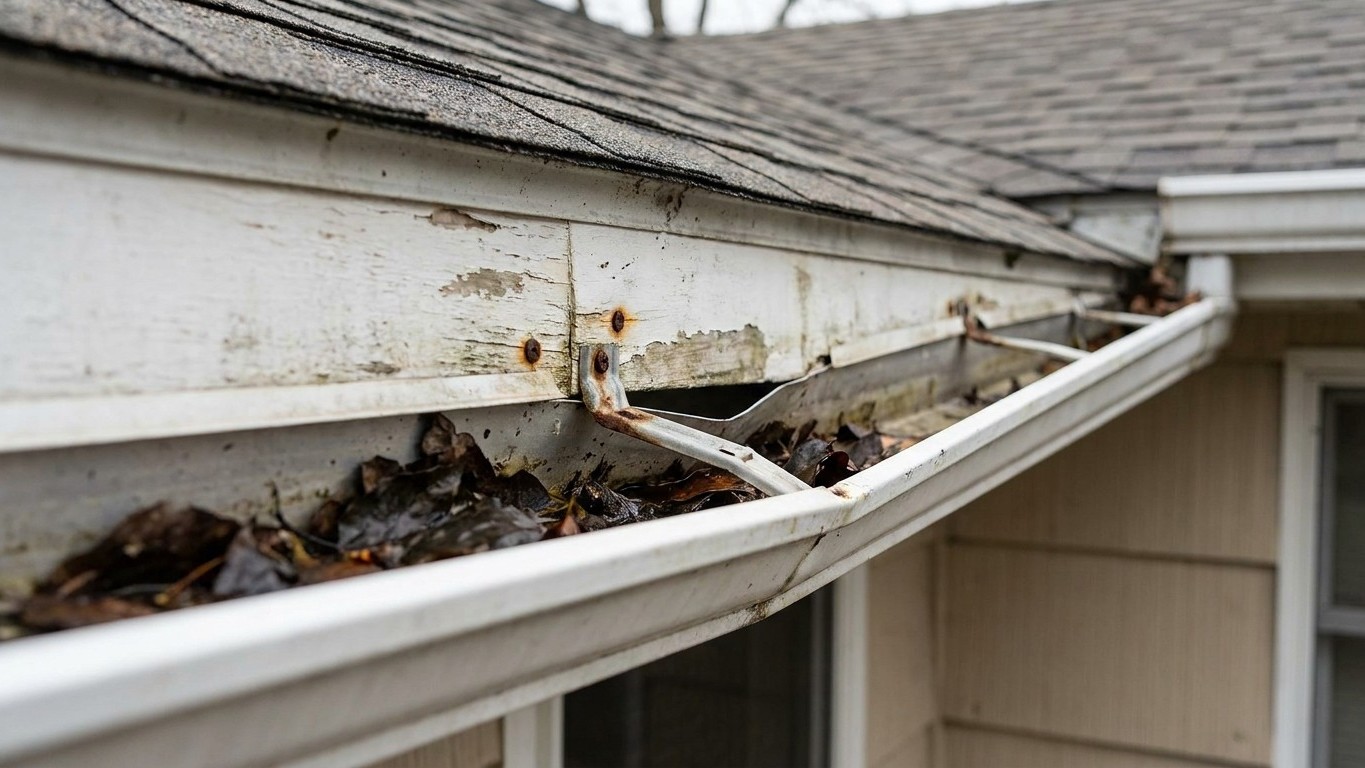

A sagging gutter means the fasteners holding it to the fascia have failed, the fascia board itself has gone soft, or both at once. Sometimes it’s a simple fix: loose spikes or brackets that just need tightening or replacing. Sometimes the wood behind the gutter is rotting, and no amount of refastening solves that. Where the gutter is pulling away tells you which problem you have, and that distinction decides everything about the repair.
What is actually happening

Gutters don’t hold themselves up. They hang from a fascia board, the horizontal trim piece that runs along the roof edge, using one of a few fastening methods: hidden hangers screwed directly into the fascia, or older spike-and-ferrule setups where a long nail is driven through the gutter and into the wood behind it. Either way, the fascia is doing the structural work. The gutter itself is just a trough.
Water is heavier than most people assume once it’s sitting in a long run of gutter, and a clogged section holding standing water, wet leaves, and maybe a layer of ice adds weight the system was never meant to carry for long. When fasteners loosen (wood shrinks and swells with the seasons, screws back out, spikes work loose from vibration) the gutter starts to sag between the points that are still holding. That’s why a fastener problem usually shows up as a gentle wave along most of the run, dipping down between supports like a slack clothesline.
Rot is a different animal. If the fascia board behind the gutter has been soaking up moisture, whether from a slow leak at the roof edge, from a gutter that’s been overflowing backward for a while, or just from age and weather, the wood turns soft and spongy. Fasteners driven into softened wood have nothing solid to grip. You can drive in a new screw and it’ll hold for a week, maybe less, before it tears back out. This is why a section that has pulled completely away, especially if it’s isolated to one spot rather than spread along the whole run, usually points to rot rather than a loose hanger.
The two problems also feed each other. A sagging section collects standing water and debris at its low point, which adds weight, which pulls the fasteners further, which lets more water sit against the fascia, which softens the wood faster. A repair that only addresses the visible sag, without checking what the wood underneath actually feels like, tends to fail again within a season.
What you can see without climbing
None of this requires a ladder to figure out. Most of the diagnostic work can be done from solid ground and from inside the attic, and that’s genuinely enough to know what you’re dealing with before anyone decides whether a repair is a weekend job or a call to a professional.
- Look from the ground with binoculars or a zoomed-in phone camera. Scan the gutter line against the fascia. A uniform wave, where the gutter dips and rises evenly along a long stretch, suggests loose or spaced-out fasteners. A section hanging visibly lower than the rest, or pulled away entirely at one seam or corner, points more toward a rot problem in that specific stretch of fascia.
- Check the fascia board’s color and texture from the same vantage point. Dark streaking, peeling or bubbling paint, or a slightly swollen look to the board are all signs that moisture has been sitting against the wood. Healthy fascia holds a flat, even paint line; compromised fascia often looks warped or discolored in patches.
- Photograph the corners, seams, and downspout connections by zooming in rather than approaching them directly. Gaps at seams, brackets visibly pulled loose from the board, or a downspout that’s separated slightly from the gutter body are all confirmations of a fastener issue rather than something you’re imagining from a distance.
- Go into the attic with a flashlight, ideally during daylight hours. Look toward the eaves for any point where daylight is visible through the roof deck. That indicates a gap that’s letting water in, not just a cosmetic gutter issue. Sweep the light across the rafter tails near the eaves, looking for water staining, dark streaking, or a slightly different wood color where moisture has been repeatedly present.
- Feel and look at the Insulation near the eave line. Damp, matted, or discolored insulation right at the point where the roof meets the wall is one of the clearest signs that water has been getting past the gutter and fascia for a while, even if nothing is visibly dripping the day you check.
If the ground-level view shows a uniform, gentle sag and the attic check comes up dry with no staining, the fix is almost certainly mechanical (fasteners, hangers, maybe a section of gutter that’s warped). If the attic shows staining or damp insulation concentrated under the sagging section, the fascia itself needs attention before anything gets reattached to it.
What it costs to leave it
Nothing about a sagging gutter announces itself loudly, which is exactly why it tends to sit unaddressed. There’s no dramatic failure moment, at least not at first. What happens instead is a slow transfer of water to places it isn’t supposed to be, and each of those places has its own way of showing the damage eventually.
The fascia board takes the first hit, since it’s in direct contact with the back of the gutter. Repeated wetting softens the wood fibers, paint starts to bubble or peel, and the board loses the rigidity it needs to hold fasteners securely. Once the fascia is compromised, the soffit underneath (the horizontal panel that covers the underside of the roof overhang) is often next, since water running down the back of a failing gutter has to go somewhere, and gravity usually sends it along the fascia and onto the soffit board.
Behind both of those is the roof deck and the rafter tails, the structural wood that the attic check is designed to catch early. Persistent moisture here doesn’t rot instantly, but wood that goes through repeated wet-dry cycles loses strength gradually, and the visible signs (dark staining, a slightly spongy feel when pressed, insulation that stays damp longer than it should) tend to show up well before any structural softness would be obvious to a casual glance. That’s the value of the attic check described above: it catches the problem while it’s still just staining, not yet a soft spot you can push a finger through.
Water that runs down the exterior wall instead of through the gutter system can also find its way behind siding or into wall sheathing, and from there occasionally into an interior ceiling near an exterior wall, particularly at corners where two gutter runs meet. None of this happens on a predictable schedule. It depends on rainfall patterns, how often the gutter actually overflows, and how well-sealed the wall assembly is behind the fascia. What’s consistent is the direction of travel: fascia first, then soffit and roof deck, then whatever is behind or below that. Catching it at the fascia stage, while the fix is still a matter of drying out and re-fastening or replacing a board, is considerably simpler than catching it after water has reached framing or drywall.
What is not a householder job
Some of this is reasonably safe to check and even fix yourself. Tightening an accessible hanger from a stable stepladder on a single-story home, on dry ground, with someone else present, is a fair task for a lot of homeowners. Getting onto the roof itself to inspect or refasten a gutter is a different category of decision, and it’s worth being blunt about where that line sits.
Anything above a single story is not a homeowner task, full stop. The height alone changes the consequences of a slip from unpleasant to severe. The same goes for any roof surface that’s wet, mossy, steep, or frosted. All four of those conditions reduce footing dramatically, and moss in particular can hide how slick a surface actually is until weight is already on it. Any repair that requires both hands occupied while standing on a sloped surface, such as holding a gutter section in place while driving a fastener, removes the one free hand you’d otherwise use to steady yourself, and that’s a specific, avoidable risk rather than a general caution.
Falls from roofs are a leading cause of serious injury in home maintenance work, and they don’t require much height to be dangerous. The instinct to “just take a quick look” from up top is understandable, but a pair of binoculars and a flashlight in the attic answer almost every question a homeowner actually needs answered. If the ground-level and attic checks described above point to something beyond a simple hanger adjustment, whether that’s suspected rot, a section that’s pulled away at a corner, or staining that suggests water has been getting past the roof deck, the next reasonable step is a proper inspection rather than a ladder. A closer look at what that inspection should cover, and how to read what a roofer finds, is worth reviewing before booking anyone. And when the work does need a professional, knowing how to vet and hire a roofer matters just as much as knowing there’s a problem in the first place. A rushed or unlicensed job on a fascia repair tends to fail in the same way the original one did.
Common questions
Can a sagging gutter be pushed back into place temporarily?
Pushing a sagging section up and reattaching a hanger can hold for a while if the fascia underneath is still solid, but it’s not a fix if the wood is soft. Forcing a fastener into rotted wood usually tears out again within days or weeks.
Does a sagging gutter always mean the fascia is rotting?
No. A uniform, gentle wave along a long run is more often a sign of loose or under-spaced fasteners than rot. Isolated pull-away at one section, especially with visible staining or soft-looking wood nearby, is the pattern more associated with fascia damage.
What should I do if I see daylight through the roof deck from the attic?
That indicates a gap at the roof edge that needs a proper inspection rather than a DIY patch, since it can involve both the roof covering and the structure underneath. Document what you see with photos and arrange for a closer look from someone qualified to assess it.
Is storm or wind damage to gutters covered by homeowners insurance?
That depends entirely on the specific policy and, in some cases, the state. Coverage rules, documentation requirements, and any filing windows vary by insurer, so the policy itself is the only reliable source. Photographing the damage as soon as it’s safely visible, from the ground, is useful regardless of what the policy ultimately says.