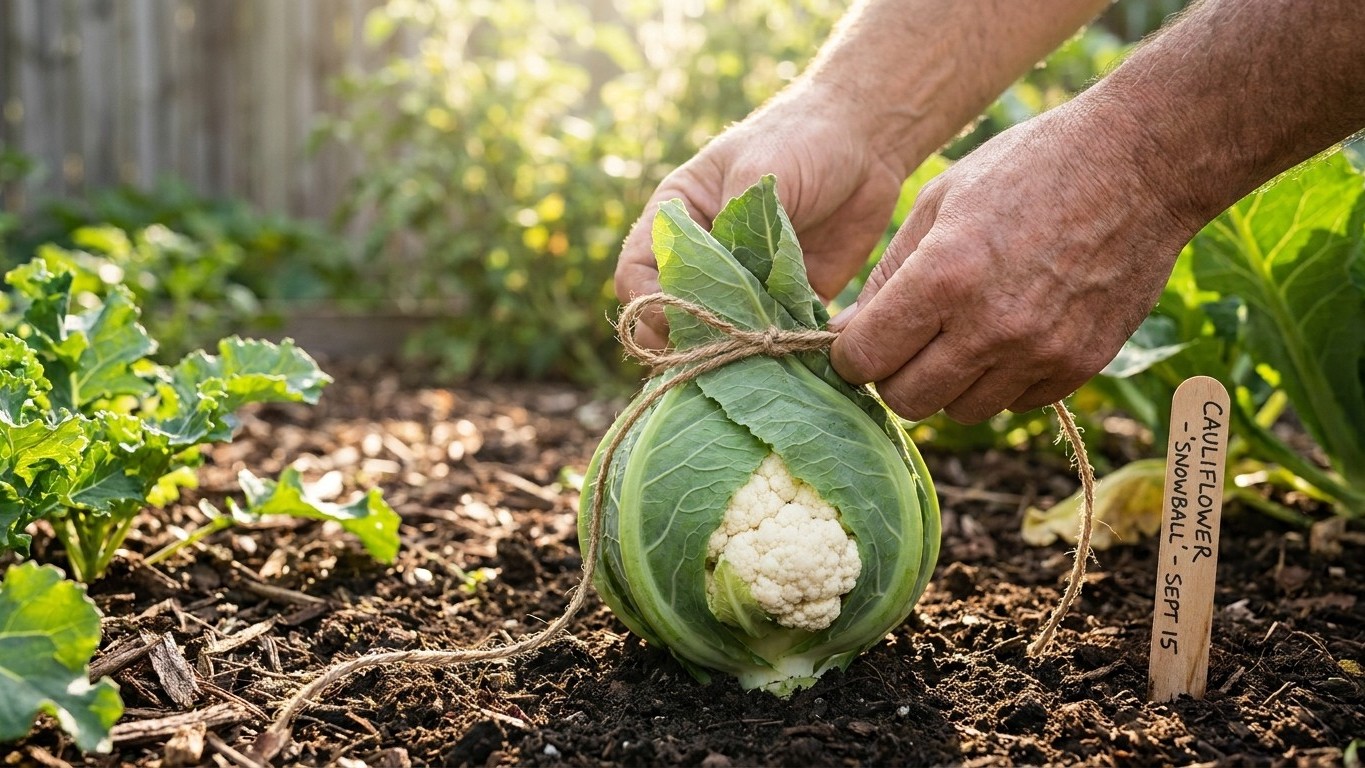

Cauliflower turns white because a gardener makes it that way, not because the plant grows it that color on its own. Once the developing head reaches the size of a silver dollar, tying the outer leaves over it blocks sunlight, and that missing light is what keeps the curds pale instead of yellow and bitter.
The short answer
Utah State University Extension states it plainly in its guide to growing cauliflower in the garden: as the head enlarges, it will discolor and turn yellow, and it will develop bitter flavors if exposed to sun. The fix is blanching, done by hand, at one specific moment. Tie the leaves together over the head with twine or rubber bands “when the heads are the size of silver dollars.” That size, not a date on the calendar, is the trigger.
This matters because cauliflower doesn’t ripen the way a tomato does, slowly changing color as it matures. The curd itself stays essentially colorless tissue underneath. What changes its appearance is whether light reaches it. A head left uncovered will yellow and turn bitter under UV exposure and heat. A head covered at the right moment stays compact, white, and mild. Miss the window, even by a few days, and the discoloration that’s already happened cannot be reversed by tying the leaves later.
The same Extension guide gives the endpoint of this process too. Harvest heads once they’re “fully developed, 6 to 12 inches in diameter, compact and blanched white.” That’s a size and texture cue, not a countdown from planting. A head can hit that range faster or slower depending on the weather it experienced, which is why gardeners are told to check heads regularly rather than mark a single harvest day on the calendar.
After cutting, cauliflower doesn’t hold indefinitely. Utah State University Extension specifies storage for three weeks at 32°F. That’s a narrow, cold-storage window, closer to what you’d give a root vegetable than a leafy green, and it reflects how quickly cut curds lose quality once they’re off the plant.
So the “white” answer has two layers: the mechanical one (tying leaves at silver-dollar size blocks light) and the practical one (that blocking has to happen before sun and heat get to the head, and the harvest and storage windows that follow are tight).
What actually decides it
Blanching is manual, not genetic, for most cultivars
For the majority of cauliflower varieties, white color is produced by the gardener’s hands, not written into the plant’s growth pattern. The head will develop its curd regardless of light exposure, but its color is a direct response to whether sunlight reaches it during that development window. This is different from crops where color change marks internal ripening. Here, an untouched head sitting in full sun for even a short stretch will pick up a yellow cast and, according to Utah State University Extension, bitter flavor, simply from exposure. Tying the leaves is what interrupts that.
Heat affects flavor separately from light
Sun exposure and heat are two different stressors on the same head, and they don’t always arrive together. Utah State University Extension notes that “hot weather conditions also affect head flavor,” a separate mechanism from sun discoloration. A blanched, properly tied head growing through a stretch of high heat can still lose flavor quality even while staying visually white. That’s why cultivar choice for warm climates or late plantings matters as much as blanching technique; heat tolerance and light-blocking solve two different problems.
Cauliflower’s temperature window differs from its cousins
Cauliflower sits in the same brassica family as cabbage and broccoli, but its heat ceiling and cold tolerance aren’t identical, and neither is its transplant timing. Confusing the three crops’ numbers is an easy mistake to make, since they’re often planted in the same bed at the same time of year.
| Crop | Transplant timing before last frost | Heat ceiling | Cold low |
|---|---|---|---|
| Cauliflower | 1-2 weeks | 75°F | 32°F |
| Cabbage | 2-3 weeks | 80°F | 25°F |
| Broccoli | 2-3 weeks | 75°F | 28°F |
Cauliflower goes out later and tolerates less cold than cabbage, which is part of why its head development, and the blanching window that follows, tends to land at a different point in the season than its relatives.
Two nutrient deficiencies that look nothing alike
Boron deficiency and molybdenum deficiency both show up in cauliflower, and both can distort head development, but they are not the same failure and shouldn’t be treated as interchangeable warning signs. Boron shortages tend to affect the internal structure of the stem and curd, producing hollow or discolored tissue inside an otherwise normal-looking head. Molybdenum shortages instead distort the leaves themselves, producing narrow, strap-like growth that never fills out normally. A head suffering from one won’t show the symptoms of the other, so diagnosing by leaf shape versus internal texture separates the two quickly.
How to do it
- Count back from your last frost date. Utah State University Extension places cauliflower transplants in the ground one to two weeks before your area’s last frost date, earlier than cabbage or broccoli, but only by that narrow margin.
- Choose a cultivar with a known days-to-maturity figure. The Extension guide names five: Snow Crown at 50 days, Self Blanche at 60 days, Amazing at 65 days, White Contessa at 65 days (noted as heat tolerant), and Denali at 80 days, which is meant for summer planting toward a fall harvest.
- Watch the developing head, not the calendar. Check plants regularly once curds begin forming. The cue you’re waiting for is a size, not a date.
- Tie the leaves at the silver-dollar stage. When the head reaches the size of a silver dollar, gather the outer leaves over it and secure them with strong twine or rubber bands. This blocks sunlight and begins the blanching process.
- Re-check tied heads periodically. Growth continues under the tied leaves, so heads should be inspected every few days rather than left tied and forgotten.
- Harvest at 6 to 12 inches in diameter. Cut when the head is fully developed, compact, and blanched white, per the Extension’s harvest criteria.
- Store immediately at 32°F. Cut heads hold for up to three weeks at that temperature, and quality drops the longer they sit at warmer conditions before refrigeration.
What goes wrong
- Head discolors yellow before tying. This happens when leaves are gathered after sun has already reached the curd. Utah State University Extension is specific that exposure causes both discoloration and bitterness, and once that exposure has happened, the yellowing already recorded on the tissue cannot be undone by tying the leaves afterward. The only remedy is tying earlier on the next planting, right at the silver-dollar size.
- Curds taste bitter despite looking white. Color and flavor aren’t controlled by the exact same mechanism. Hot weather during head development affects flavor on its own, separate from sun exposure, so a properly blanched head can still turn bitter if it matured during a heat spell. Choosing a heat-tolerant cultivar, such as the Extension-named White Contessa, is the practical response for warm-season plantings.
- Stem or curd tissue looks hollow or discolored inside. This points toward boron deficiency, an internal-structure problem distinct from anything caused by light or heat. It shows up regardless of how carefully the head was blanched.
- Leaves grow narrow and strap-like instead of filling out. This is the signature of molybdenum deficiency, not boron shortage, and it affects the leaves rather than the internal curd tissue. Mixing up the two deficiencies leads to the wrong correction being applied.
- Harvested heads go soft or lose quality within days. This usually traces back to storage temperature rather than anything that happened in the garden. Utah State University Extension’s three-week window applies specifically at 32°F; heads held at warmer temperatures won’t hold nearly that long.
Common questions
How do I know when to tie the leaves over a cauliflower head?
Watch head size, not the calendar. Utah State University Extension’s cue is the silver-dollar stage, meaning tie the leaves as soon as the developing head reaches roughly that diameter, before sun has a chance to reach it.
Can I fix a cauliflower head that’s already turned yellow?
No. The discoloration reflects sun exposure that already happened, and tying the leaves after the fact won’t reverse it. The fix applies to the next head, tied earlier.
Do all cauliflower varieties need to be tied for blanching?
The Extension guide’s core advice covers the general blanching method: tying the leaves over the head. It names five cultivars with their days to maturity, including Self Blanche and White Contessa, without describing any of them as skipping the tying step.
How long can I keep harvested cauliflower before it goes bad?
Utah State University Extension specifies three weeks of storage at 32°F. Holding heads at higher temperatures will shorten that window considerably.