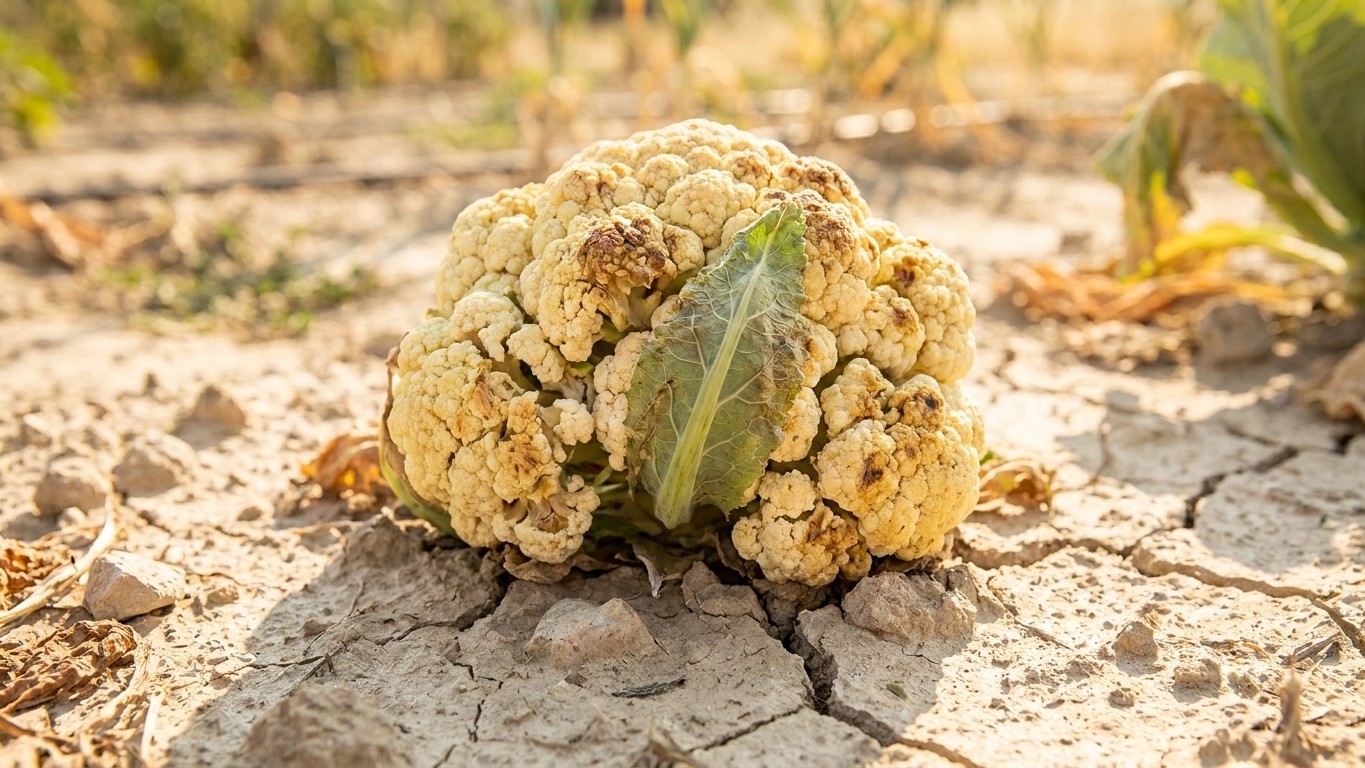

Open heads, a stray leaf poking through the curd, or a head that looks duller than it should: all three point to the same root cause. According to Utah State University Extension’s Cauliflower in the Garden guide, cauliflower grows best when temperatures stay under 75 F, and it starts losing quality once thermometers cross 80 F or drop to 32 F. Add insufficient water during heat, and those thresholds turn into visible defects on the plant in front of you.
The short answer
Utah State University Extension is blunt about the ceiling and the floor on this crop. Cauliflower “grows best when temperatures do not exceed 75 F,” and both ends of the thermometer punish it: “low (32 F) or high (greater than 80 F) temperatures decrease plant growth, lower yields and decrease head quality.” That single sentence explains a lot of the disappointment gardeners feel when a head comes in smaller, looser, or duller than expected. There’s no single mechanism at play, there are two, and they overlap in late-summer weather in a way that makes cauliflower one of the fussier brassicas to time right.
The open-head problem specifically traces to water, not just heat on its own. The Extension notes that “during hot weather, plants may not get enough water which leads to poorer quality heads that are more open.” Heat raises the plant’s demand for moisture right as soil often dries fastest, and if the gardener doesn’t compensate, the curd segments separate instead of staying tight. The fix named in the source is direct: “keep plants well-watered during the heading period.”
Leafy heads are a related but distinct symptom. The source states plainly that “water stress and high temperatures can cause leaf growth in the heads.” That’s a small leaf emerging through the curd itself, not just loose curd texture. It happens because the same combination, heat plus a moisture deficit, disrupts the plant’s normal signal to keep producing tight flower buds instead of foliage at that spot. Two different visible failures, one shared upstream cause.
Yellowing and general dullness fall under the broader quality decline the source attributes to both Temperature extremes, not to water stress alone. A head that colors unevenly or looks tired after a stretch above 80 F, or after a cold snap near 32 F, is registering exactly the kind of stress the Extension’s ceiling-and-floor numbers describe. None of this is a disease. It’s the plant’s physiology responding to conditions outside its comfort range, and the remedy starts with managing water and soil temperature before the plant ever shows the symptom.
What actually decides it
The temperature ceiling and floor
Cauliflower has a narrower comfort zone than its brassica relatives, and Utah State University Extension names both edges of it: 32 F on the cold side, 80 F on the hot side, with the ideal range sitting at or below 75 F. Growth rate, yield, and head quality all decline once the plant sits outside that band for any length of time. This is a genetic ceiling built into the crop, not something a gardener can water or feed their way around. What a gardener can control is exposure, by timing plantings and managing soil temperature so the plant spends as little time as possible above 80 F or near freezing during the critical heading stage.
Water stress during heading
The heading period, when the curd is actively forming, is the single most water-sensitive window in the plant’s life. Heat increases the plant’s water demand at the exact moment soil moisture tends to evaporate fastest, and if irrigation doesn’t keep pace, the curd segments loosen and the head opens up rather than staying compact. This is a management outcome as much as a weather outcome: two plants under identical heat can produce very different heads depending on whether the gardener kept the root zone consistently moist.
Leaf growth through the curd
This is a separate mechanism from simple looseness, even though it shares the same trigger. Water stress combined with high temperature disrupts the signal that keeps the growing point producing curd tissue instead of leaf tissue, so a small leaf pushes through where a smooth curd surface should be. It’s worth keeping these two symptoms mentally separate: an open head is a texture failure, a leafy head is a developmental one, and both trace back to the same water-and-heat combination described by the Extension, just expressed differently on the plant.
How to do it
- Count back one to two weeks from your area’s average last frost date to set transplants outside. This is cauliflower’s own timing window per Utah State University Extension, shorter than the two-to-three-week window used for cabbage and broccoli, which reflects the crop’s lower tolerance for lingering cold.
- Choose a cultivar suited to your expected conditions. The Extension names five with their days to maturity: Snow Crown at 50 days, Self Blanche at 60 days, Amazing at 65 days, White Contessa at 65 days and noted as heat tolerant, and Denali at 80 days, recommended for summer planting toward a fall harvest. Matching the cultivar to the season you’re actually growing in reduces the odds of heading occurring during a heat spike.
- Water consistently through the heading period, not just when the soil looks dry. The Extension’s instruction is to keep plants well-watered specifically while the head is forming, since this is the window where a shortfall shows up as an open or leafy head later.
- Apply organic mulch once temperatures climb above 80 F. This is the Extension’s own threshold for when mulching becomes worthwhile, and it works by moderating soil temperature and holding moisture, addressing both halves of the heat-plus-water problem at once.
What goes wrong
- Heads come in open and loose. This happens when hot weather outpaces irrigation during heading, per Utah State University Extension. The remedy is consistent watering through that window going forward; a head that’s already opened won’t tighten back up, since it’s recording a moisture deficit that already occurred.
- A leaf pushes through the curd. This is What the Extension describes as leaf growth in the head caused by water stress and high temperature together. It’s a record of past stress on that specific plant, not a defect that can be reversed once it appears. Going forward, closer attention to soil moisture during hot stretches is the only real prevention.
- Heads look dull, undersized, or slow to develop. This tracks with the Extension’s broader warning that both 32 F cold and temperatures above 80 F reduce growth, yield, and head quality. Since this is a temperature-range issue rather than a single-event stress, the fix is timing, planting so the heading period falls inside the 75 F comfort range as much as possible, or choosing a heat-tolerant cultivar like White Contessa for a summer heading window.
- Mulch gets skipped during a hot stretch. Once temperatures pass 80 F, skipping mulch removes one of the few tools available for buffering soil temperature and moisture at the same time. The Extension names 80 F as the point where mulching becomes worth the effort, so it’s a preventable gap rather than an unavoidable one.
Common questions
Is an open cauliflower head still safe to eat? Yes. Openness is a quality and appearance issue tied to water stress during hot weather, not a safety issue, according to Utah State University Extension.
Can I stop a leaf from growing through the curd once I see it? No. The Extension describes this as caused by water stress and high temperature that already occurred, so it’s a record of past conditions on that particular plant rather than something that can be corrected after the fact.
Why does the source name 32 F as a problem when frost usually helps cool-season crops? Because cauliflower’s comfort range sits between those two points; the Extension states that both low (32 F) and high (above 80 F) temperatures reduce growth, yield, and head quality, making cold as much a concern as heat for this particular crop.
Does mulching help before temperatures actually reach 80 F? The Extension specifically recommends applying organic mulch once temperatures increase above 80 F, tying the practice to that threshold rather than to an earlier point in the season.