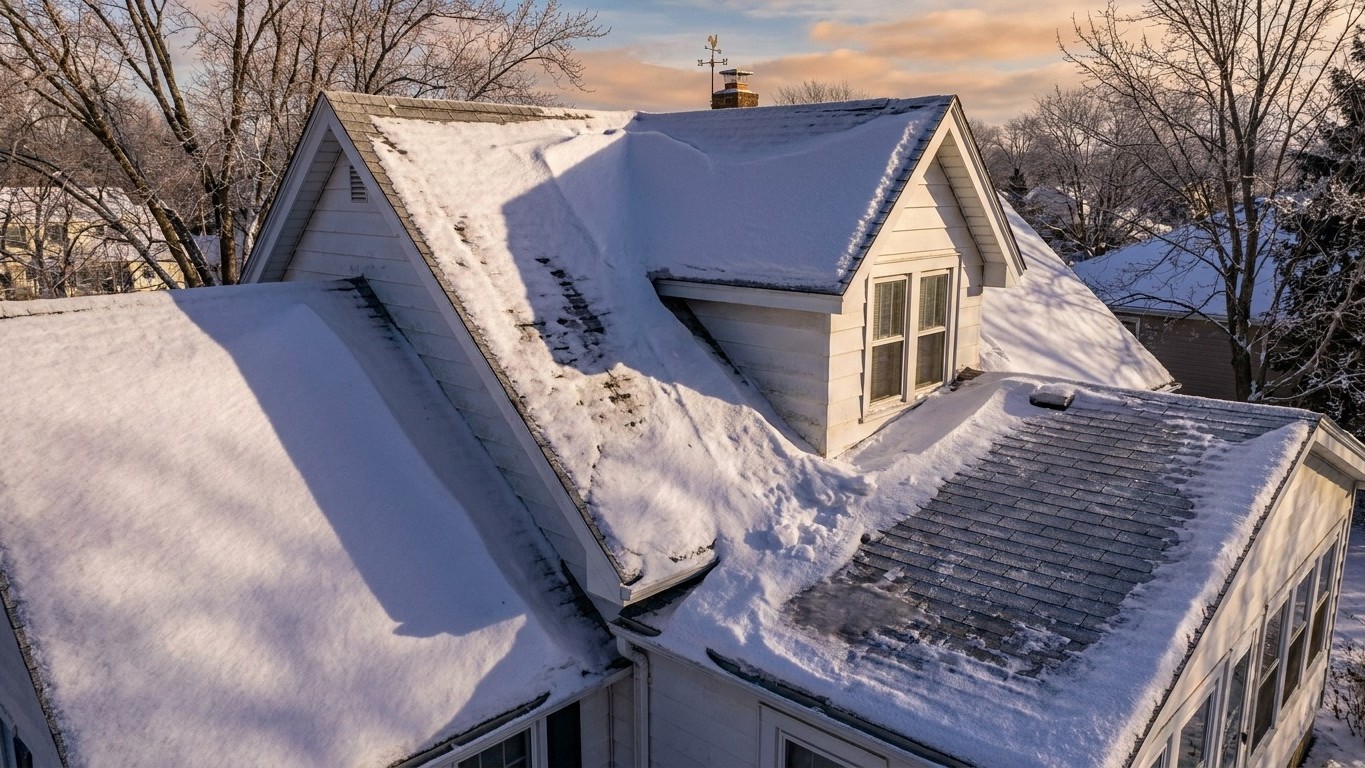

A roof carries snow just fine until three things line up: the snow gets heavy, it piles unevenly, and it stays put through repeated freeze-thaw cycles. That combination, not the raw depth on the ground, is what turns a normal winter into a roofing problem. Most homes never see it. The ones that do usually show warning signs weeks before anything gives way, and those signs are visible from the ground.
What is actually happening
Snow isn’t one material. Fresh powder is mostly air, which is why a foot of it can feel almost weightless compared to the same foot after a thaw-and-refreeze cycle compacts it into something closer to slush with a crust on top. Wet, dense snow can weigh several times what the same depth of dry, fluffy snow does. That difference is the entire story of why one storm is a non-event and another, with less total snowfall, causes real trouble.
A roof structure is built to spread weight across rafters or trusses and down into the walls and foundation. Engineers design for a regional expectation, an average load spread evenly over the whole surface. The problem is that snow rarely spreads evenly. Wind pushes it against parapets, dormers, and anywhere the roofline steps up, piling drifts three or four times deeper than the open field of the roof. Valleys where two roof planes meet do the same thing, collecting runoff and snow long after the flat sections have shed theirs. A roof that could handle its full-surface average without strain can still be overloaded in one localized spot it was never asked to carry alone.
Why slope changes the equation
The shallower the slope, the less snow slides off under its own weight, and the longer it sits exposed to freeze-thaw cycling. A steep roof sheds snow readily once it starts to warm; a low-slope or flat roof holds onto it, sometimes for the whole season, giving each freeze a chance to add another glazed layer on top of the last. That’s also where ice dams start: heat leaking from the attic melts the underside of the snowpack, that water runs down to the cold eaves, refreezes into a ridge of ice, and then backs up under the shingles behind it. None of this requires a blizzard. It just requires snow that doesn’t leave.
What you can see without climbing
None of this needs a ladder. A pair of binoculars, or a phone camera zoomed in from the yard, tells you most of what matters, and the attic tells you the rest. Work through it in order.
- Scan the roofline from the ground. Look for drifts noticeably deeper near dormers, chimneys, and valleys than across the open field of the roof. Uneven depth is normal. A drift several times the surrounding snow is worth noting.
- Check the eaves for ice buildup. A thick ridge of ice along the gutter line, especially with icicles hanging below it, is the visible sign of an ice dam forming. Water pooling behind that ridge is what eventually finds its way under the roofing material.
- Look for sagging. Sight along the roofline from a distance, ideally from across the street. A ridge that should be straight but reads as a shallow dip or wave is a structural signal, not a cosmetic one.
- Move to the attic with a flashlight. Daylight visible through the roof deck means a gap or damaged section somewhere above. Check it on a bright day for the clearest read.
- Check rafters and the underside of the deck for staining. Brown or dark streaks on wood that should be uniform in color usually mean water has already gotten in, even if no leak has reached the ceiling below yet.
- Touch the Insulation, don’t just look at it. Damp or compressed insulation holds moisture against the wood and loses much of its effectiveness, and it often feels cold and heavy rather than looking obviously wet.
If any of these show up, that’s the point to bring in a professional roof inspection rather than guess at severity from the attic floor. A trained eye can tell the difference between a cosmetic stain and an active leak path in a way a flashlight scan alone can’t.
What it costs to leave it
Water finds the slowest path possible, which is exactly why roof damage from snow tends to stay hidden longer than people expect. An ice dam that backs water under the shingles doesn’t usually produce a dramatic indoor leak on day one. It seeps into the roof deck first, then into the insulation below it, and only reaches a visible ceiling stain once enough has accumulated to travel that far. By the time a homeowner sees a brown ring on the drywall, the wood above it has typically been wet for a while already.
The sequence is fairly consistent. Wet insulation loses its ability to slow heat loss, which feeds more melt to the same ice dam and makes the problem worse rather than static. Wood that stays damp starts to soften, and softened roof decking loses its grip on fasteners, which is how a small leak becomes a soft spot you can feel underfoot in the attic. Left long enough, sustained dampness in wood framing invites rot and mold growth, neither of which reverses once the roof dries out. Both require removal and replacement of the affected material rather than a simple repair.
There’s also a structural side that’s easy to overlook. A drift concentrated in one section of roof, sitting there through repeated freeze-thaw cycles, puts sustained stress on the rafters or trusses beneath it. Most roofs never approach a failure point. But a visible sag, spotted from across the street, means that section has already been asked to do more than it’s comfortable doing, and it won’t correct itself once the snow melts.
If a storm causes sudden, visible damage such as a section of roofing torn loose by wind or a heavy hail event alongside the snow, that’s a homeowner’s insurance question, not just a repair question. Coverage details, documentation requirements, and filing windows vary by policy and by state, so the policy itself governs what’s covered and by when. Photographing the damage as soon as it’s safely visible, before any repair work starts, is the one step that helps regardless of what the policy says.
What is not a householder job
Getting onto a snow-covered roof to check something you could already see from the ground isn’t worth the risk it carries. Falls from roofs are a leading cause of serious home injury every winter, and snow, ice, and moss all make a surface that’s already sloped considerably less predictable underfoot. There is no version of “just a quick look” that changes those conditions.
Some situations put this out of bounds entirely, no matter how confident someone feels standing at the base of the ladder:
- Anything above a single story, where a fall has real consequences and rescue access is harder
- Any surface that’s wet, mossy, steep, or carrying frost, all of which remove traction without warning
- Any task that needs both hands free while standing on a slope, such as clearing snow, chipping ice, or handling tools
Snow removal from a roof in particular is a job built around specialized tools and an understanding of how much weight can be safely pushed or pulled off a given section without shock-loading the rest of the structure. It’s a job for someone who does it regularly, not a one-time chore for the person who lives there.
The useful move, once the ground-and-attic checks raise a concern, is to schedule a proper roof inspection and, if repair work turns out to be needed, bring in a roofer rather than attempt the fix solo. Both of those next steps are covered in more detail on this site: see the roof inspection guide for what a professional check actually involves, and the guide to hiring a roofer for how to vet someone before they’re on your roof.
Common questions
Does more snow always mean more roof risk?
Not directly. Depth matters less than density and distribution. A deep layer of dry, fresh powder can be lighter overall than a shallower layer that’s gone through a thaw and refreeze, and an evenly spread load is far less concerning than the same total weight piled into one drift.
Can I tell if my roof is overloaded just by looking at the snow?
Not reliably. Uneven drifting near dormers and valleys, ice buildup at the eaves, and any visible sag in the roofline are the signs worth acting on. The snow’s appearance alone doesn’t tell you what’s happening to the structure underneath it.
Is a flat roof automatically more at risk than a sloped one?
Low-slope and flat roofs do tend to hold snow longer since less of it slides off on its own, which extends the freeze-thaw cycling that leads to ice dams. That’s a difference in exposure time, not a guarantee of damage, and a well-maintained flat roof can carry a full winter without issue.
Should I hire someone to remove snow every time we get a big storm?
Not automatically. Most roofs are built to handle typical seasonal snowfall without intervention. The ground-and-attic checks are what tell you whether a particular buildup, drift, or storm sequence has crossed from normal into something worth having a professional look at.