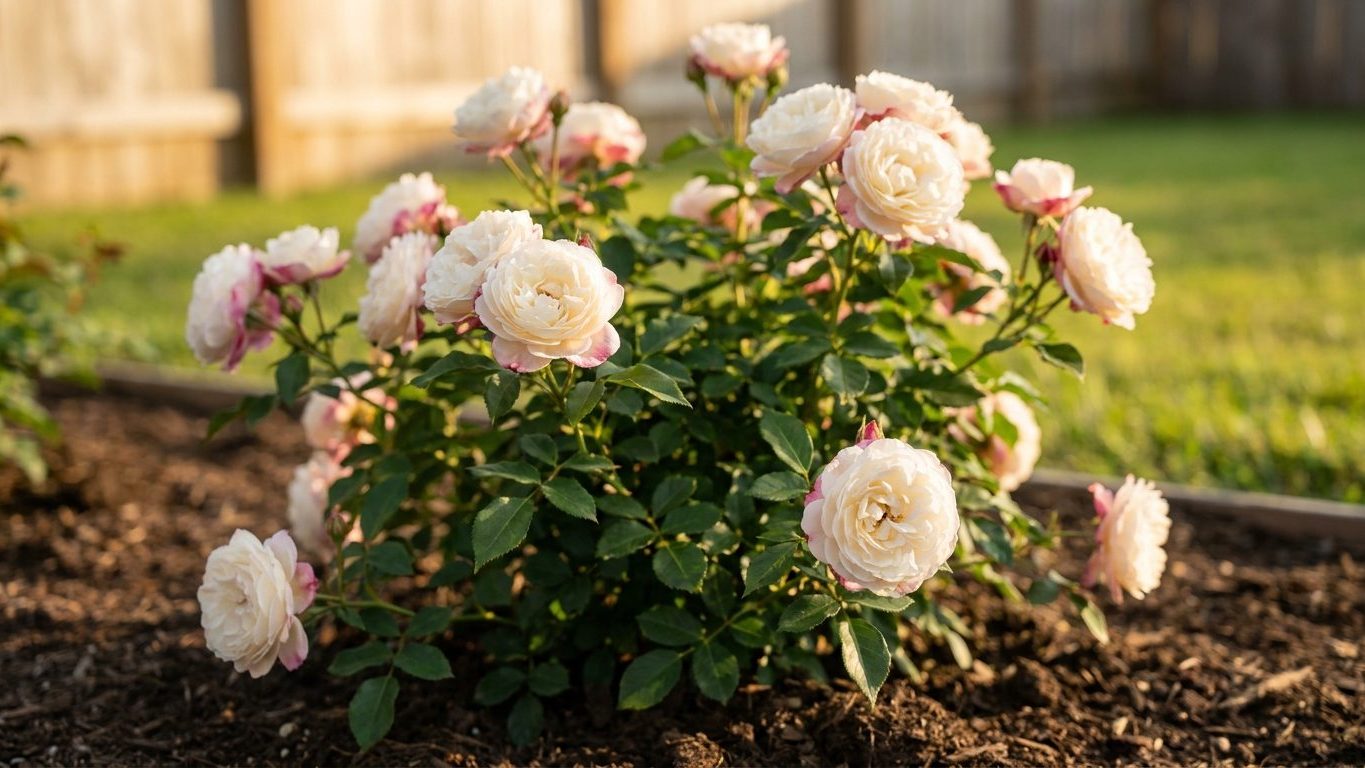

Carefree Wonder is a shrub rose (‘MELpitac’), not a vegetable, and nothing about it ripens on a calendar the way a tomato does. What decides whether it thrives in your yard is hardiness (USDA zones 5a through 11b), the wood it blooms from, and how well that wood survives your winter.
What Carefree Wonder actually is
Carefree Wonder is a shrub rose, bred under the name ‘MELpitac’ by Meilland, with a medium-sized bloom in cream-white with rose-pink reverse petals. According to the North Carolina Extension Gardener Plant Toolbox, the genus Rosa spans USDA hardiness zones 5a through 11b, needs full sun (6 or more hours of direct light a day), and tolerates clay or loam soil with a pH from acid (below 6.0) to neutral (6.0-8.0). Size within the genus runs 1 to 8 feet tall and 1 to 6 feet wide, depending on the cultivar, with a medium growth rate and high overall maintenance.
The detail that changes how you prune this rose is its flowering wood: Carefree Wonder blooms on new wood, the growth put on during the current season, not on canes left over from last year. That fact decides the pruning approach, and the source is explicit that light pruning is correct here, because hard pruning costs bloom rather than encouraging it. Flower parts on any rose come in multiples of five, and petal count on doubles like this one can run past twenty.
For a sense of where Carefree Wonder sits next to other shrub and climbing types, the full list of rose varieties covers the range from own-root landscape shrubs to budded climbers, and the wood habit is the first filter worth applying to any of them.
What Carefree Wonder is good for

The honest answer is landscape presence and cut flowers, not fruit, hips aside. The double petal count holds shape in the bed and in a vase longer than a single, five-petaled rose would, which is why shrub roses like this one get planted as hedges and border anchors. The cream-to-pink reverse gives the flower two tones depending on the light.
If you cut it for the house, the right moment is once the sepals have folded back and the first one or two petals are starting to unfurl; a bud cut tighter than that often never opens. Fragrance in roses generally falls into five documented groups (old rose, fruity, tea, myrrh, musk), but the source doesn’t assign Carefree Wonder to one specifically.
The rose hip is worth mentioning because most gardeners cut it off out of habit. It’s an accessory fruit holding the plant’s achenes, it’s edible, and it turns from green to red in fall; leaving a few hips late in the season is also how you stop pushing soft new growth right before frost, since every deadheading cut forces a fresh shoot.
There’s also a wildlife angle unrelated to the flower. Stem-nesting native bees use dead rose canes cut back to 12 to 24 inches and left standing over winter, so part of what this rose offers is a small contribution to pollinator habitat if you resist cutting every stem to the ground.
Where it ripens in time, and where it is a gamble
Since this is a rose, not an annual crop, the real question is whether your zone gives the plant enough growing season to build new wood, bloom on it, and let that wood mature enough to survive winter. The documented range, zones 5a through 11b, covers very different growing realities.
At the cold edge, zone 5a, winters are harsh enough that new wood can die back hard, and the following season has to rebuild that wood before any bloom shows. At the warm edge, zone 11b, frost essentially never happens, so the plant keeps producing new wood in a near-continuous cycle and summer heat stress becomes the limiting factor instead. In between, most of the country sits in a zone where the plant reliably builds, blooms, and matures new wood within a single season.
| Zone range | What it means for this rose | Rough US region |
|---|---|---|
| 5a (cold edge) | New wood can die back over winter; bloom depends on rebuilding growth each spring | Upper Midwest, northern Great Plains |
| 6b-8a (mid-range) | A full season to build, bloom on, and ripen new wood without either extreme | Mid-Atlantic, Carolinas, Pacific Northwest interior |
| 9a-10b | Long bloom season; summer heat becomes the main stress rather than cold | Gulf Coast, coastal California, central Florida |
| 11b (warm edge) | Frost essentially absent; near-continuous new-wood cycle, heat is the limiting factor | South Florida, Hawaii |
This page deliberately stops short of naming a pruning month, a specific zone recommendation, or a mounding depth for winter protection, those depend on exactly where you garden. The state-specific pages in this collection carry that detail; this page only establishes the mechanism so the local number makes sense.
The two ways a season goes wrong
Because Carefree Wonder flowers on new wood, both failure modes come down to the plant either losing that wood or being cut back the wrong way before it can bloom.
The first is winter dieback at the cold edge of the zone range. In a 5a winter, canes can die back well below where they stood in fall, and if the dieback runs past the graft union (on a budded plant) or below the crown (on an own-root plant), that season’s bloom is delayed while the plant rebuilds wood from lower down. This is a winter-hardiness problem, not a disease or pest problem, and no amount of spring feeding fixes it after the fact.
The second is a pruning mistake made by the gardener, not the climate. Because this cultivar blooms on new wood, it’s tempting to assume an aggressive cutback in late winter will force more growth and more bloom. The source is specific that the opposite is true: hard pruning costs bloom on Carefree Wonder, and light pruning is what keeps the flowering going. Since the cold-edge dieback only applies to gardeners at the 5a end of the range, while the pruning error is available to anyone with a pair of loppers, the pruning mistake is the more common way a season underperforms nationally.
What it resists, and what it does not
The North Carolina Extension source lists pests and diseases for the genus Rosa broadly, and it does not publish a cultivar-specific resistance grade for Carefree Wonder, so the honest position is to treat it as susceptible to the standard genus-wide list rather than assume built-in protection that isn’t documented here.
The diseases named are botrytis, blights, powdery mildew, leaf spots, and anthracnose. Two deserve a specific note: black spot-type leaf spots overwinter both in fallen leaves and in lesions on the canes themselves, while powdery mildew overwinters in dormant buds and on stems rather than in leaf litter. Raking up fallen leaves in fall helps with one problem and does almost nothing for the other; both need attention to head off a repeat.
- Fuller rose beetle
- Japanese beetle
- rose chafer
- rose thrips
- southern red mite (an arachnid, not an insect)
- two-spotted mite (also an arachnid)
Since mites are arachnids rather than insects, a product labeled for insect pests won’t necessarily touch them, worth knowing before spraying based on a label alone. Nothing here is graded as “high resistance” for Carefree Wonder specifically, so standard sanitation, watching for early leaf spot, and avoiding late-day overhead watering are the practical defaults.
Growing it without the usual mistakes
Because Carefree Wonder flowers on new wood, its pruning plan is the opposite of a climber like New Dawn, which flowers on old wood and needs its established canes left largely intact. Here, light pruning in late winter, removing only what’s damaged or crossing, is what the source calls for, rather than the harder renewal cuts suited to a cultivar that rebuilds from the base every year.
Spacing and support follow from the genus size range of 1 to 8 feet tall and 1 to 6 feet wide, wide enough that you should check this cultivar’s mature dimensions on the plant tag before setting hedge spacing. Soil pH from acid to neutral (below 6.0 up to 6.0-8.0) covers most garden soils without amendment; the one documented trouble condition is strongly alkaline ground above roughly pH 7.5, where iron chlorosis shows up.
Stop deadheading late in the season rather than continuing right up to frost: every cut pushes a new shoot, and one that starts too late won’t ripen before cold arrives, leaving soft growth more vulnerable to winter dieback. When you cut back for winter, leave dead stems at 12 to 24 inches rather than flush to the ground; the same cut protects stem-nesting native bees and costs nothing in bloom the following year. Before mounding soil over a graft union, check the tag: many landscape shrub roses today, Knock Out and Drift among them, are own-root and have no union to protect, in which case it’s the crown that needs attention instead. Gardeners comparing habits sometimes look at a climber like Joseph’s Coat alongside a shrub rose like this one because the pruning calendar is so different between the two, a difference that always traces back to which wood carries the bloom.
Common questions
Does Carefree Wonder rose need hard pruning?
No. It blooms on new wood, but the source is specific that hard pruning costs bloom on this cultivar. Light pruning in late winter, removing damaged or crossing growth, is the recommended approach.
What USDA zone is best for Carefree Wonder rose?
The documented range is zones 5a through 11b. Zones in the middle of that range give the plant a full season to build and mature new wood without either winter dieback at the cold edge or heat stress at the warm edge working against it.
Are the thorns on Carefree Wonder rose dangerous?
They’re prickles, not true thorns. Prickles grow from the outer skin of the stem, which is why they can be rubbed off, unlike a true thorn, which is a modified stem that’s woody all the way through.
Does Carefree Wonder rose need staking?
As a shrub rose with a self-supporting habit, it typically doesn’t need staking the way a tall climber does. Mature size within the genus ranges from 1 to 8 feet, so it’s worth checking this cultivar’s specific size on the plant tag before deciding on support or spacing.