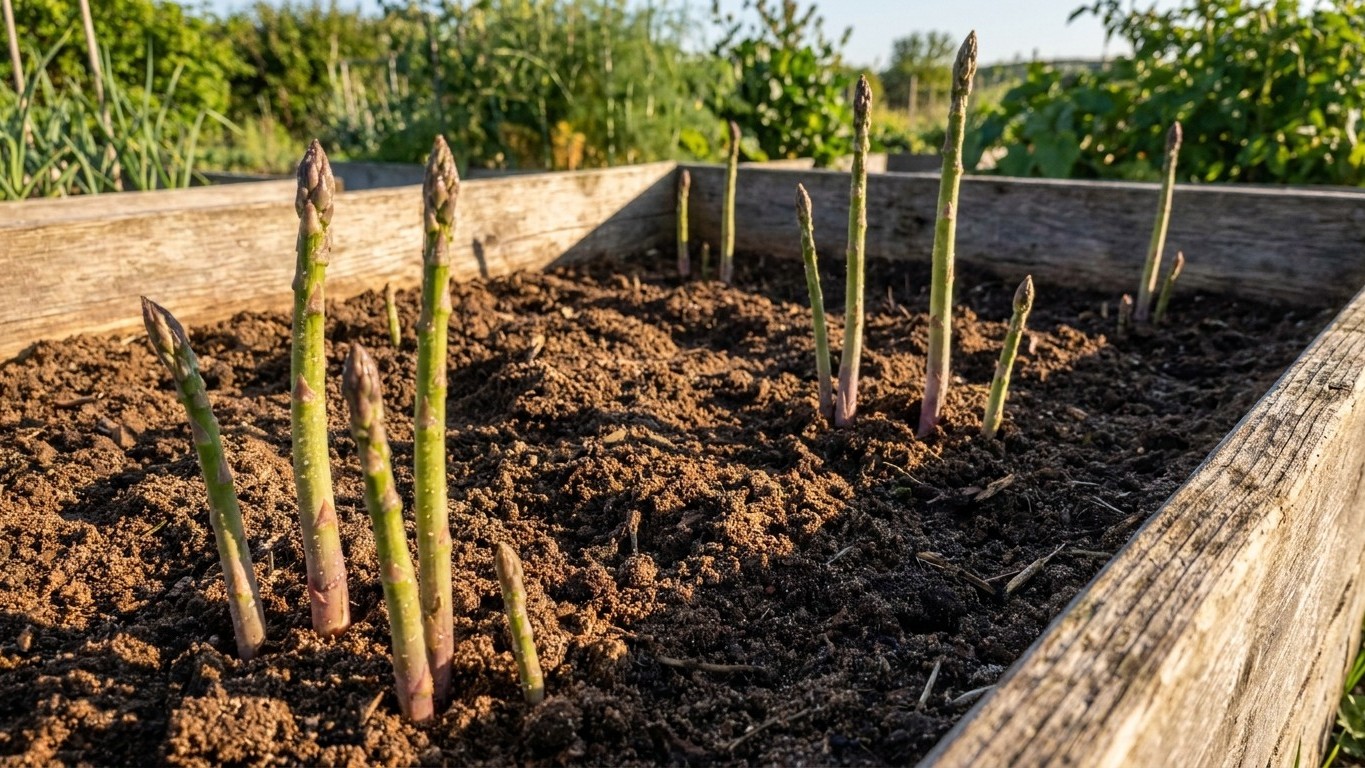

Five insects show up on Arkansas asparagus with any regularity, and none of them show up before the spears themselves do. Aphids, Japanese beetles, scale insects, stink bugs and whiteflies are the ones documented for this crop in the state. Two more pests on the state’s general watch list never touch asparagus at all, and knowing why matters as much as knowing what does.
Which pests attack asparagus in Arkansas

The University of Arkansas Division of Agriculture Cooperative Extension documents seven insects as garden pests broadly relevant to the state: aphids, Japanese beetles, scale insects, squash bugs (Anasa tristis), squash vine borer, stink bugs, and whiteflies. That is the full list this territory carries. Not all seven belong on an asparagus bed, and a gardener who spends a season watching for the wrong two is wasting a summer.
Squash bugs and squash vine borer do not appear on asparagus at all, and the reason is simple biology rather than a documentation gap. Both are cucurbit specialists. The squash bug feeds and breeds on squash, pumpkin, and cucumber vines; the vine borer’s larvae tunnel into the base of those same vines, not into a fern or a spear. Neither insect has mouthparts or a life cycle built around asparagus tissue, so if something is chewing a fern nearby, the culprit is not one of these two, no matter how common they are in a mixed vegetable garden a few rows over.
That leaves five insects actually worth watching on this crop. Aphids and whiteflies are soft-bodied sap feeders that colonize the fine, feathery growth asparagus puts up after harvest ends, the ferny top growth that photosynthesizes and feeds the crown for next year. Scale insects attach to stems and spears and are easy to miss because they barely move once settled. Japanese beetles chew visible holes in the ferns and will strip tissue fast when numbers build. Stink bugs are generalist feeders that pierce spears and ferns alike, leaving small discolored punctures rather than open holes.
None of these five is asparagus-exclusive. All of them also live on tomatoes, beans, roses, and a dozen other garden plants, which is exactly why they turn up on asparagus without needing a specialized reason to be there. A short-lived pest list is not a sign that Arkansas gardens have it easy with asparagus. It just means the extension service has not documented anything more specific to this crop than the general garden roster, and that roster is what a grower should learn to recognize on sight.
When each one shows up, and what it does first
Arkansas’s last spring frost, by NOAA’s 1991-2020 normals for the reference station, falls somewhere between March 12 and March 28. Asparagus spears push through soil close to that window, since crowns are planted in early spring and the plant responds to warming soil rather than a calendar date. Pest activity on established beds follows the same soil-temperature logic: nothing shows up until the ferns are up and growing, which for a bed past its third year means the weeks right after the frost-free window closes.
Aphids and whiteflies are usually the first sign of trouble, and they show up as a change in the ferns rather than damage to the spears. Look for a sticky film on the foliage, a slight curling of the fine needle-like growth, or a fine white dust that lifts off when the plant is brushed. Both insects reproduce fast in the mild, humid stretch of a Southern spring, so a light infestation in the first weeks after the ferns open can become a heavier one within days.
Scale insects appear later and more quietly, once ferns have matured for a few weeks. The first sign is rarely a bug at all. It is a dulling or yellowing of a stem section, sometimes with a slightly raised, waxy bump that does not brush off. Because scale insects settle in one spot and stay there, an infestation can sit undetected on the lower stems for a stretch before a grower notices the fern above it thinning out.
Japanese beetles are a summer arrival, drawn to ferns once they are fully leafed out, and they announce themselves with visible feeding holes and skeletonized patches of foliage, sometimes with the beetles themselves clustered on the damaged section in daylight. Stink bugs show up around the same stretch and leave a different signature: small sunken or discolored spots on spears and stems, from piercing rather than chewing, without the beetle’s obvious hole pattern.
Telling the damage apart from everything else
A fern that looks stressed in an Arkansas garden is not automatically an insect problem. The state’s representative soil, the Stuttgart series, runs surface pH around 5.6 and is somewhat poorly drained, which on its own can produce yellowing or stunted growth that looks a lot like pest damage from a distance. Add a summer where August rainfall averages just 3.16 inches, the driest month of the year, and a bed that looks chewed on may simply be a bed that is thirsty.
The clearest tell is where the damage is, not just what it looks like. Insect feeding leaves visible holes, punctures, or insects themselves on close inspection. Drought and nutrient stress produce even, gradual yellowing across whole fronds with no chew marks or bumps anywhere on the stem.
| What you see | Likely cause | What settles it |
|---|---|---|
| Holes or ragged edges on ferns, beetles visible | Japanese beetles | Insects present on the damaged foliage in daylight |
| Sticky residue, curling fine growth | Aphids or whiteflies | Insects or white specks visible when foliage is brushed |
| Dull, waxy bumps on stems, no chewing | Scale insects | Bumps do not brush off; stem beneath discolors |
| Small sunken punctures on spears or stems | Stink bugs | No chew marks, no insect visible up close |
| Even yellowing across whole ferns, no marks | Drought stress or poor drainage | Soil is dry or waterlogged at root depth; no insects found anywhere |
A soil test, not a guess, is the only way to rule out a nutrient issue on a specific bed, since the state figures above describe the mapped Stuttgart series and not any one garden’s worked soil. When damage does not match any row in that table, or when several signs overlap, that is exactly the point to stop guessing and call the local extension office rather than treat for the wrong problem.
What actually works here, and what is a waste of time
Timing matters more than any product on a short growing season. Asparagus is not harvested at all until the third year after planting, and even then the harvest window itself is short, so protecting the ferns that feed the crown for next year’s spears is the actual goal in most seasons, not defending a harvest. A bed left unprotected during fern growth loses next year’s spear count, not this year’s.
Physical checks done early work better than anything applied after an infestation is visible. Walking the bed weekly during the weeks after the frost-free window, checking the undersides of ferns and the base of stems, catches aphids, whiteflies, and scale while colonies are still small enough to remove by hand or hose off. Once Japanese beetles or stink bugs are established in numbers, hand-picking beetles in the cool of morning, when they move slowly, does more than most home remedies people reach for.
What wastes time is treating symptoms that were never insects in the first place. Spraying anything on a fern that is yellowing evenly from drought or from the state’s somewhat poorly drained surface soil does nothing for the actual cause and can stress the plant further. Broad, repeated treatments applied on a schedule rather than in response to an actual sighting also waste effort on a plant with a fifteen-year bed life. This site does not name products, rates, or active ingredients, because what is labeled for use on asparagus in Arkansas is a question for the state’s extension service, not a general gardening page. Anyone reaching for a treatment should confirm with that office first, which is also the office that knows what has actually changed in labeling this season.
Where to check this for your own county
The University of Arkansas Division of Agriculture Cooperative Extension is the authority behind every pest named on this page, and it operates a county office in every county in the state. Statewide documentation is not the same thing as a confirmed pest in one garden, and that gap is where a county office earns its keep: local agents track what is actually being reported nearby, which can run well ahead of or behind the general seasonal pattern described here.
A garden a few miles from another can have a heavier aphid year while its neighbor sees none, depending on how the ferns leafed out, how wet the spring was, or what was planted nearby the season before. None of that shows up in a statewide list. It shows up in what an office fields calls about in a given week.
Anyone with a spear or fern that does not match the patterns above, or a bed that seems to be struggling for a reason a soil test alone cannot explain, should bring a sample or a clear photo to the county extension office rather than guess from a description online. That is also the office to ask about soil testing itself, since the Stuttgart series figures cited here describe the state’s representative soil, not the pH or drainage of any one backyard bed.
Common questions
Do squash bugs ever move from a nearby cucurbit patch onto asparagus?
The University of Arkansas Division of Agriculture Cooperative Extension documents squash bugs as a pest of squash, pumpkin, and cucumber plants. They are not documented as an asparagus pest, and their feeding habits are built around cucurbit tissue rather than fern growth.
Can an asparagus bed be treated before spears emerge in spring?
The source for the state’s frost timing is silent on any pest treatment schedule tied to spear emergence. What is worth doing at that point is inspecting the crown area and prior year’s fern debris for scale or overwintering insects, and referring anything found to the county extension office.
Does variety choice affect which pests attack asparagus in Arkansas?
Utah State University Extension names four common varieties by sex only, all-male Jersey Giant and Jersey Knight, and male/female UC 157 F1 and Purple Passion, without publishing any pest resistance, flavor, or yield comparison between them. No pest preference among varieties is documented here.
Is yellowing fern growth in August always a pest problem?
Not necessarily. August is the driest month of the Arkansas summer by NOAA’s normals, averaging 3.16 inches, and even, unmarked yellowing across ferns is as likely to be drought stress on the state’s somewhat poorly drained soil as it is to be insect damage. Checking for actual chew marks, punctures, or visible insects is what separates the two.