
The short version: it depends on which patch of ground you’re standing on, not on the state as a whole. Arkansas’s official state soil, the Stuttgart series, is rated “somewhat poorly drained”, the one condition asparagus can’t tolerate over a 10- to 15-year bed. That doesn’t rule out a bed here. It means drainage, not fertility or acidity, is the question worth answering before you dig.
The short answer
Asparagus is unusual among garden crops because the planting decision is a fifteen-year decision, not a seasonal one. Utah State University Extension notes that a bed, once established from crowns, keeps producing for 10 to 15 years, and that most soils will support it provided one condition is met: the ground drains. Nothing about pH, fertility, or texture is a dealbreaker in that guidance. Drainage is the whole test.
Arkansas’s representative state soil doesn’t pass that test cleanly. The Stuttgart series, an Alfisol formally named the state soil in 1997, is a loam-to-silt profile: about 30 percent sand, 16 percent clay, and 54 percent silt, with organic matter around 1.8 percent in the surface horizon and a surface pH near 5.6, slightly acid. USDA’s own drainage class for it reads “somewhat poorly drained.” That’s the middle of the scale, not the bottom, but it’s the wrong direction for a crop that will sit in the same spot for a decade and a half with roots that rot fast in standing water.
What the state soil can and can’t tell you
None of this is a diagnosis of any one backyard. The Stuttgart series is a mapped average built from seven representative components across the state, and it exists to describe a tendency, not to replace a soil test on an actual garden plot. A homeowner on a hillside, a river terrace, or a lot a builder graded and filled ten years ago could be sitting on ground that behaves nothing like the state series. The organic-matter figure, for instance, is a surface-horizon average for mapped, uncultivated ground, not a number from a worked garden bed.
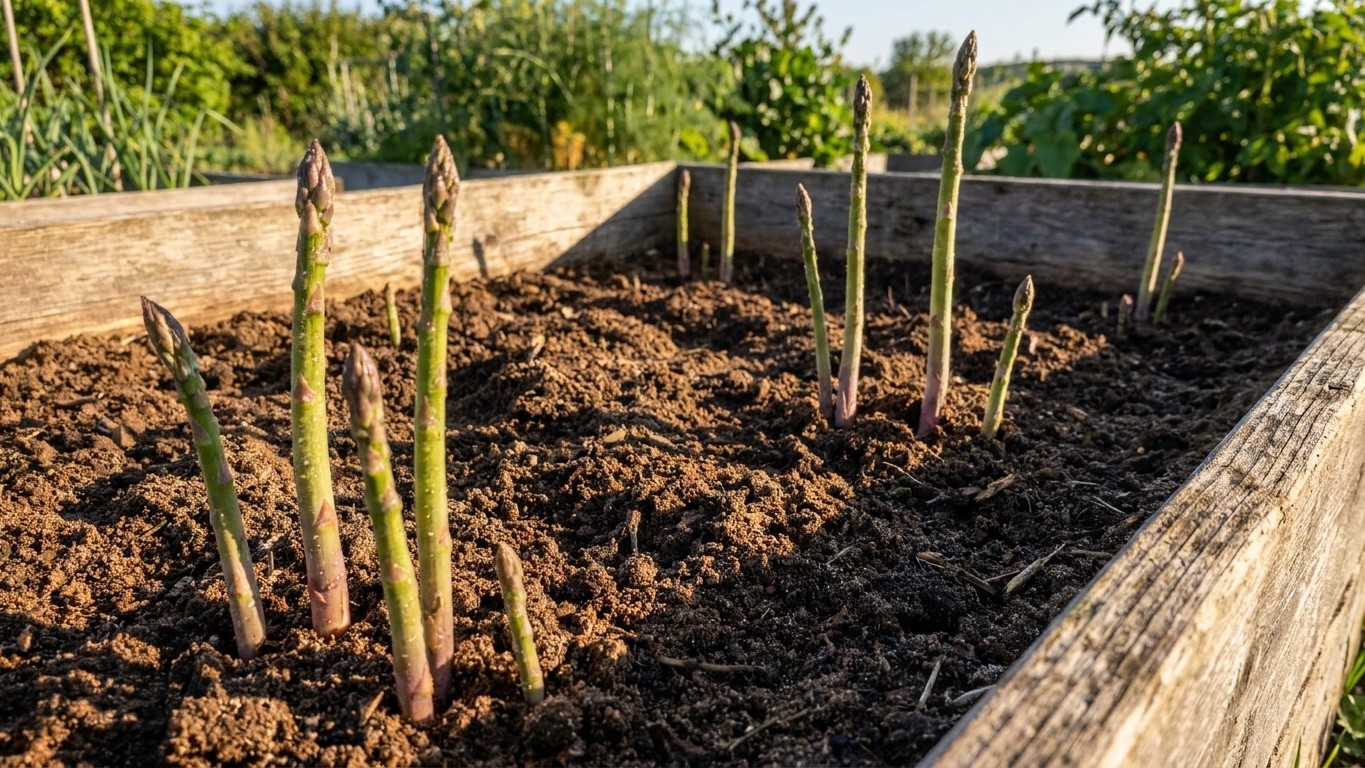
What the state figure is useful for is framing the odds. If a silt-heavy, somewhat poorly drained profile is common in your part of Arkansas, a low spot in the yard is more likely to pond after a storm than it would be on a sandy Coastal Plain soil elsewhere. The fix, where drainage is marginal, is not to abandon asparagus but to raise the bed: mounding soil eight to twelve inches above grade, or building a framed raised bed, gets the crowns out of the water table without changing anything about the fifteen-year commitment. Given that the harvest doesn’t even begin until the third year, and that a bed then needs to keep producing for a decade after that, sorting out drainage before planting is cheaper than discovering the problem in year four.
Will the summer here water it for you?
Utah State University Extension’s watering guidance for an Asparagus Bed is a two-stage schedule: 1 to 2 inches every other week for the first two growing seasons while the root system establishes, then a lighter 1 to 2 inches every three weeks once the bed matures. Set against what Arkansas summers typically deliver, based on 1991-2020 climate normals for the state’s reference station, here’s how the math runs.
- Young bed, years one and two: the target is roughly 2 to 4 inches a month during the every-other-week phase. June’s normal rainfall is 3.55 inches, July’s is 3.33 inches, and August’s is 3.16 inches, each falls inside or close to that range on paper.
- But rain doesn’t arrive on a schedule. Summer totals in this climate tend to come as thunderstorms rather than steady soakings, so a month can hit its 3-plus inch average in two downpours and go two dry weeks in between, exactly the gap the every-other-week rule is designed to prevent.
- Mature bed, year three onward: the lighter every-three-weeks target is easier to clear passively, since even August’s driest-of-the-summer 3.16 inches usually covers it without supplemental watering in most years.
- August is the month to watch. It’s the driest of the three summer months in the state’s normals, and it’s also the stretch where a young bed is most likely to need a hose if the storms haven’t lined up.
- The only fix that actually works: a rain gauge on the bed itself. Regional normals describe an average station, not a driveway or a backyard; a rain gauge tells a gardener whether the last two weeks actually delivered the inch or two the schedule calls for.
Total summer rainfall across the season runs about 10.0 inches against a full year’s 50.4 inches, which puts Arkansas summers on the wetter side for asparagus by national standards. That’s a reasonable baseline, not a guarantee for any specific plot or any specific summer.
When to put the crowns in
Crowns go into the ground in early spring, timed to the last frost rather than the calendar. For the reference station used in these normals, the 32°F freeze probability window runs from around March 12 to around March 28, a range, not a fixed date, because it’s built from thirty years of averages and any given spring can land earlier or later. Planting crowns around that window, once the soil has warmed and can be worked, keeps young growth clear of the worst of the last hard freezes without pushing planting so late that the crowns lose a chunk of their first growing season.
The furrow itself is dug about 8 inches deep, and the backfilling is not a one-time job. Soil goes back over the crowns gradually across the season, about 2 inches every other month, rather than filling the trench flush on planting day. That staged approach lets the emerging spears push through loose soil rather than fighting a compacted trench all at once.
For gardeners who’d rather not source crowns, starting from seed is the alternative route, though it adds an extra year before the crowns are large enough to set out at the same spring window described above. Whichever route is chosen, the varieties named in Utah State University Extension’s guidance are distinguished only by sex, not by flavor or yield: Jersey Giant and Jersey Knight are all-male hybrids, while UC 157 F1 and Purple Passion include both male and female plants. No performance ranking between them is published by that source, so the choice comes down to what’s available locally rather than a documented reason to prefer one over another.
One more number worth holding onto before the crowns go in the ground: harvest doesn’t start the first year, or even the second. The bed goes untouched until year three, then opens with roughly a four-week cutting season, extending to about six weeks the following year and eight weeks after that. The stopping point each season isn’t a date on a calendar, it’s a visual cue, cutting stops once most of the spears coming up are thinner than a pencil. Skipping that discipline in the early years is the fastest way to weaken a bed that’s supposed to still be producing a decade later.
Common questions
Does Arkansas’s state soil pH matter for asparagus? The Stuttgart series runs about 5.6 at the surface, slightly acid, but Utah State University Extension’s guidance on asparagus doesn’t set a pH requirement or preference. That figure describes the mapped state soil, not necessarily your garden’s own soil, and it isn’t a factor the source ties to bed success either way.
Can I fix poor drainage instead of moving the bed? Raising the planting area above grade, whether by mounding or by a framed raised bed, is the standard workaround where the natural ground drains sluggishly. It sidesteps the drainage problem without changing the depth of the furrow or the timing of planting.
How early should I start watering a new bed? From planting, using the every-other-week 1-2 inch target through the first two growing seasons, checking actual rainfall against a gauge on the bed rather than assuming regional averages apply to that exact spot.
Is there a winter chilling requirement I should plan around? Not published in the guidance behind this article. It covers frost dates for spring planting and the watering and harvest schedule, but it’s silent on any chilling hours, so that figure isn’t something to substitute from general knowledge of the plant.