
Yes, Pennsylvania requires an interior vapor retarder on framed walls, and the reason is simpler than the code language suggests: the entire state sits in IECC climate zones 4A and 5A, and the one exception that removes the requirement only applies to zones 1, 2 and 3. Neither Pennsylvania zone qualifies, so the obligation stands from Erie to Philadelphia.
What the code asks for in Pennsylvania

The 2021 International Residential Code, Section R702.7, states it directly: a vapor retarder of the class given by Table R702.7(2) shall be provided on the interior side of frame walls. That’s the baseline rule, and it applies everywhere the code has been adopted unless one of four named exceptions kicks in. The exception that matters most nationally reads: “A vapor retarder shall not be required in Climate Zones 1, 2 and 3.” Read that sentence again, because it’s the whole story for the southern half of the country and the reason this rule doesn’t behave the same way in every state.
Pennsylvania’s 67 counties break down into two zones: 53 counties fall in zone 5A, and 14 counties fall in zone 4A. Both are moist zones, marked with the “A” designation, and neither one is a 1, 2 or 3. That means the exception simply doesn’t reach Pennsylvania. A homeowner in a 5A county in the Poconos and a homeowner in a 4A county closer to Philadelphia are both covered by the same requirement, even though they sit in different climate zones and would land on different rows of an insulation table.
This is worth sitting with for a second, because it’s not the pattern readers see in warmer states. Pennsylvania isn’t a state with a patchwork answer where some counties need a retarder and others don’t. Both zones present in the state land on the same side of the line drawn by R702.7’s exception. The requirement is not required nowhere, and it is not required only in part of the state, it is required statewide because no Pennsylvania county carries a zone number low enough to trigger the exception.
None of this means every wall assembly in Pennsylvania must use the same class of retarder, or that a builder has no choices. It means the baseline obligation, a vapor retarder somewhere on the interior side of the wall, applies across the state. What varies from house to house is which class satisfies that obligation, and that decision belongs to whoever is pulling the permit, working from the code edition their local building department has actually adopted. A wall assembled with the wrong vapor control doesn’t announce the mistake with a crack in the drywall. It shows up years later as soft framing and a moisture problem nobody saw coming.
Why the answer is the opposite in a warm climate
Pennsylvania’s answer only makes sense next to its opposite. In a warm, humid climate, states in zones 1, 2 and 3, the same interior vapor retarder that protects a Pennsylvania wall becomes the source of the damage. The mechanism runs on which direction the moisture is traveling, and that direction flips depending on where the house sits.
In a cold climate like Pennsylvania’s, warm, damp air lives inside the house all winter. That air wants to migrate outward, through the wall cavity, toward the cold sheathing and siding. If it gets there unimpeded, it condenses against a cold surface, and now the insulation is wet. The interior vapor retarder exists to intercept that moisture before it reaches the cold zone, keeping the assembly dry where it counts.
Flip the climate, and the physics flips with it. In a warm, humid state, the outside air is the source of the moisture, not the inside. That humid air pushes inward through the wall assembly, and if there’s a Class I vapor retarder installed on the interior side of the insulation, it becomes the coldest, most impermeable surface the vapor can find. The U.S. Department of Energy’s Building America program spells out exactly what happens next: “If the wall contains a vapor retarder on the interior side of the insulation, the water vapor will condense on this cool, impermeable surface,” resulting in “ruined insulation, mold, and structural rot of framing members.”
That’s not a minor caveat buried in a footnote. That’s the reason the code writes different rules for different zones in the first place. It isn’t bureaucratic inconsistency or a leftover from an older code cycle. It’s the code tracking which way the water is actually moving through the wall, and refusing to require a barrier that would make the problem worse in half the country. Pennsylvania’s winters put it firmly on the side of the line where the interior retarder does its job as intended.
The three classes, and why the word matters
Requiring “a vapor retarder” doesn’t mean requiring plastic sheeting. The code sorts vapor retarders into three classes by how much moisture they let through, measured in perms, and the differences between them are large enough to change how a wall performs.
| Class | Example materials | Permeance |
|---|---|---|
| Class I | Sheet polyethylene, nonperforated aluminum foil | 0.1 perm or less |
| Class II | Kraft-faced fiberglass batts, vapor retarder paint | Above 0.1, up to 1.0 perm |
| Class III | Latex or enamel paint | Above 1.0, up to 10.0 perm |
Polyethylene sheeting is a Class I vapor retarder, one of the most restrictive options on the table, not “a vapor barrier” in some generic sense. Calling it that skips over the detail that actually decides whether it belongs in a given wall. The disagreement between a builder working in a cold zone and a builder working in a warm-humid zone was never about whether to include a retarder at all. It’s about which class fits the direction the moisture is traveling in that particular climate.
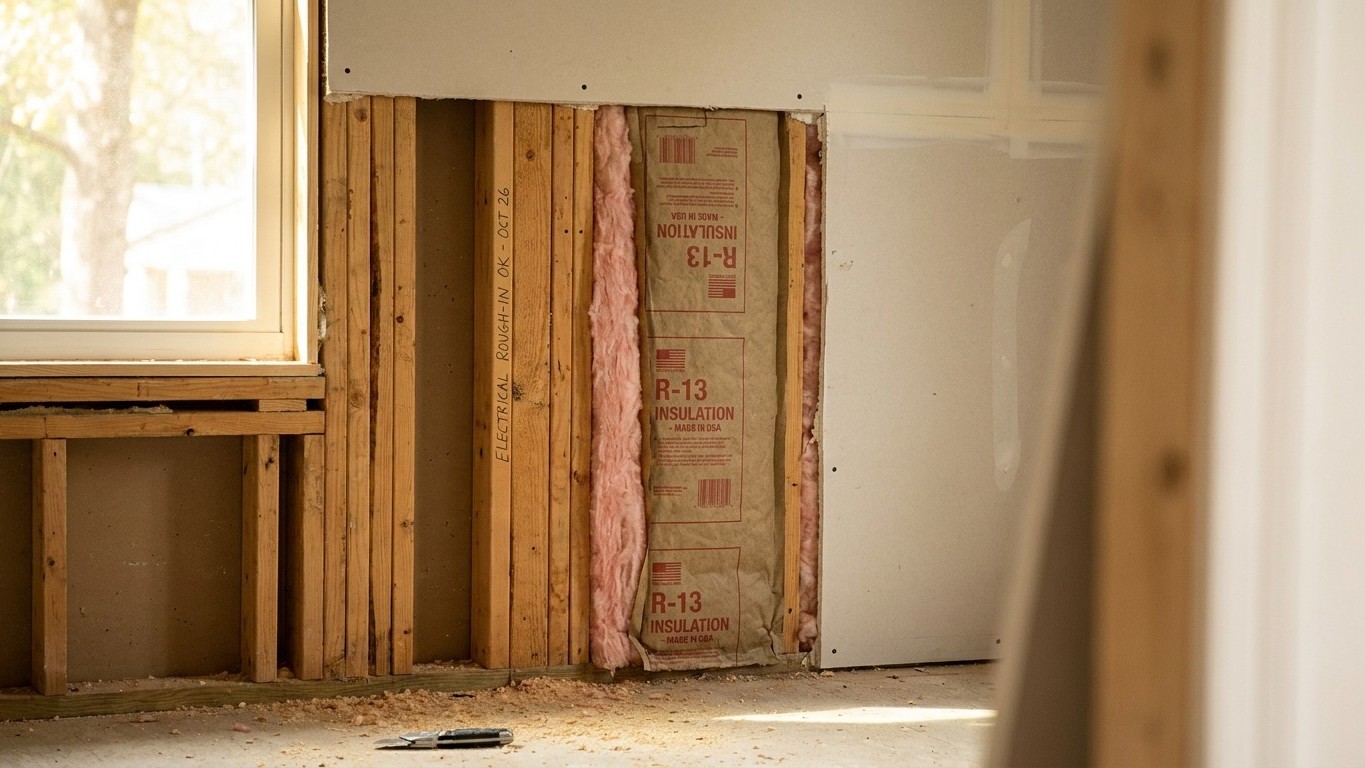
Here’s the detail most homeowners miss entirely: ordinary latex paint qualifies as a Class III vapor retarder. Anyone who has painted an interior wall with a standard latex finish already has a vapor retarder on that wall, whether they intended one or not. That’s how loose the definition is at the low-permeance end, and it’s why the code can require “a vapor retarder” on nearly every wall without demanding plastic sheeting on nearly every wall.
One distinction worth keeping straight: a vapor retarder is not an air barrier. They solve different problems, slowing moisture diffusion versus blocking bulk air movement, even though a single product, like some foil-faced sheathings, can sometimes do both jobs at once. Confusing the two leads to shopping for the wrong material for the wrong reason.
Where the rule stops
R702.7’s baseline requirement comes with four exceptions, and the zone-based one covered above isn’t the only carve-out that matters. The full list:
- Basement walls
- The below-grade portion of any wall
- Construction where accumulation, condensation or freezing of moisture will not damage the materials
- Climate Zones 1, 2 and 3 (not applicable to Pennsylvania, as covered above)
The basement exception is the one most Pennsylvania homeowners actually run into, since finished basements are common across the state’s older housing stock. A poured concrete foundation wall behaves nothing like a framed wall above grade. Concrete holds moisture from the soil around it for years, releasing it slowly, and it needs to be able to dry toward the interior. Sealing that wall with an impermeable interior vapor retarder traps the moisture the concrete is trying to shed, which sets up the same condensation problem discussed above, just below grade instead of above it. That’s why the code exempts basement walls and the below-grade portion of any wall outright, rather than adjusting the class.
This site’s basement wall guide covers that assembly in more detail, since finishing a Pennsylvania basement involves a different set of decisions than framing an above-grade wall in the same house.
The third exception is narrower and more situational: it applies where the construction itself won’t be damaged by moisture accumulation, condensation or freezing, a case-by-case determination rather than a blanket rule tied to a zone or a wall type. None of these three exceptions ban a vapor retarder from being used. They remove the obligation to include one in that specific location, which is a different thing entirely from prohibiting it.
Who actually decides, in Pennsylvania
Everything above describes the model code, the 2021 IRC as published by the International Code Council. It is not automatically the code enforced in any specific Pennsylvania municipality. States adopt model codes on their own schedule, sometimes with amendments, sometimes years behind the edition currently in print, and Pennsylvania is no exception to that pattern. The only way to know which edition, and which amendments, apply to a specific address is to ask the local building department handling that permit.
This matters more here than it might in a state with a milder, more forgiving climate. Philadelphia International Airport’s climate normals put the area at roughly 4,510 heating degree days a year against about 1,358 cooling degree days, a lopsided split that shows a heating season carrying real weight against a mild cooling season. Heating degree days measure demand, the accumulated distance between each day’s mean temperature and 65 F, not a single cold reading. A number that size is why Pennsylvania’s wall assemblies deal with sustained cold-side moisture pressure for a real stretch of the year, and why the interior vapor retarder required by R702.7 isn’t a formality here the way it might be read as one somewhere warmer.
None of this settles what belongs in any individual reader’s wall. It settles what the rule is, and what the rule depends on: the climate zone assigned to the county, the class of retarder chosen for that wall, and the code edition the local jurisdiction has actually adopted. A wall built with the wrong vapor control doesn’t fail in a way anyone notices right away. It rots quietly behind the drywall, and the owner usually finds out only once the damage is already done. The building department with jurisdiction over that address is the only source that can close that gap with certainty.