
Yes, but Idaho’s answer comes with an asterisk. The state straddles two IECC climate zones, both on the cold, dry side of the national map, and Boise averages 47.5 days a year above 90°F. That’s a real summer, not a token one, but it shares the calendar with a long, serious heating season.
The short answer for Idaho

Insulation slows summer heat gain in Idaho homes, and the 47.5 days a year that reach 90°F or higher at the Boise reference station is the number that sizes how much that matters. It’s a meaningful stretch of hot weather, enough to push attics into triple digits and strain a central air system on the worst afternoons. But it isn’t the six-month furnace of a desert Southwest summer, and Idaho’s climate designation says so directly.
The state’s 44 counties split almost evenly between two IECC zones: 22 counties sit in zone 5B, and 22 in zone 6B. Both carry the “B” moisture regime, meaning dry, and both fall on the cold-climate side of the code’s national divide. That’s the honest framing for this territory: winter heating load is the dominant story here, and summer cooling is the secondary one, real but not the main event.
What that means in practice is that Insulation bought for Idaho’s climate should be sized for the cold season first. The good news is that the same material that blocks heat from escaping in January also blocks heat from entering in July. A homeowner in Coeur d’Alene or Idaho Falls isn’t choosing between a winter product and a summer product. There’s one job, and it happens to pay twice.
Where this gets specific is in how the two zones are treated for retrofit purposes. Zones 5B and 6B both land in the same row of the ENERGY STAR insulation guidance, grouped together with zone 4C under a single recommended level. That’s a detail worth knowing before shopping for material, because it means a county in the cooler 6B zone and a county in the milder 5B zone are pointed at the same target, at least for attic and floor insulation. The county-level split doesn’t change the recommended level, only the relative weight of heating versus cooling in the energy bill.
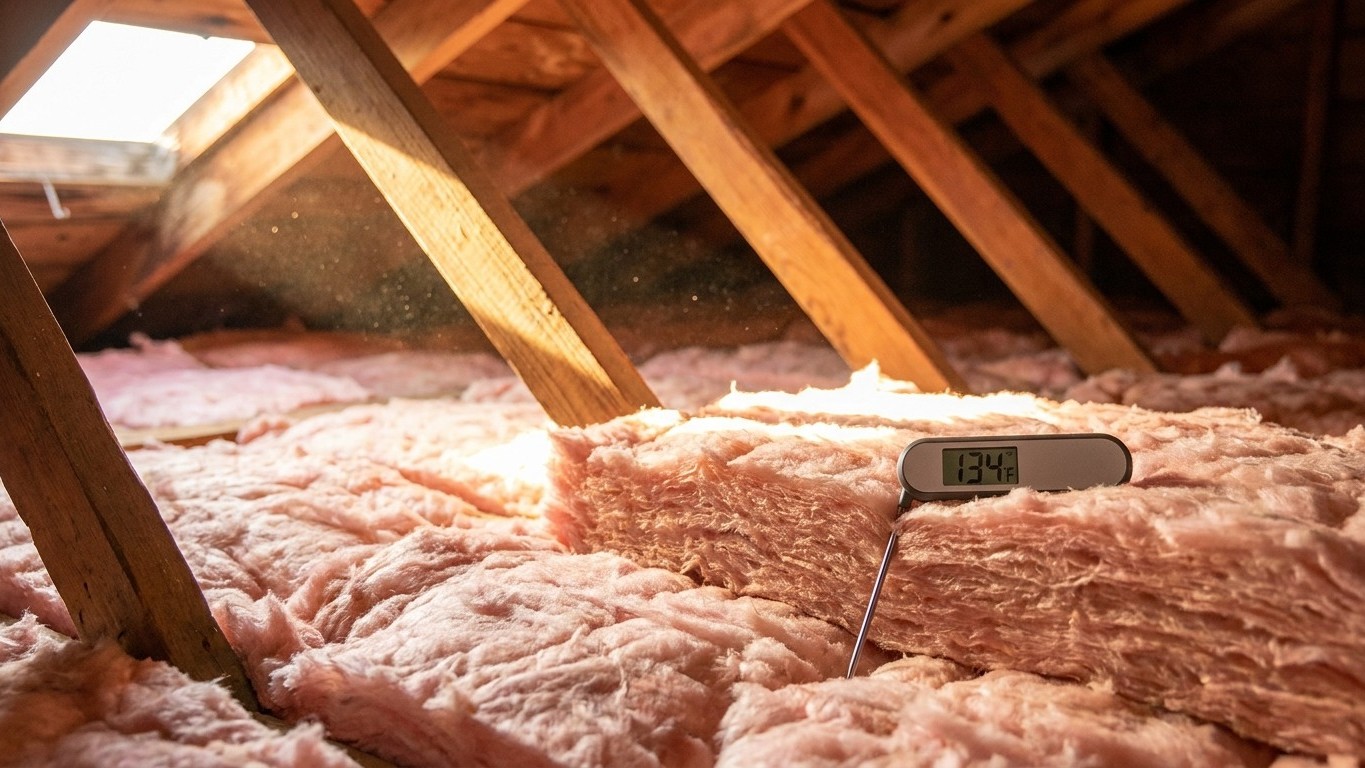
None of this means summer heat in Idaho is trivial. Forty-seven and a half days above 90°F is enough to bake an unshaded attic well past 130°F on a clear afternoon, enough to matter for anyone with ductwork or storage up there. It just means the case for insulation in Idaho rests as much on the furnace bill as the air conditioner, and a homeowner sizing the investment should expect the payback to show up across both seasons, not concentrated in one.
What happens above the ceiling
A sun-loaded roof deck is the real driver of summer heat in any attic, Idaho’s included. Asphalt shingles absorb solar radiation all afternoon, and the roof deck underneath can run 50 to 70 degrees hotter than the outdoor air by mid-afternoon. That superheated deck radiates downward into the attic space, and everything below it, the ceiling drywall, any ductwork routed through the attic, boxes stored near the hatch, sits under that heat load until the sun drops and the roof cools.
Ceiling insulation is the layer standing between that superheated attic and the living space below it. The physics don’t care which direction the heat is trying to move. In January, warm indoor air rises and tries to escape through the ceiling into a cold attic, and insulation resists that flow. In July, the attic is the hot side and the house is the cool side, and the same material resists the flow running the other way. It’s not a winter product pressed into summer service. It’s a resistance to heat flow, full stop, and the direction of that flow simply reverses with the season.
ENERGY STAR’s retrofit guidance for existing wood-framed homes lays out recommended levels by climate zone, and the table has three columns worth knowing, not two: what to add if the attic is currently uninsulated, what to add if it already has 3 to 4 inches in place, and a separate figure for the floor over an unheated space like a crawl space.
| Climate Zone | Attic (uninsulated) | Attic (already has 3-4 in.) | Floor |
|---|---|---|---|
| Zone 1 | R30 | R25 | R13 |
| Zone 2 | R49 | R38 | R13 |
| Zone 3 | R49 | R38 | R19 |
| Zones 4A and 4B | R60 | R49 | R19 |
| Zones 6, 5 and 4C | R60 | R49 | R30 |
| Zones 7 and 8 | R60 | R49 | R38 |
Idaho’s zones 5B and 6B both fall in the “Zones 6, 5 and 4C” row: R60 for an uninsulated attic, R49 if 3 to 4 inches are already in place, and R30 for the floor over a crawl space. These figures are for retrofitting an existing wood-framed home, not a new-construction code minimum, and they’re the same numbers whether the priority in mind is a cold January or a hot July afternoon. That dual purpose is the one improvement on this list that serves both seasons without compromise.
What homes in Idaho cool with
Idaho households rely on air conditioning at a high rate: 81% of homes use some form of air-conditioning equipment. But that number splits in a way worth understanding before deciding where insulation fits. Of that 81%, 64% of all homes use a central air-conditioning unit, while 19% rely on individual equipment, a ductless mini-split, a window or wall unit, or a portable. Both figures describe a share of households surveyed, not a share of houses standing, and the gap between them is the story.
Central air, run in 64% of Idaho homes, almost always means ductwork, and a lot of that ductwork is routed through the attic, the hottest space in the building on a 90-degree afternoon. Ceiling insulation does nothing to protect ducts sitting exposed above the insulation layer or run through an unconditioned attic. That’s a separate problem with its own fix, duct sealing and duct insulation, and it deserves its own attention rather than getting folded into an attic upgrade.
For the 19% running window units, wall units, portables, or mini-splits, the calculation is different. There’s no attic ductwork to worry about, but the room’s own envelope, its windows, its exterior wall, its ceiling if it’s a top-floor room, is what determines how hard that unit has to work. A well-insulated room lets a modest window unit keep up on the hottest days; a poorly insulated one turns the same unit into a losing fight against a bakes-uh attic overhead or a west-facing window pouring in afternoon sun.
Ceiling fans show up in 70% of Idaho homes, and while a fan doesn’t lower the actual temperature, it’s a low-cost companion to whichever cooling system is in place, letting a thermostat sit a few degrees higher while still feeling comfortable. For the mechanics of the two cooling paths described here, readers running central air through an attic should look at this site’s duct sealing and insulation guide, and readers relying on window or mini-split units will find more detail in the room air conditioner guide.
What the heat asks for that the cold does not
Two tools belong specifically to hot climates, and Idaho’s moderate, cold-leaning summer is the right test for whether either one applies here.
A radiant barrier reflects radiant heat instead of resisting conducted heat the way standard insulation does. It carries no R-value of its own, it isn’t insulation in the technical sense, and it earns its keep specifically under a heavily sun-loaded roof in a climate where attic temperatures spike hard and often. Idaho, with 47.5 days a year above 90°F and both its zones classified on the cold side of the national divide, isn’t that climate. A radiant barrier isn’t the wrong product everywhere, but for a house in Boise, Idaho Falls, or Coeur d’Alene, the R60 attic insulation described above is doing the heavy lifting, and a radiant barrier would be an add-on chasing a marginal gain rather than the tool this house actually needs.
Vapor movement is the second consideration, and it runs in the opposite direction depending on season and climate. In a warm, humid climate, moisture-laden air sits outside the house in summer and pushes inward, which is exactly why the model code doesn’t require an interior vapor retarder in the country’s warmest, most humid zones. Idaho’s “B” moisture designation means dry, not humid, which changes that calculation. Getting vapor barrier placement right for a dry, cold-dominant zone like 5B or 6B is a distinct question from the summer heat question this page answers, and it deserves its own careful answer rather than a quick aside here. Readers weighing that decision should consult this territory’s vapor barrier page before making a change to an existing wall or ceiling assembly.
What the work is worth
ENERGY STAR’s own estimate, unchanged in its wording, is this: “EPA estimates that homeowners can save an average of 15% on heating and cooling costs (or an average of 11% on total energy costs) by air sealing their homes and adding insulation in attics, floors over crawl spaces, and accessible basement rim joists.” Both figures matter together, and neither means much without the other. Fifteen percent applies specifically to heating and cooling costs, the combined bill for keeping a house warm in January and cool in July. Eleven percent is a separate number, an average share of total energy costs, which includes water heating, appliances, and lighting alongside the mechanical loads.
The reason this figure fits this page precisely is that it’s never split by season. It isn’t a winter saving that happens to carry over into summer as an afterthought. It’s a combined figure, modeled across both halves of the year, which lines up with what the rest of this page has argued: in a state with two cold-leaning IECC zones and a genuine but secondary summer heat load, the payoff from insulation shows up in both directions, not concentrated in one.
Two caveats belong here plainly. This is an average drawn from energy modeling of a typical existing U.S. home, not a guarantee for any specific house in Idaho, whose actual savings depend on its current insulation levels, air sealing, window area, and orientation. And the figure covers a specific set of locations only, attics, floors over crawl spaces, and accessible basement rim joists. It says nothing about walls, windows, or doors, and stretching it to cover those upgrades would be reading more into the number than the agency published.