
Yes, insulation helps keep a Washington home cooler, but the honest version of that answer depends on where in the state you live and how hot your summers actually run. For most of Washington, summer heat is a brief guest, not a season-long tenant, and the payoff from insulation leans winter-heavy. The same material still blocks heat gain on the hot days that do show up.
The short answer for Washington

At the Seattle reference station, the National Weather Service records an average of just 3.0 days a year reaching 90 F or higher, based on the 1991-2020 climate normals. That’s not a typo and it’s not being rounded down for effect. Three days. Compare that to a Gulf Coast city that logs three months of 90-degree afternoons, and the picture is clear: summer heat load in Washington is small by national standards, at least at the reference point NOAA tracks.
That number describes one station, not every backyard in the state. Washington’s 39 counties fall across four different IECC climate zones: zone 5B covers 18 counties, zone 4C covers 14, zone 5C covers 4, and zone 6B covers 3. The “B” and “C” letters matter as much as the number, they mark the moisture regime, dry or marine, and they change which insulation targets apply. A state with four zones doesn’t have one climate story. It has four, layered over mountains, a coastline, and a dry interior.
Where does that leave the answer on insulation and summer heat? For the marine zones near Puget Sound, cool ocean air keeps afternoons mild most of the year, and the case for insulation rests mostly on winter heating bills, with summer comfort as a secondary bonus. For the drier interior counties in zone 4C, summers run warmer and drier, closer to a continental pattern, and the cooling side of the ledger carries more weight. Neither answer is wrong. They’re just different answers for different parts of the same state, and a homeowner in Spokane County is not solving the same problem as one in Whatcom County.
What doesn’t change across zones is the mechanism. Insulation resists heat flow in both directions, whether that flow is heat trying to leave a warm house in January or heat trying to get into a cool house in July. In a state where summer is short, that resistance still earns its keep on the days it’s needed. It just isn’t carrying the whole year the way it would in Phoenix or Houston.
What happens above the ceiling
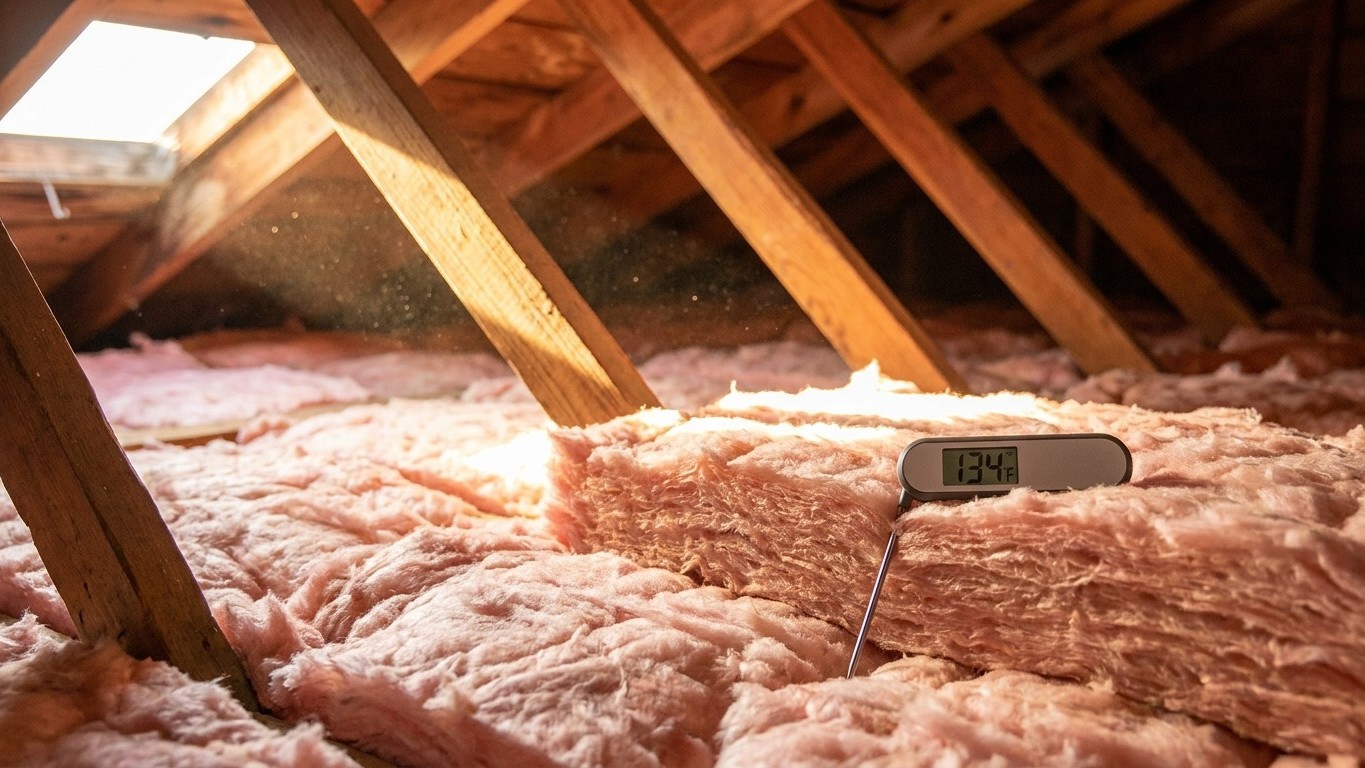
Roofing material sitting in direct sun does not stay at outdoor air temperature. Dark shingles can run 50 to 70 degrees hotter than the surrounding air on a clear summer afternoon, and that heat radiates straight down into the attic below. An unshaded attic can turn into the hottest space in the entire house, easily topping 130 F even when the thermometer outside reads a comfortable 80. Everything under that roof deck, the ceiling drywall, any HVAC ductwork routed through the attic, stored boxes, sits underneath that heat load and absorbs it slowly, hour after hour.
Ceiling insulation is the barrier between that superheated attic and the living space below. It’s worth being clear about something people get backwards: this isn’t a “winter” product that happens to also do something in summer. It’s a resistance to heat flow, full stop, and in July that flow runs downward, from the hot attic into the cooler house. The same fiberglass or cellulose that keeps warm air from escaping in January is doing the reverse job in August, keeping attic heat from soaking into the ceiling below.
ENERGY STAR’s retrofit targets by zone
ENERGY STAR publishes recommended insulation levels for retrofitting existing wood-framed homes, organized by climate zone, with figures for attic insulation depending on what’s already there, plus a separate figure for floors over unheated spaces. These are retrofit numbers for existing homes, not new-construction code minimums, and the source groups Washington’s zones together in one row:
| Zone | Attic if uninsulated | Attic if you already have 3-4 inches | Floor |
|---|---|---|---|
| Zone 1 | R30 | R25 | R13 |
| Zone 2 | R49 | R38 | R13 |
| Zone 3 | R49 | R38 | R19 |
| Zones 4A and 4B | R60 | R49 | R19 |
| Zones 6, 5, and 4C | R60 | R49 | R30 |
| Zones 7 and 8 | R60 | R49 | R38 |
Every zone found in Washington, 5B, 4C, 5C, and 6B, falls under that “Zones 6, 5, and 4C” row: R60 for an uninsulated attic, R49 if you’ve already got 3 to 4 inches down, and R30 for the floor. That’s the table row that applies across the state, from the wet side to the dry side. Confirming which zone applies to a specific county still means checking the ENERGY STAR map or a county-level table, since a homeowner buying the wrong depth of material is buying the wrong project.
What homes in Washington cool with
According to EIA’s 2020 Residential Energy Consumption Survey, 53% of Washington households use some form of air-conditioning equipment. Only 30% of households run a central air-conditioning unit. The other 25% rely on individual equipment: ductless mini-splits, window units, wall units, or portables. That 23-point gap between “has air conditioning” and “has central air” is the real story, and it tells you something about how this state’s building stock developed, a lot of homes here were built in an era, or a climate, where central air wasn’t assumed the way it is in the Southeast.
Ceiling fans show up in 44% of homes, which fits a state where moving air is often enough to solve a mild-heat problem that central cooling would be overkill for.
All of those percentages describe a share of households surveyed, not a share of houses standing, and none of them are zero even when small, a suppressed or unreported figure in this kind of survey never means nobody has the equipment.
Here’s where insulation and cooling equipment connect, and where they don’t. In homes with central air where the ducts run through the attic, that ductwork sits inside the hottest space in the building, the same space discussed above. Ceiling insulation does nothing to protect ducts already up there; sealing and insulating the ducts themselves is a separate job, covered on this site’s duct insulation guide. In homes cooling with a window unit or a mini-split, the insulation and air-sealing of that one room’s envelope is what actually determines how hard the unit has to work, a topic covered in the room air conditioner guide.
What the heat asks for that the cold does not
Two things belong specifically to hot climates, and neither applies uniformly to a state with three hot days a year at its reference station.
A radiant barrier is a reflective layer installed under the roof deck to bounce radiant heat back out before it ever reaches the attic insulation. It carries no R-value of its own, it is not a substitute for insulation, and its entire value proposition depends on a roof deck baking in direct, sustained sun. For most of Washington, given a summer heat load this small, a radiant barrier is not the tool the house is asking for; that money is better spent bringing the attic insulation up to the R60 target discussed above. In the drier, warmer zone 4C counties, a radiant barrier deserves more consideration, but it’s still a secondary measure behind getting the basic insulation depth right.
The second thing is moisture direction. In a warm, humid climate, water vapor pressure runs from the hot, damp outdoors toward the cooler, drier indoors in summer, the opposite of how it moves in winter. That’s why the model energy code doesn’t require an interior vapor retarder in the country’s warmest, most humid zones, it would trap moisture on the wrong side of the wall. Washington’s zone mix, split between marine and dry designations, doesn’t fit that warm-humid pattern the way the Gulf Coast does, and vapor barrier placement here follows its own logic. That’s a decision this territory’s vapor barrier page is better positioned to walk through than a summer-heat overview.
What the work is worth
ENERGY STAR puts a number on this, and it’s worth quoting exactly rather than rounding it into something looser: “EPA estimates that homeowners can save an average of 15% on heating and cooling costs (or an average of 11% on total energy costs) by air sealing their homes and adding insulation in attics, floors over crawl spaces, and accessible basement rim joists.”
Both figures matter, and they’re measuring different things. The 15% applies to heating and cooling costs specifically. The 11% applies to total energy costs, the wider bill that includes water heating, appliances, and everything else running on the meter. Neither number is a promise for one specific house; both come from energy modeling of a typical existing U.S. home, and a well-sealed newer home or a leaky older one will land on either side of that average.
Notice where the work is modeled: attics, floors over crawl spaces, and accessible basement rim joists. Not walls. Not windows. Not doors. That’s a deliberate scope, and it’s precisely the reason this figure covers heating and cooling together rather than one season alone. In a state like Washington, where the summer heat load is small at the reference station but real on the days it shows up, and where the same attic project pays back through a long, mild winter as well, that combined framing is the accurate one. The saving isn’t a winter number that happens to carry into July. It’s one job, counted honestly across both seasons.