
Cucumber seed doesn’t pause and wait for better conditions when the ground is cold. It swells with moisture, stalls, and starts to rot before it ever cracks open. That’s the real reason gardeners who sow “on schedule” often end up reseeding two weeks later, while the neighbor who waited for warm soil is already picking fruit.
What is actually going on

Air temperature is what people feel and what forecasts report, but it’s a poor stand-in for what a cucumber seed actually experiences. The seed sits an inch or so below the surface, surrounded by soil that heats and cools far more slowly than the air above it. A warm afternoon can push the thermometer into the 70s while the soil at planting depth is still sitting in the 40s or low 50s, especially early in the season when the ground has spent months losing heat to winter.
Cucumbers are warm-season cucurbits, and their germination biology reflects that. Seed sown into soil below roughly 60°F takes up water through a process called imbibition, but the internal chemistry that should follow, the enzyme activity that breaks down stored starches into usable energy, barely functions at those temperatures. The seed sits swollen and vulnerable. Soilborne fungi that cause damping-off and seed rot thrive in that exact window: cold, wet, and slow-draining. By the time a gardener notices nothing has come up, the seed is often already compromised.
This is where the “second sowing catches up” pattern comes from. A batch planted into 55°F soil might take three weeks to limp up, if it comes up at all, and much of that time is really rot and replanting rather than growth. A batch sown two or three weeks later into soil holding steady at 70°F can germinate in less than a week and grow without the setback of chilling injury, which damages cell membranes even in seeds that technically survive the cold. The later planting isn’t behind. It’s often ahead, because it never lost time to a false start.
This holds true across cucumber types. Pickling types, slicing types, burpless varieties, parthenocarpic types that don’t need pollination, bush habits bred for containers, and long vining types all share the same cucurbit germination physiology. None of them get a pass on soil warmth because of how the fruit is used or how the vine grows. For which specific types perform well in a given region, a state extension service’s variety trial data is the reliable source, not a seed rack display.
In the garden
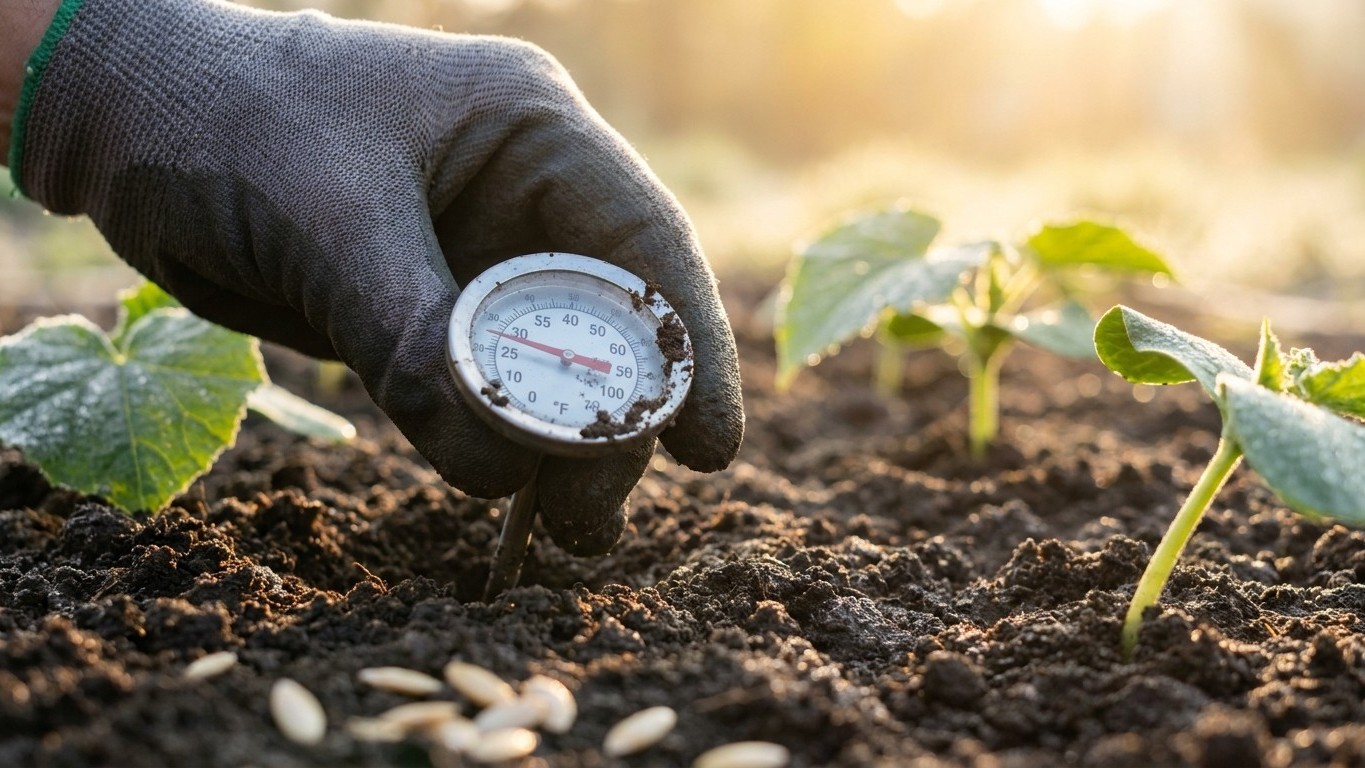
Judging soil temperature doesn’t require guesswork, and it doesn’t require expensive equipment either. A basic soil or meat thermometer pushed to the depth you intend to plant, checked in the morning over three or four consecutive days, gives a far more honest answer than a calendar ever will. Some gardeners use volunteer weeds as a rough signal: when purslane or lambsquarters starts germinating on its own in a bed, the soil has usually crossed into cucumber-friendly territory. It’s not a precise substitute for a thermometer, but it’s a useful gut check.
The table below breaks down what tends to happen at different soil temperature ranges, and what to do when a reading falls short.
| Soil temperature at planting depth | What happens | What to do instead |
|---|---|---|
| Below 50°F | Seed absorbs water but rarely germinates; high risk of rot before any sprout appears | Hold seed, wait for a sustained rise, or start seed indoors under controlled warmth |
| 50°F to 59°F | Germination is slow and uneven, sometimes taking two to three weeks; surviving seedlings are often weak and slow to establish | Delay sowing; use black plastic mulch or a low tunnel to raise soil temperature faster |
| 60°F to 64°F | Marginal zone; germination happens but is inconsistent from seed to seed | Acceptable if temperatures are clearly trending upward, not if they’re plateaued or falling |
| 65°F to 95°F | Fast, even germination, typically within three to seven days depending on conditions | This is the target window; proceed with direct sowing or transplanting |
| Above 95°F | Germination can actually slow again, and young seedlings may show heat stress | Water consistently and consider light afternoon shade for newly emerged seedlings |
The pattern worth internalizing is that sowing “too early” doesn’t just risk a slow start. It risks a full loss that requires buying more seed and starting over, which is where the real time gets lost. A gardener who waits an extra ten days for soil to firmly settle into the 65°F-plus range almost always harvests sooner than one who gambled on an early date and had to replant.
Raising soil temperature without waiting on the weather
Black plastic mulch laid over a bed for a week or two before sowing can raise soil temperature several degrees by trapping solar heat at the surface. Raised beds also warm faster than ground-level rows because they drain better and expose more surface area to sun. Neither trick replaces the need to actually check the soil, but both can shave meaningful time off the wait in a slow spring.
What it depends on where you are
Everything above, the mechanism, the temperature ranges, the rot risk, is biology and applies the same way regardless of zip code. What differs by location is when those soil temperatures actually arrive, how long they last, and how much margin a gardener has before summer heat or fall frost closes the window on the other end.
Season length is the obvious variable. A grower in a region with a long, hot summer has room to wait an extra two or three weeks for soil to warm without threatening the harvest window. A grower in a region with a short growing season is working with tighter margins, where the case for warming the soil artificially, through black plastic, cold frames, or raised beds, becomes stronger simply because there’s less slack to lose to a failed early sowing.
Summer heat intensity and rainfall patterns matter too, in ways that aren’t uniform across the country. Regions with heavy clay soil and frequent spring rain tend to stay cold and wet longer than sandy or well-drained soils even at the same latitude, which means two gardens at similar elevation and similar last-frost dates can still be weeks apart in when their soil actually crosses into cucumber-friendly territory. Humidity and rainfall also affect how fast fungal seed rot spreads once cold, wet conditions set in, which is a regional risk factor this page has no way to quantify for any specific place.
None of that can be answered generically, and this page won’t pretend otherwise. The state-level pages in this cucumber guide series cover regional timing patterns in more detail, and a state extension service, often through a county office, publishes soil temperature data and locally trialed variety recommendations that reflect actual conditions on the ground rather than a national average.
The mistake that costs the most
The single most expensive habit in cucumber growing is sowing by a date on a calendar instead of a reading from the soil. It’s an understandable habit. Seed packets print planting windows, garden centers stock transplants on a schedule, and “plant after last frost” gets repeated so often it starts to feel like a rule rather than a rough guideline built around air temperature, not soil temperature.
The cost shows up in stages. First, the seed sits in cold, wet ground and rots, or germinates so weakly that the seedling never really establishes. Second, the gardener has to buy more seed and replant, which by itself erases any head start the early sowing was supposed to provide. Third, and this is the part that gets missed, seedlings that do struggle through cold soil often emerge stressed, and stressed young cucumber plants are more vulnerable to early-season pest pressure, including cucumber beetles, which can also spread bacterial wilt. A rough start doesn’t just delay harvest. It can compromise the whole plant’s resilience for the rest of the season.
The fix costs nothing but a few days of patience and a thermometer. Check soil temperature at planting depth across several consecutive mornings rather than relying on a single warm afternoon. Wait for a consistent reading in the mid-60s or higher before direct sowing any cucumber type, whether it’s a pickling, slicing, burpless, parthenocarpic, bush, or vining variety. If the season is short and the wait feels risky, warm the soil artificially with plastic mulch or a raised bed rather than gambling on cold ground. The calendar can tell a gardener roughly when to start paying attention. Only the soil can tell them when to actually plant.