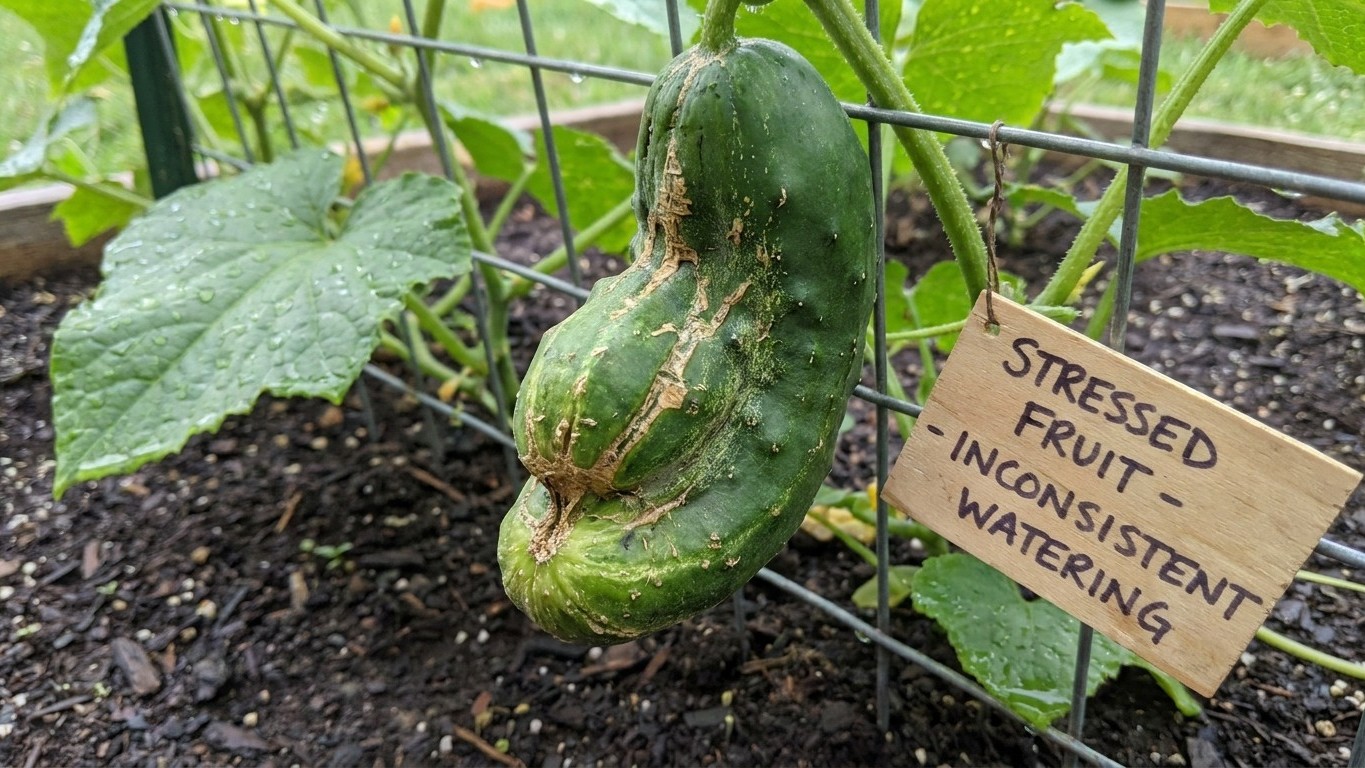

Cucumbers need about one to one and a half inches of water a week, delivered on a steady schedule rather than in one soaking after days of dry soil. The plant tolerates a lot of things, poor soil, some shade, crowding, but it does not tolerate a feast-or-famine watering routine, and the fruit shows the damage within days.
What is actually going on

A cucumber fruit is over ninety-five percent water. That single fact explains almost everything else about how this plant behaves. Unlike a tomato, which can pause fruit development and resume it without much visible penalty, a cucumber fruit is actively swelling with water on a near-daily basis during its growth window. Cut off that supply, even for a few days, and the plant does not simply slow down politely. It pulls water back out of the developing fruit to keep the leaves and roots alive, and the fruit shows it: pinched at one end, bitter-tasting, oddly bulbous, or just stalled at half size.
The mechanism is osmotic, not mysterious. Roots take up water and push it through the plant under pressure. When soil moisture drops, that pressure drops too, and the fruit, being the least essential organ from the plant’s point of view, loses out first. Then the rain comes, or someone finally drags the hose over, and the roots flood with water again. The fruit tries to catch up all at once. That’s the moment a cucumber splits down the side or develops a hollow, gappy interior. The damage isn’t from too little water or too much water. It’s from the swing between the two.
Bitterness works on a similar logic. The compounds responsible for that harsh taste, cucurbitacins, build up under stress and are normally diluted to unnoticeable levels by steady water flow through the fruit. Let the plant dry out repeatedly and that dilution stops happening, so the bitterness concentrates instead of washing through.
Type matters here more than variety name. Vining types, which put on long runners and a large leaf canopy, pull more water out of the soil per plant and dry out the root zone faster than compact bush types bred for containers and small beds. Parthenocarpic types, often grown under row cover or in greenhouses because they set fruit without pollination, tend to fruit more continuously, which means the water demand is more constant rather than coming in waves tied to flowering flushes. None of this changes the underlying rule. It changes how much buffer a gardener has before an irregular schedule turns into visible damage. For which types perform well in a given climate, a state extension service’s vegetable variety trial results are a better source than any name that shows up in casual gardening chatter.
In the garden
“Regular” water for cucumbers means the top two to three inches of soil never fully dry out between waterings, checked by hand rather than by calendar. In hot, dry stretches that can mean watering every day for container plants and every two to three days for in-ground beds; after a rainy week it can mean not watering at all. The schedule bends to the soil, not the other way around.
Water stress shows up in a specific order, and most of it is visible before the plant ever wilts outright. The table below walks through what appears first and what it means.
| Sign | What’s happening | What it means for the fruit |
|---|---|---|
| Leaf edges curl slightly upward at midday, recover by evening | Normal transpiration outpacing uptake in heat | Nothing wrong yet, but a signal to check soil moisture that day |
| Leaves stay curled or dull into the evening | Soil moisture has actually dropped below what roots can pull | Fruit already slowing its swelling; water within a day to limit damage |
| New fruit pinched or hook-shaped at the blossom end | Uneven water during the fruit’s active growth phase | That fruit won’t straighten out; it’s a marker of past stress, not a current fix |
| Fruit tastes bitter near the stem end | Cucurbitacin buildup from repeated dry stretches | Affects that fruit only, but signals the whole plant has been swinging wet-dry |
| Fruit splits along its length after a big drink | Sudden rehydration after a prolonged dry period | Fruit is a loss; the fix is preventing the swing next time, not this fruit |
| Whole plant wilts even with damp soil visible at the surface | Root system compromised or root zone too shallow from shallow, frequent watering | Points to a watering-depth problem, not a watering-frequency one |
That last row catches a lot of well-meaning gardeners. Watering a little bit every single day keeps the surface damp but trains roots to stay shallow, since they never have to reach down for moisture. A shallow root system is more exposed to heat and more vulnerable the day watering gets skipped. Deep, less frequent watering that soaks down six to eight inches builds a root system with some reserve built in, which is exactly the buffer that makes an occasional missed day survivable instead of costly. Mulch helps on both fronts: it slows evaporation from the surface, which narrows the gap between a good watering day and a bad one.
What it depends on where you are
The one to one and a half inch weekly figure is a national average, and it moves in both directions depending on three things: how long the growing season runs, how hot the summer gets, and how much of that water arrives as rain versus needing to come from a hose. A garden that gets regular afternoon thunderstorms through midsummer is working with a different baseline than one where July and August pass with barely a drop, and no single number covers both fairly.
Heat changes the math directly. Cucumber leaves lose water through transpiration faster as temperatures climb, especially past the mid-90s, and a plant transpiring faster needs more coming in from the roots to keep up. That’s a straightforward physical relationship, but it plays out differently depending on how long those hot stretches last in a given region and how much nighttime cooling the plant gets to recover. Wind matters too, since it accelerates the same evaporative loss from both soil and leaf surface, which is part of why an open, exposed garden bed dries out faster than one with some windbreak nearby.
Soil type is the other local variable, and it’s more about the specific plot than the region. Sandy soil drains fast and needs more frequent watering to hold that steady moisture band; heavy clay holds water longer but risks staying too wet after rain, which brings its own set of root problems. Raised beds and containers dry out faster than in-ground plantings almost everywhere, simply because there’s less soil mass buffering the roots against temperature and evaporation.
None of this is something a single national gardening page can responsibly pin down. Season length, typical summer rainfall, and heat patterns are tracked at the state level, and a state’s cooperative extension service publishes watering guidance, and often trial-tested variety recommendations, calibrated to that state’s actual conditions. That’s a more reliable next stop than trying to force a one-size answer onto a specific backyard.
The mistake that costs the most
The single most expensive mistake with cucumbers isn’t underwatering. It’s a rescue watering, the deep soak that shows up after several days of drought stress once a gardener finally notices the wilted leaves or catches up on a missed week. That one big drink, arriving after the plant has already pulled moisture out of its developing fruit, is what triggers the splitting and the sudden misshapen growth that gets blamed on “bad luck” or a supposedly weak variety. The variety was rarely the problem. The swing was.
The fix isn’t more water. It’s smaller, steadier applications on a schedule tied to soil moisture rather than to whenever the neglect becomes visible. Checking the soil two to three inches down with a finger, a few times a week, catches the drying trend before the plant shows any stress signs at all, which is a far cheaper habit than trying to undo the damage after fruit has already split or turned bitter. Mulch buys extra margin here, since it slows the rate at which soil dries out between checks, which matters most for anyone watering by hand rather than on an automated drip line.
This also argues for drip irrigation or a soaker hose over overhead sprinkling wherever it’s practical, not because sprinklers deliver less water but because they make consistency harder to maintain. A drip line on a simple timer removes the human forgetfulness that causes most rescue-watering situations in the first place, and it delivers water at the soil level where roots actually use it rather than onto leaves, which also cuts down on the damp-leaf conditions that favor fungal disease. For a gardener choosing between bush types in a container on a patio and vining types sprawling through an in-ground bed, that same principle holds regardless of type: steady beats generous, every time water and cucumbers are involved.