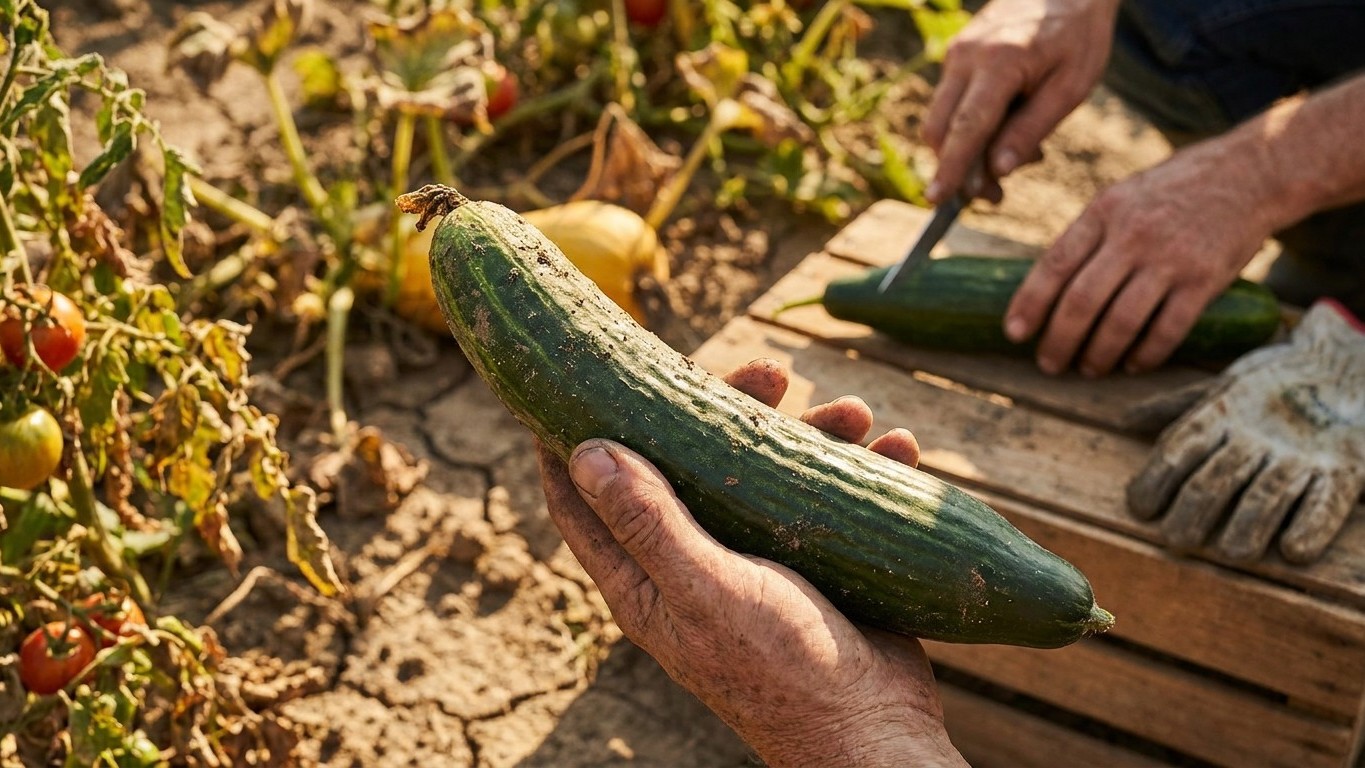

Bitterness in cucumbers comes from cucurbitacins, natural compounds the plant ramps up when it’s stressed, most often by heat, drought, or watering that swings between soaked and bone-dry. Variety plays a small role, but the bigger driver is what’s happening in the soil and the weather that week, not which packet the seed came from.
What is actually going on

Every cucumber plant carries the genetic instructions to make cucurbitacins, a family of bitter-tasting compounds that double as a natural pest deterrent. Under calm, steady growing conditions, the plant makes very little of them and routes what it does make into the leaves and stems, away from the fruit. Stress changes that routing. When a plant is short on water, baking in a heat spike, or struggling in compacted or nutrient-poor soil, it dials up cucurbitacin production and some of it ends up in the fruit itself.
The compounds don’t spread evenly. They concentrate at the stem end, the part nearest where the fruit attaches to the vine, and in a band just under the skin. That’s why a cucumber can taste sharply bitter at the top and mild everywhere else, and why peeling and trimming an inch off the stem end solves the problem more often than tossing the whole fruit.
Genetics does matter, just not the way most gardeners assume. Older open-pollinated types, especially some pickling and slicing lines bred decades ago, tend to carry a stronger baseline capacity for cucurbitacin production. Modern breeding programs, including many parthenocarpic and burpless types developed for greenhouse and home garden use, have selected for lower bitterness potential as a standing trait. But “lower potential” isn’t “none.” Put any of these plants under enough heat and drought stress, and the bitter response can still show up. That’s the detail that gets lost when people blame the seed packet: a type bred for mild flavor can still turn bitter in a bad year, and a type with no particular reputation can taste perfectly clean in a good one.
Bush and vining habit doesn’t change the chemistry directly, but it changes exposure. Vining plants sprawling on the ground often deal with more uneven soil moisture across their root zone than bush types grown in a contained bed, which is one reason gardeners sometimes notice a pattern that looks varietal but is really about root environment. Anyone choosing between types for a specific climate is better served checking with their state extension service, which trials cultivars regionally and can name what actually performed well nearby, rather than picking a name off a seed rack based on flavor promises alone.
In the garden
Bitterness rarely has one cause. It’s usually the accumulation of two or three stressors hitting the plant around the same time. Here’s how the main ones play out, and what happens when each goes unmanaged.
| Stress | What triggers it | What happens if ignored | What helps |
|---|---|---|---|
| Irregular watering | Deep soak followed by days of dry soil | Fruit tastes bitter at the stem end even on otherwise healthy vines | Even moisture on a consistent schedule, mulch to buffer swings |
| Heat spikes | Several days above the plant’s comfort range, especially with low humidity | Bitterness shows up across a whole flush of fruit at once | Afternoon shade cloth, harvesting slightly earlier during hot stretches |
| Poor soil fertility | Depleted or overly light soil, especially low in organic matter | Plants stay stressed all season, bitterness becomes the norm rather than the exception | Compost worked in before planting, steady feeding through the season |
| Root disturbance | Rough transplanting, cultivating too close to the root zone | A short-term bitter streak in fruit that sets shortly after the disturbance | Direct-seeding where possible, handling transplants gently, keeping cultivation shallow |
| Overripe or overgrown fruit | Fruit left on the vine past its prime | Bitterness concentrates along with tougher skin and larger seeds | Regular harvesting, picking on the smaller side rather than letting fruit sit |
Two of these deserve a second look because gardeners tend to underestimate them. Heat stress doesn’t need a record-breaking day to matter. A run of nights that stay warm, so the plant never really cools down, can be just as bitter-inducing as a single scorching afternoon, because the plant never gets a recovery window. And overripe fruit is sneaky: a cucumber can look fine on the outside and still have crossed into bitter territory internally, especially in types left a few days longer than intended for “just a bit more size.”
If a harvest does come in bitter, it isn’t automatically a loss. Peel the skin and trim an inch or so from the stem end, then taste a small piece before committing the rest to a salad or a pickle brine. Cucurbitacins are concentrated, not evenly distributed, so removing the worst-affected parts often rescues most of the fruit.
What it depends on where you are
Some of this is universal biology: the cucurbitacin response works the same way in a cucumber grown in a container on a balcony as it does in a quarter-acre garden plot. But the conditions that trigger it are entirely local, and that’s the part this page can’t answer for any specific reader.
Season length changes how much margin a gardener has. In regions with a short, mild growing window, cucumber plants may face fewer extended heat stretches, but a late cold snap or a short burst of drought can still hit at exactly the wrong developmental stage. In regions with a long, hot summer, the risk shifts toward sustained heat and the watering discipline needed to keep up with it, often for months rather than weeks.
Summer rainfall patterns matter just as much as temperature. A region with regular, evenly spaced rain does some of the moisture-management work automatically, while a region with sporadic downpours followed by long dry spells puts more pressure on the gardener to smooth out that swing artificially, through mulch, drip irrigation, or a watering schedule that doesn’t depend on the sky cooperating. Soil type interacts with both of these: sandy soils dry out faster and swing harder between wet and dry, while heavier clay soils hold moisture longer but can stress roots differently when they compact.
None of this is something a national gardening page can specify accurately, because it depends on a particular state, a particular soil, and a particular summer. The most reliable local answer comes from a state extension service, which tracks regional cucurbitacin risk factors, cultivar trial results, and seasonal rainfall data specific to that area. This site’s own state-level cucumber guides are built to fill that gap for regions covered so far, translating the general mechanism explained here into planting windows, watering guidance, and type recommendations suited to a specific climate rather than a national average.
The mistake that costs the most
The single most expensive mistake is treating watering as something to catch up on rather than something to keep steady. Gardeners who water heavily once or twice a week, especially during a hot stretch, are recreating the exact soak-then-drought cycle that pushes cucurbitacin production into the fruit. It feels efficient, one big watering instead of several small ones, but it’s the pattern most likely to turn an otherwise healthy plant bitter across an entire harvest, not just one fruit.
The fix isn’t complicated, but it does require a shift in habit. Consistent, shallower watering on a regular schedule, ideally paired with a couple of inches of mulch to slow evaporation, keeps the root zone in a narrower moisture band than an occasional deep soak ever can. Drip irrigation or a soaker hose on a timer removes the guesswork entirely, which matters most during the exact heat stretches when bitterness risk is highest and when a gardener is least likely to remember a manual watering can.
This matters more than cultivar choice, more than soil amendments, more than almost anything else covered here, because it’s the stress factor most directly under a gardener’s control and most commonly mismanaged. A type bred for low bitterness potential, whether pickling, slicing, burpless, or parthenocarpic, still depends on the plant experiencing steady conditions to express that trait. Choose a promising type based on a state extension trial, then back it up with watering discipline. Skip the second half, and the first one won’t save the harvest.