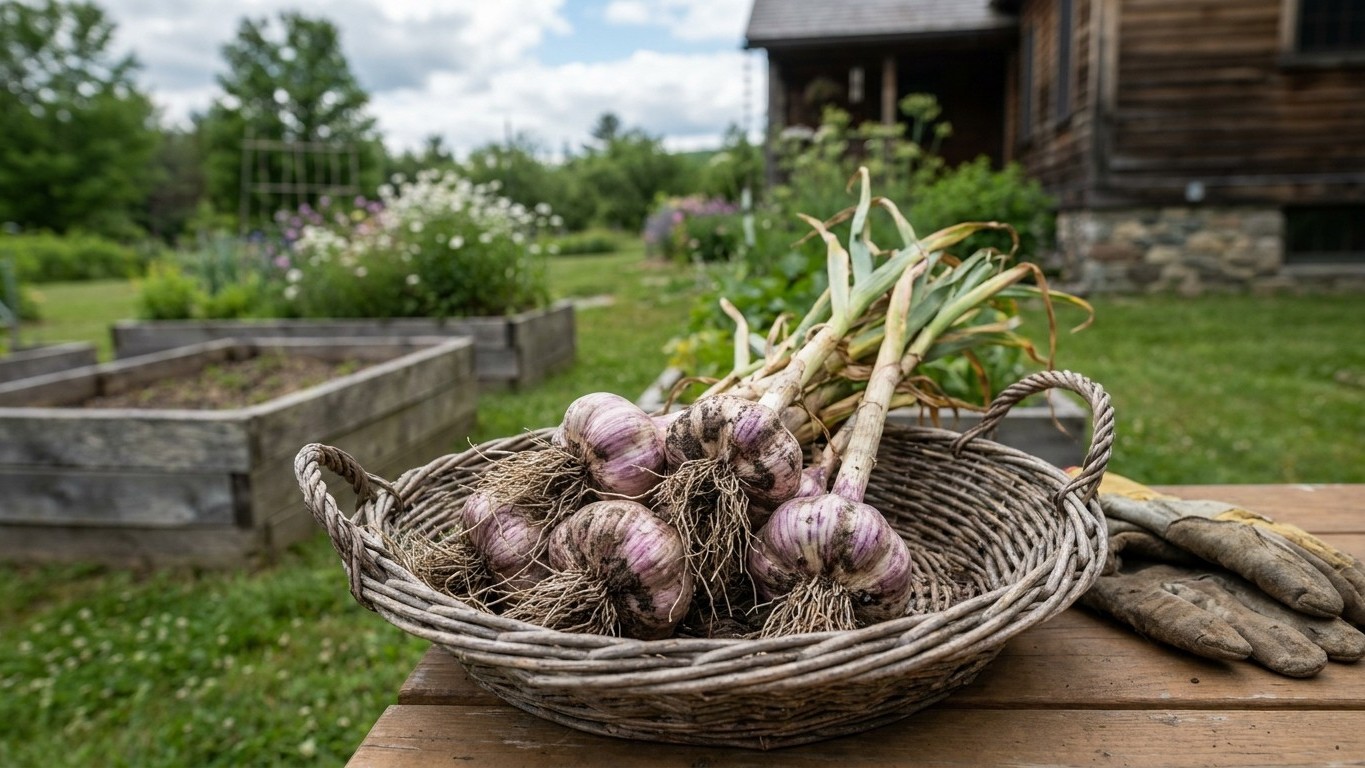

Garlic in Massachusetts comes out of the ground when the lower leaves have gone brown while the top few stay green, which usually lands somewhere in the second half of July into early August. Pull too early and the wrappers won’t have formed; wait too long and the bulb splits open in the soil. After lifting, plan on three to four weeks of curing in a shaded, airy spot before you trim, sort, and put bulbs away for the winter.
When garlic is ready to lift in Massachusetts
The calendar is a rough guide here, not a rule. What actually tells you a bulb is ready is the leaves themselves: garlic dies back from the bottom up, and each green leaf still standing corresponds to a paper-thin wrapper layer still intact around the bulb below. When the lower leaves have browned and collapsed but a handful up top are still green, that’s the signal to stop watering and start watching closely. Dig one test bulb before committing to the whole bed. If the cloves are plump and the skins around them separate into distinct, papery layers, the rest of the row is probably close behind.
Timing shifts year to year with how wet or dry the spring was and how warm June and July ran. A cool, damp spring pushes maturity later; a hot, dry stretch through early summer can pull it forward by a couple of weeks. Gardeners in the Berkshires and the colder Worcester County hill towns tend to see their beds mature a bit later than growers on the South Coast or around Boston, simply because the whole season starts later inland.
Why the planting date still matters in July
Massachusetts garlic goes into the ground the previous autumn, several weeks before the soil locks up for winter, and that fall planting window sets the clock for everything that follows. NOAA’s 1991-2020 climate normals for the Boston/Logan station put the average first fall freeze somewhere between November 3 and November 14. That’s a midpoint drawn from three decades of data, not a promise: in roughly half of those years, the freeze arrived later than that window, and in the other half, earlier. Gardeners who plant close to that midpoint, rather than waiting for the freeze to actually show up, give the cloves enough time to root before the ground hardens, which in turn sets a stronger, more even start the following July.
Stop watering the bed about a week before you expect to harvest. Wet soil at lift time means dirt clings to the wrappers, and that extra moisture on the bulb surface is exactly what invites mold once the garlic goes into curing.
Curing it, and where to hang it here
Curing is what turns a freshly dug bulb, still full of moisture, into something that will keep for months. The bulbs need airflow, shade, and time, roughly three to four weeks, before you trim roots and tops. Direct sun during this stage can scorch the wrappers and cook the outer cloves, so curing happens out of the light, not on a sunny driveway or a south-facing deck.
Massachusetts summers bring a stretch of humid, sticky weather right around harvest time, and that humidity is the main complication curing has to work around here. A garage with the door cracked, a barn with cross-ventilation, an open-sided shed, or a covered porch with a box fan running are the go-to spots for a lot of home growers in the state. Basements sometimes get used too, but only if there’s a dehumidifier or fan moving air through, since a still, damp basement will slow curing to a crawl and raise the odds of soft rot before the bulbs are even properly dried.
Signs curing is finished
Bulbs are cured, not just dry on the outside, when the neck just above the bulb has tightened down and gone papery, with no give or moisture left in it. The outer wrapper leaves should rustle rather than feel leathery. At that point, trim roots down close to the base and cut tops to an inch or two above the bulb, or leave them long and braid them if that’s your storage method. Set aside any bulb with a soft spot, a bruise, or discoloration at the neck. Those don’t belong in long-term storage; use them first.
Hanging garlic in bundles works well as long as there’s real air movement around each bundle, not bulbs packed tight against each other. Mesh bags or old onion sacks hung from rafters accomplish the same thing with less bulk. What doesn’t work in a humid Massachusetts summer is piling garlic on a countertop or laying it flat in a single closed box; without airflow underneath and around each bulb, the ones on the bottom stay damp far longer than the ones on top.
Storing it through a Massachusetts winter
Once cured, garlic wants a cool, dry, dark spot, ideally somewhere that holds a steady temperature rather than swinging widely with the outside weather. That’s a harder ask in a New England house than it sounds. Basements in older Massachusetts homes often run damp, which encourages sprouting and mold over the winter. Attached garages, on the other hand, can swing well below freezing during a hard January cold snap, and repeated freeze-thaw cycles damage cloves from the inside even when the bulb looks fine on the outside.
An unheated but insulated space, an enclosed porch, a mudroom closet, a pantry along an exterior wall, tends to split the difference better than either a wet basement or an uninsulated garage. Whatever spot you pick, mesh bags, loosely woven baskets, or old pillowcases keep air moving around the bulbs, which matters more once heating season kicks in and indoor humidity drops sharply. That drier winter air is actually an advantage for garlic storage, as long as the temperature doesn’t swing into deep freeze territory.
What to avoid
The refrigerator seems like an obvious choice and isn’t. Refrigerator humidity is high enough to trigger sprouting within weeks, and the cold plus moisture combination is worse for garlic than a merely cool room would be. Plastic bags and sealed containers cause the same problem by trapping the bulb’s own moisture against itself. Check stored garlic every few weeks through the winter, since one soft or moldy bulb sitting against its neighbors can spread rot through a whole bag faster than most people expect.
Softneck types generally outlast hardneck types in storage, often keeping well past the point where hardneck bulbs have started sprouting or softening, which is worth factoring in if you’re deciding what to plant again this coming fall for next year’s harvest.
What goes wrong here
Most garlic failures in Massachusetts trace back to moisture at the wrong stage, either in the ground right before harvest or in storage afterward. Neck rot shows up as a soft, water-soaked collapse right where the stem meets the bulb, usually the result of curing in a spot without enough airflow. Bulbs that were pulled while the soil was still wet, or that went straight into a sealed bag without curing at all, are the ones most likely to mold from the outside in over the following weeks.
Garlic itself isn’t a primary target for most of the insect pests that UMass Extension documents for gardens in this territory. Those documented pests include cabbage root maggot fly, Colorado potato beetle, European corn borer, lily leaf beetle, Mexican bean beetle, spotted lanternfly, squash bug, squash vine borer, striped cucumber beetle, and winter moth. None of them are garlic specialists. Where the list still matters is crop rotation: a garlic bed that follows squash, beans, or cabbage-family crops in the rotation can inherit some of those pests’ overwintering larvae or eggs in the soil, so the timing and layout of a rotation plan is worth thinking through even though garlic isn’t the pest’s actual host.
Physical damage during harvest causes more losses than any pest does. Nicking a bulb with a fork while digging opens a wound that mold moves into during curing, even if the bulb looked perfect coming out of the ground. Loosening soil by hand around the bulb before pulling, rather than yanking straight up, cuts down on that kind of damage considerably.
Common questions
Can garlic stay in the ground past when the leaves brown?
Leaving mature bulbs in the ground too long lets the wrapper layers degrade and the cloves separate underground, which shortens their storage life even if the garlic still tastes fine fresh. Once the lower leaves have died back and a test bulb shows well-formed cloves, it’s better to lift than wait.
Does hardneck or softneck garlic change the harvest timing?
The leaf die-back signal works the same way for both types. Where they differ is afterward, in storage: softneck garlic generally holds up longer over a Massachusetts winter than hardneck does.
Is a garage safe for curing garlic in Massachusetts?
It can work well in summer if the door stays cracked or a fan keeps air moving, since the goal during curing is airflow and shade, not cold. That same garage becomes a poor storage spot once winter cold snaps push temperatures well below freezing.
What temperature should stored garlic stay above?
The published facts here don’t include a specific storage temperature threshold for this territory, so no number is given. The practical guidance that holds regardless of exact degrees is to avoid a refrigerator’s damp cold and to avoid a space that freezes solid and thaws repeatedly through the winter.