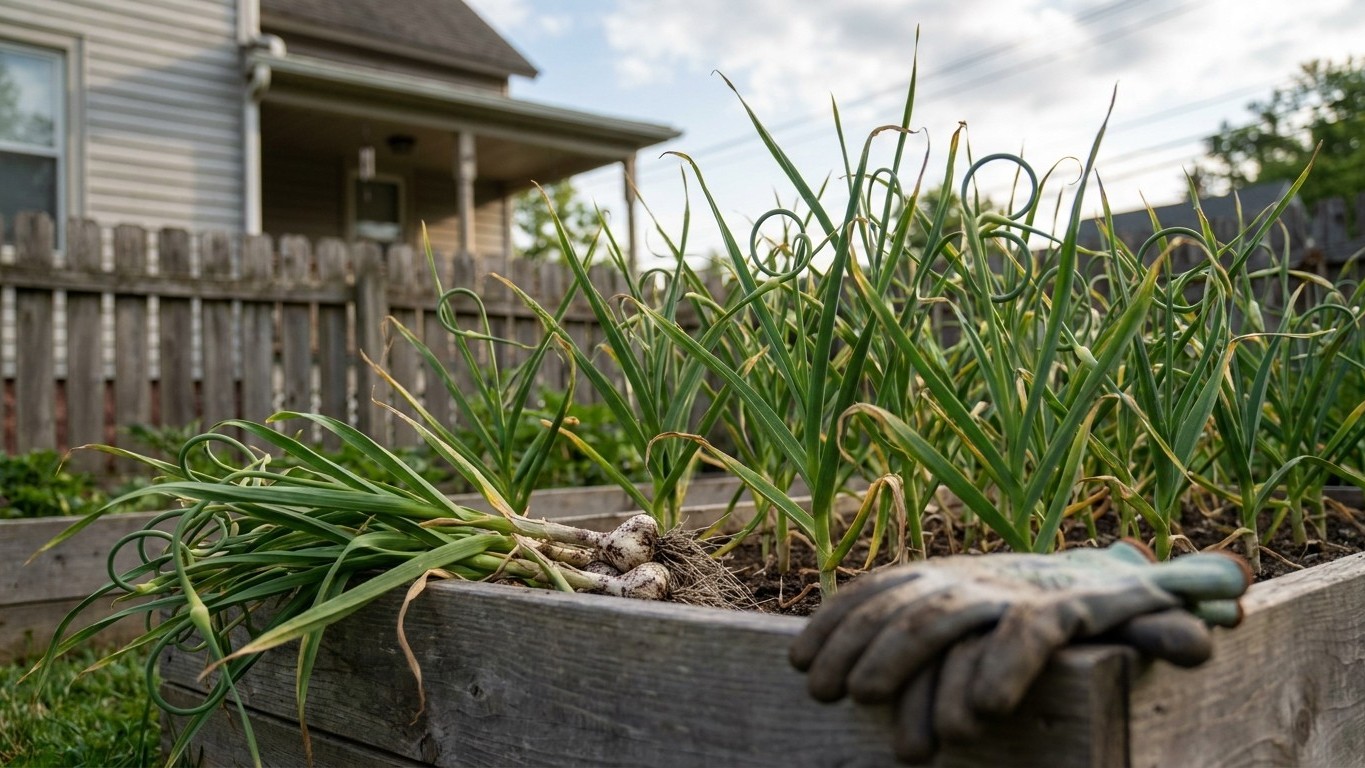

Garlic in Michigan goes into the ground mid September to late September, and that’s true whether you’re planting a softneck or a hardneck. That window gives cloves three to five weeks to grow roots before your first fall frost, which is what gets them through winter in good shape. Order your seed garlic now, pick a week in that mid-to-late-September stretch, and nudge it a few days earlier or later depending on whether your own soil runs heavy and slow or light and fast-draining.
The short answer for Michigan

For most of Michigan, garlic goes into the ground mid September to late September. That window is anchored on the Detroit-area first fall frost, which MSU Extension’s Michigan Garden Calendar places between October 6 and October 21 for zone 6a. Planting three to five weeks ahead of that frost gives cloves enough time to grow roots before the ground gets too cold for root growth, without pushing so much top growth that a hard freeze damages the shoot.
That frost window is a midpoint, not a guarantee. In roughly half of Michigan’s years, the first fall frost at Detroit falls after October 21, and in the other half it arrives before October 6. Treat late September as the planting target, not a date to push against. A garlic clove that’s rooted in before a frost is far better protected than one still sitting in dry soil when the first cold snap hits.
This date holds for every cultivar on the list below, from Inchelium Red to German White. Garlic doesn’t need a warm fall to grow top growth. It needs enough weeks of cool, workable soil to put down roots, and that’s what the mid-to-late-September window buys it in southeast Michigan.
Why this date can shift
The date moves because frost itself moves. A location just a few miles from the Detroit reference station, with different elevation or drainage, can run several degrees warmer or colder on any given night. That’s the reason this figure is described as a range rather than a single day, and why the arithmetic in the next section matters more than memorizing a calendar date.
Working it out for your own garden
The arithmetic is simple once you have a frost window to start from. Take the first fall frost date for your area, subtract three to five weeks, and that’s your planting window. For the Detroit-area figure MSU Extension publishes, October 6 to October 21, counting back three to five weeks lands squarely on mid September to late September, which is exactly why every cultivar below carries that same recommendation.
Why three to five weeks, not a fixed number
Garlic roots grow whenever soil temperature allows it, and that keeps happening for weeks after the air above has cooled. Three weeks is the minimum for a clove to anchor itself before winter. Five weeks gives it a head start with more root mass, which shows up as a sturdier plant in spring. Neither end of that range is wrong. Pick the earlier end if your soil is heavy clay and slow to warm and cool, and the later end if you’re on light, fast-draining sand that tracks air temperature closely.
If you garden away from the Detroit reference point, you need your own frost window before this calculation means much. Elevation changes it: gaining a few hundred feet in the northern Lower Peninsula typically brings a first frost earlier than a low-lying valley nearby at the same latitude. A large lake changes it in the other direction, since the Great Lakes hold summer heat into fall and delay the first frost for shoreline counties compared with inland ground close by. Both effects can move a local frost date by roughly two weeks in either direction from a regional average, enough to shift a planting window from September into early October, or the reverse.
Once you’ve picked a planting week, the cultivar you choose doesn’t change that timing, only what you’re planting. Every variety in the table below shares the same mid-to-late-September window for the Detroit area. The choice between them comes down to flavor, clove size, and whether you prefer a softneck’s braidable stalks or a hardneck’s easier-to-peel cloves.
| Variety | Type | Detroit-area planting window |
|---|---|---|
| Early Red Italian | Softneck | Mid to late September |
| Inchelium Red | Softneck | Mid to late September |
| Italian Late | Softneck | Mid to late September |
| Lorz Italian | Softneck | Mid to late September |
| Bavarian Purple | Hardneck | Mid to late September |
| Blue Music | Hardneck | Mid to late September |
| Chesnok Red | Hardneck | Mid to late September |
| Duganski | Hardneck | Mid to late September |
| Fall Festival | Hardneck | Mid to late September |
| Georgian Crystal | Hardneck | Mid to late September |
| Georgian Fire | Hardneck | Mid to late September |
| German Red | Hardneck | Mid to late September |
| German White | Hardneck | Mid to late September |
| Ivan | Hardneck | Mid to late September |
If you haven’t settled on which type suits your kitchen and your storage space, Garlic Varieties That Suit Michigan Winters breaks down the differences before you commit to seed stock. And if you haven’t prepped a bed yet or chosen a spot, Growing Garlic in Michigan covers that groundwork before this planting step matters.
What changes across Michigan
Michigan is long enough, and split enough by open water, that no single frost date describes it. The Detroit-area figures are only a starting point for the southeast corner of the Lower Peninsula.
Where it runs earlier
The Upper Peninsula and the higher, inland parts of the northern Lower Peninsula see their first fall frost well before the Detroit window. Elevation and distance from open water both work against these areas holding onto fall warmth, so gardeners there should expect to move their whole planting calendar earlier rather than trying to stretch the Detroit dates to fit.
Where it runs later
Counties along the Lake Michigan shoreline, and to a lesser extent the Lake Huron shoreline, benefit from the lake-effect delay that keeps fall air warmer near open water than it is a few miles inland. That’s the same effect that makes West Michigan’s fruit belt possible, and it can push a first frost later than the Detroit figure by a meaningful stretch in some years.
Southeast Michigan, including the Detroit area itself, sits in between: inland enough to avoid the strongest lake-effect delay but far enough south to avoid the earlier frosts of the north. That’s why the Detroit figures are used as the reference point here, not because they apply everywhere. Confirm your own area against county-level data before finalizing a date, especially if you garden within a few miles of a Great Lakes shoreline or well above the surrounding land in elevation.
Soil type compounds these regional differences. A sandy, fast-draining field in a lake-effect county still cools faster than a heavy clay field inland, so two gardens twenty miles apart can call for planting dates a week or more apart even after frost timing is accounted for.
The mistakes this climate punishes
Michigan’s winters run cold for a long stretch. University of Georgia Extension’s garlic publication (C854) counts roughly 26.1 weeks below 40°F in a typical winter here, well past the six to eight weeks garlic needs after planting to split into cloves. Under-chilling isn’t the risk in this state. The mistakes that actually cost a crop here are about timing and depth, not cold.
Planting too early
Set cloves out ahead of mid September and top growth can get well established before a hard freeze, especially in a warm fall. That exposes a hardneck’s stalk to freeze damage going into winter. Stick to the mid-to-late-September window even if a warm spell tempts you earlier.
Planting too late or too shallow
Wait until October and cloves may not get three full weeks to root before the ground turns cold enough to stall root growth, leaving a smaller root system going into winter. Planting shallow compounds it: a clove that isn’t set deep enough, or left without a mulch layer over it, is more exposed to frost heave through freeze-thaw cycles across a Michigan winter.
Skipping certified, disease-free seed stock
Garlic diseases arrive on the clove, not from the local climate, and Michigan’s fall and spring temperatures sit well inside the range where two of the most damaging ones are active. UC IPM’s guidelines for onion and garlic (UC ANR Publication 3453) put white rot‘s active range at 50 to 75°F, a band that covers five months of Michigan’s growing season including one right at the disease’s optimum, and Fusarium basal rot‘s range at 59 to 90°F, covering four months. Those are air-temperature figures compared against a published soil threshold, and a monthly average hides plenty of days above and below it, so treat this as a rough guide to risk rather than a forecast tied to one reference station. Neither figure means Michigan gardens are safe outside those months. Infected seed stock carries both pathogens regardless of season. Buying certified disease-free seed garlic, and rotating away from any bed that grew onions or garlic in recent years, matters more here than tracking a monthly temperature average.
Checking this against your county
The Detroit-area figures come from MSU Extension’s Michigan Garden Calendar, and MSU is the right place to check whether your county runs earlier or later. The MSU Extension directory lists county offices that keep local frost and planting data, and a call or visit to the office covering your county is the fastest way to confirm a date. If you garden more than about thirty miles from Detroit, or near a Great Lakes shoreline, treat this as a starting estimate and confirm locally before you order seed stock.
Common questions
What happens if I miss the September window and it’s already October?
Plant as soon as you can rather than waiting for spring. Since the Detroit-area frost date is a midpoint, MSU Extension’s window of October 6 to October 21 means frost hasn’t necessarily hit yet even into mid October, and a shorter rooting period still beats none at all. Add an extra inch or two of mulch to compensate for reduced root growth going into winter.
Can I Plant Garlic in spring instead of fall in Michigan?
You can, but expect smaller bulbs. Garlic needs an extended stretch of winter cold to divide into cloves, and fall planting lets a Michigan winter do that job naturally. Spring-planted garlic, even after cold storage, tends to produce smaller, less uniform bulbs than a properly fall-planted crop.
Does it matter if I plant hardneck or softneck varieties here?
Both types handle Michigan winters fine when planted on the same mid-to-late-September window. Hardnecks such as German Red, Duganski or Chesnok Red tend to be the more forgiving choice for a first-time grower dealing with heavy clay or a harsher microclimate, while softnecks like Inchelium Red or Lorz Italian store longer in the pantry once cured.
Should I mulch garlic over winter in Michigan?
Yes, a mulch layer over the bed helps even though Michigan’s winter cold is more than sufficient for garlic’s chilling needs. Mulch’s job here is buffering the freeze-thaw cycles that heave shallow-planted cloves out of the ground, not adding extra cold, so it matters most in years with little snow cover to insulate the soil naturally.
Some gardeners also time this by the Moon: when to plant garlic by the moon, as almanac tradition rather than fact.