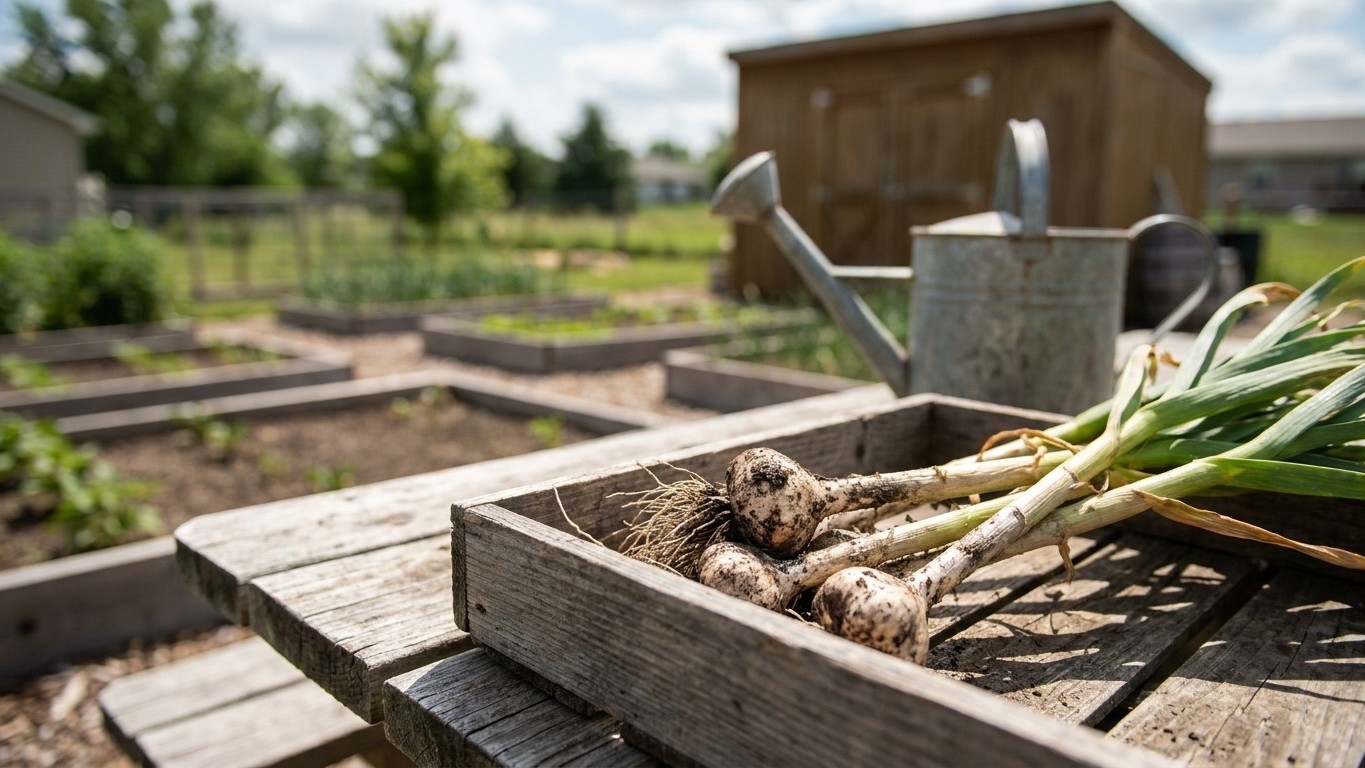

Garlic in Missouri comes out of the ground by leaf color, not by a date on the calendar. Most gardeners across the state lift bulbs sometime between late June and mid-July, when the lower third to half of the plant has browned but five or six upper leaves are still green. Wait for total collapse and you lose the papery wrappers that protect bulbs in storage.
When garlic is ready to lift in Missouri
The countdown actually starts the previous fall. Missouri garlic goes into the ground in October, roots through winter, then bulbs up the following summer once day length and soil temperature line up. That fall planting window matters more than most gardeners realize, because a clove that goes in too late doesn’t build the root mass it needs before the ground locks up.
NOAA’s 1991-2020 Climate Normals put the first fall freeze at Kansas City International Airport somewhere between October 18 and October 29, based on the 32-degree freeze probability band. That’s a midpoint, not a guarantee. In one year out of two, the first freeze arrives later than that window. Treat it as a planning marker, not a green light to procrastinate. The station itself sits well north of downtown Kansas City, which tends to see its first freeze roughly five days later, and southern Missouri counties run milder still. A clove planted at that midpoint has roughly eight months underground before it’s ready to lift, weather permitting.
Come harvest season, the signal to watch is foliage, not the thermometer. Garlic tells you it’s done by dying from the bottom up. Once three to four lower leaves have browned and the plant still holds a handful of green leaves up top, dig one test bulb from the row. Slice it in half. The cloves should fill out distinct segments with wrappers still intact around each one. If the bulb looks smooth and undivided, give the patch another week.
Southern Missouri gardens, with their milder winters and earlier spring warm-up, often reach this point a week or so ahead of gardens in the northern part of the state. That’s a general pattern tied to the same freeze-date variation NOAA tracks for fall planting, not a fixed rule you can circle on a calendar. Soil type shifts things too. Heavier clay soils in parts of the state hold moisture longer into early summer, which can push bulb maturity a few days later than in well-drained loam.
Lift with a garden fork, not by pulling. Loosen soil a few inches out from the stalk and lever bulbs up gently. Pulling on dry-topped stalks in compacted Missouri clay snaps necks clean off, and a bulb without its neck won’t cure or braid properly.
Curing it, and where to hang it here
Curing is the step that turns a fresh-dug bulb into something that lasts through winter. It’s a slow dry-down, not a quick rinse and shelf job. Freshly lifted garlic still carries moisture in its neck and wrapper layers, and that moisture has to leave gradually or the bulb rots from the inside before it ever gets stored.
Skip the hose entirely. Brush loose soil off with a dry hand or soft brush and leave roots and tops attached. Cutting them fresh invites rot to travel straight into the bulb. Lay or hang bulbs somewhere shaded, out of direct sun, with air moving freely around them. A garage with the door cracked, a covered porch, or a shed with a box fan running all work fine. Direct sunlight is the one thing to avoid outright, since it can scorch wrappers and cook cloves sitting just under the surface.
Fighting Missouri’s humidity during cure
This is where the state’s summer weather works against you. Missouri summers run humid, and stagnant, damp air is exactly what slows curing down and invites mold onto the outer wrappers. A small fan pointed across hanging bulbs, rather than directly at them, keeps air exchanging without drying things unevenly. In a particularly muggy stretch, a household dehumidifier running in the curing space for a few hours a day makes a measurable difference. Space bulbs apart from each other, whether they’re braided, bundled, or laid on a mesh screen, since bulbs touching in a humid garage cure unevenly and trap moisture between them.
Curing typically runs three to four weeks. You’ll know it’s finished when the outer wrappers turn papery and dry, the neck above the bulb has tightened down, and roots have shriveled to dry threads. Only then should you trim tops down to an inch or so above the bulb and cut roots close. Trimming too early, while the neck is still green and full of moisture, opens a channel for rot to reach the cloves before they’ve had a chance to seal.
Storing it through a Missouri winter
Once cured, garlic wants cool, dry, dark, and airy conditions, and Missouri’s own seasonal swings make some spots in the house better than others. A basement corner away from a furnace, a mudroom, or an unheated pantry along an exterior wall tend to hold steadier conditions than a kitchen cabinet near the stove, where warmth and steam shorten storage life fast.
Mesh bags, loosely woven baskets, or hanging braids all work because they let air move around each bulb. Sealed plastic bags or airtight containers trap the small amount of moisture bulbs still release, and that’s often the fastest route to a soft, sprouting bulb by midwinter. Softneck varieties, more common in home gardens for their storage life, generally hold six to eight months under good conditions. Hardneck types, prized for flavor, tend to soften and start sprouting sooner, often within four to five months.
What to check through the season
Garlic in storage isn’t a set-it-and-forget-it crop. A quick check every few weeks catches problems before they spread through the whole batch.
- Soft or mushy bulbs: pull and discard immediately, since rot spreads to neighboring bulbs in a shared basket or braid
- Green sprouts pushing through the top: still edible, but use those bulbs first since flavor and storage life drop fast once sprouting starts
- Papery wrappers flaking off entirely: not a problem on its own, but it means that bulb has lost some protection and should move up in the use-it-soon pile
- Condensation on a storage bin or bag: a sign the space is too humid, and bulbs should move somewhere drier before mold sets in
Winter temperature swings inside a Missouri home, especially near exterior walls or unheated additions, can push storage areas colder than ideal for stretches. Garlic tolerates cool conditions well down into the 30s and 40s, but repeated freeze-thaw cycles right at the bulb’s surface can affect texture over time. A spot that stays consistently cool, rather than one that swings widely with outdoor temperatures, holds bulbs better through a full Missouri winter.
What goes wrong here
Most storage failures trace back to one of two mistakes: harvesting at the wrong moment, or curing in conditions too damp to finish the job. Pulling bulbs while most leaves are still green gives you undersized, underdeveloped cloves. Waiting until every leaf has collapsed means the protective wrapper layers have already started to split apart underground, leaving bare cloves exposed to soil moisture and rot organisms right up until harvest day.
Missouri’s humid summers deserve real blame here too. A cure that looks finished after two weeks in a stagnant, muggy garage often isn’t. Bulbs that seem dry on the outside can still hold moisture in the neck, and that hidden dampness shows up weeks later as soft spots deep in storage. Running airflow through the curing space, whether that’s a fan, an open shed door, or a dehumidifier on the worst days, isn’t optional in this climate the way it might be in a drier region.
University of Missouri Extension tracks regional pest pressure through its IPM program, and the documented pests for Missouri gardens include bagworms, the brown marmorated stink bug, cucumber beetles, the hunting billbug, Japanese beetle, spider mites, the squash bug, squash vine borer, and both tobacco and tomato hornworm. None of these target garlic bulbs directly, but several share garden space with garlic in mixed vegetable beds, and a heavy infestation on neighboring crops can pull attention and resources away from monitoring the garlic patch at exactly the point in summer when it needs a final check before harvest. Gardeners running a mixed plot benefit from checking University of Missouri Extension resources for regional pest timing rather than guessing.
The other recurring problem is storage location drift. A bulb cured perfectly in a shaded garage sometimes ends up stored in a warm kitchen cabinet out of convenience, and that single change in temperature and airflow undoes weeks of careful curing within a month or two.
Common questions
Can I harvest garlic early if I need the space in the garden bed?
Pulling bulbs before the lower leaves have started browning gives you smaller cloves with underdeveloped wrappers, and those bulbs won’t store nearly as long. If bed space is tight, a test dig tells you exactly where the bulbs stand rather than guessing.
Does washing garlic before curing speed things up?
It does the opposite. Washed bulbs hold surface moisture that slows the dry-down and increases the chance of mold forming on the wrappers before curing finishes. Brush soil off dry and leave the bulb intact.
How long does curing take in a humid Missouri summer compared to a dry climate?
Three to four weeks is typical here with decent airflow, sometimes longer in a stretch of especially humid, still weather. A fan or dehumidifier in the curing space shortens that gap by keeping air moving instead of letting moisture sit around the bulbs.
Is a root cellar necessary for storing garlic through winter?
No. A cool, dry basement corner, an unheated pantry, or a mudroom away from heating vents works fine as long as air can move around the bulbs. What matters more than the specific room is avoiding sealed containers and steady exposure to kitchen humidity or warmth.