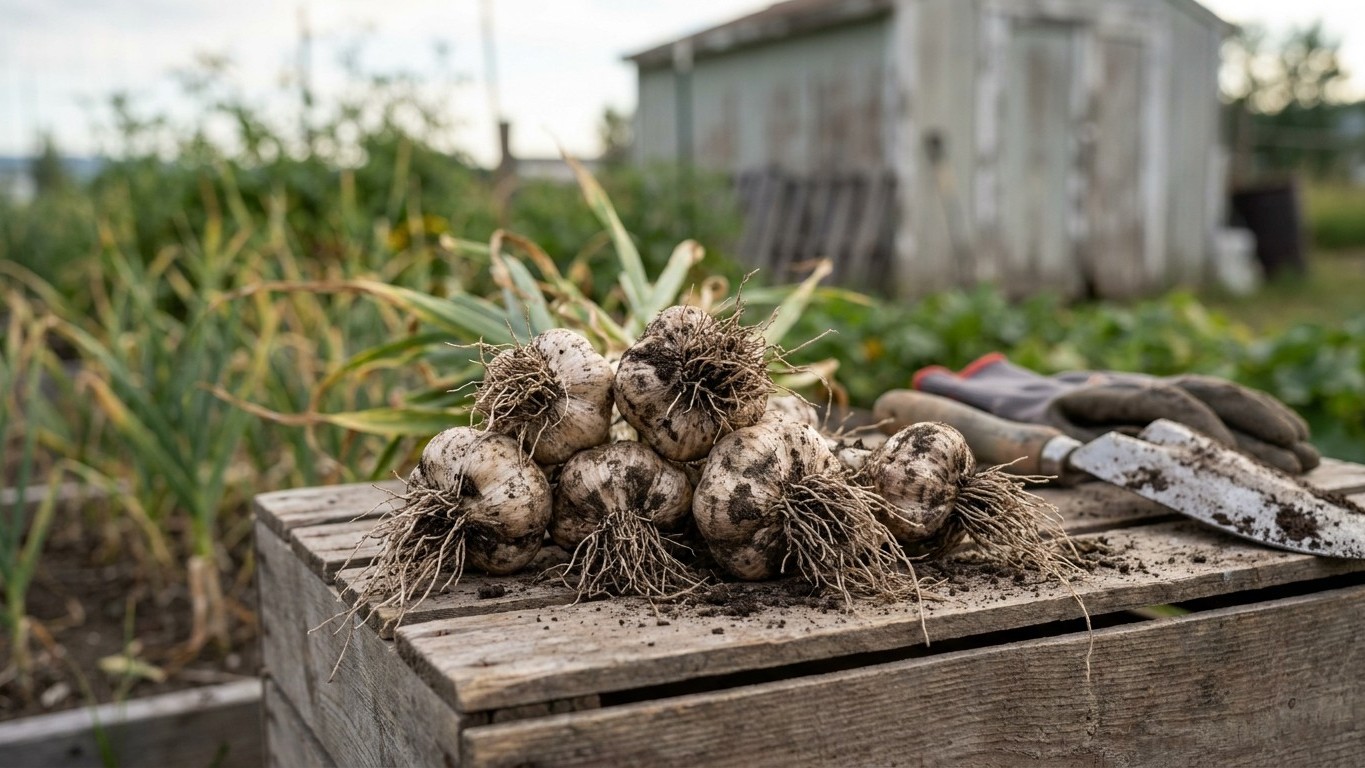

Sometime in the first three weeks of September, and no later than the month’s end — that’s when garlic cloves belong in Montana ground. The exact day depends on how early your yard turns cold, since frost settles into low spots and high ground well before it reaches the valley floor. Walk your own property before you pick a weekend: note where frost lingers on fence lines or low corners in fall, and plant there first, working outward as the season allows.
The short answer for Montana

Plant garlic cloves in early September to late September. That window is built around the first fall freeze recorded at Billings, which NOAA’s 1991-2020 Climate Normals from the National Centers for Environmental Information (NCEI) place between October 1 and October 14. Garlic wants roughly four to six weeks of root growth in the ground before the soil freezes solid for the season, so counting back from that freeze date lands you in the first three weeks of September at the earliest and the closing days of the month at the latest.
That October 1 to October 14 span is a midpoint, not a guarantee. NOAA’s normals describe the range where the probability of a 32°F freeze sits between 30 and 70 percent across three decades of Billings records. In roughly half of those years the first freeze arrived earlier than this range, and in the other half it arrived later. Treat late September as your backstop rather than your target if you want cloves with real root mass in place before the ground locks.
The date does not shift by cultivar. A softneck type and a hardneck type planted for this state both want the same early September to late September window, because what actually varies between cultivars is how many days they need to finish bulbing the following summer, not how many weeks a clove needs to root in before winter. That difference matters for harvest planning, covered on Growing Garlic in Montana, but it does not move the planting calendar.
Working it out for your own garden
The arithmetic is simple once you have a frost date to anchor it. Start from Billings’ first fall freeze of October 1 to October 14, per NOAA’s 1991-2020 Climate Normals, and subtract garlic’s four to six week rooting requirement.
Doing the math from Billings
Count back four weeks from October 1 and you land near the last week of August moving into the first days of September. Count back six weeks from the far end of the range, October 14, and you land near the very end of August. Run the arithmetic across the whole span and early September through late September covers every reasonable calculation, which is why that is the window given for each cultivar sold for this state rather than a single date.
Your own garden is not Billings, and NOAA’s figure is a reference point, not a forecast for your yard. Elevation is the biggest single factor: gain a few hundred feet and cold air that would otherwise drain away tends to pool, moving your effective first frost earlier than the valley-floor normal. A large body of water works the other direction. Ground near Flathead Lake, for instance, holds heat longer into fall than inland ground at the same elevation, which can push the first frost later than a Billings-based estimate would suggest. Neither effect has a published county-by-county figure attached to it here, so treat both as reasons to watch your own thermometer rather than reasons to distrust the Billings range outright.
Choosing among the listed cultivars
Because the set-out window is identical across cultivars, the choice between them comes down to neck type and what you want out of storage and flavor, not timing. The table below lists what is available for this state, with links to the ones that have their own variety page.
| Variety | Neck type | Set-out window (Billings-anchored) |
|---|---|---|
| Early Red Italian | Softneck | Early Sept to late Sept |
| Inchelium Red | Softneck | Early Sept to late Sept |
| Italian Late | Softneck | Early Sept to late Sept |
| Lorz Italian | Softneck | Early Sept to late Sept |
| Bavarian Purple | Hardneck | Early Sept to late Sept |
| Blue Music | Hardneck | Early Sept to late Sept |
| Chesnok Red | Hardneck | Early Sept to late Sept |
| Duganski | Hardneck | Early Sept to late Sept |
| Fall Festival | Hardneck | Early Sept to late Sept |
| Georgian Crystal | Hardneck | Early Sept to late Sept |
| Georgian Fire | Hardneck | Early Sept to late Sept |
| German Red | Hardneck | Early Sept to late Sept |
| German White | Hardneck | Early Sept to late Sept |
| Ivan | Hardneck | Early Sept to late Sept |
If you have not settled on a cultivar yet, the fuller breakdown of storage life, clove count and cold tolerance lives on Garlic Varieties That Suit Montana Winters.
What changes across Montana
Billings sits in one of the state’s milder valleys, and the NOAA figures above come from that one station. Mountain valleys elsewhere in Montana can see frost in any month of the year, which means a grower in one of those pockets should treat the Billings window as a starting guess to test against their own records, not a schedule to copy directly.
Elevation is the mechanism that matters most. Cold air is heavier than warm air, so it drains downhill overnight and settles in low ground, which is why mountain valley floors, river bottoms, and any garden sitting in a natural bowl tend to frost earlier and harder than a slope or a ridge just above them. A garden a few hundred feet higher in elevation than the valley floor nearby can actually see a later first frost than the bottomland below it, because the cold air keeps draining past rather than pooling.
Large water bodies push the other way. Ground near Flathead Lake holds summer heat into the fall longer than dry ground at a comparable elevation, which delays the first freeze for gardens close to the shoreline relative to inland sites nearby. None of this is quantified county by county in the NOAA dataset used here, so the practical move is to compare your own garden’s frost history, if you keep one, against the Billings range rather than assume either effect by feel.
The mistakes this climate punishes
The vernalization myth
Growers sometimes delay planting because they think the cloves need to catch the coldest part of winter to split properly. Billings-area winters average 30.4 weeks with a mean temperature below 40°F, which clears the six to eight weeks garlic needs to vernalize and divide into cloves several times over, according to University of Georgia Extension bulletin C854. Under-chilling is not a realistic risk in this state. The actual deadline is root establishment before the ground locks, and delaying planting to line up with deep winter cold works against that, not for it.
The mechanical mistakes cost more here than the biological ones. Planting too late leaves cloves with too little root mass to survive freeze-thaw cycles, and shallow planting lets frost heave push cloves partway out of the soil over winter, exposing them to desiccation and cold injury. A thick mulch layer, laid down before the first hard freeze and anchored against wind, covers both problems at once.
Disease pressure by month
Planting stock, not the calendar, carries most of garlic’s disease risk into a new garden. UC IPM’s Pest Management Guidelines for Onion and Garlic (UC ANR Publication 3453) publish temperature ranges for the pathogens that matter most, and matching those ranges against Billings’ monthly mean air temperatures across the September to July growing season gives a rough picture of pressure:
| Disease | Published range | Months inside range at Billings |
|---|---|---|
| White rot (Sclerotium cepivorum) | 50-75°F | 4: September, May, June, July (2 at optimum) |
| Fusarium basal rot (Fusarium oxysporum f. sp. cepae) | 59-90°F | 3: September, June, July |
| Southern blight (Sclerotium rolfsii) | 86-95°F optimum | 0 |
| Pink root (Setophoma terrestris) | 75-85°F optimum | 0 |
Read that table carefully. The published thresholds are soil temperatures, and the count above uses air temperature means, so treat it as a rough overlap, not a diagnosis. Soil lags air by weeks and swings far less day to day than the air does. A month with a mean in range does not mean the whole month sits there, since a September averaging in the 50s still holds days well above and below that figure. Billings is one station, and conditions in a mountain valley or an irrigated bottom elsewhere in the state will differ. Most important, a zero count for southern blight and pink root does not mean those diseases cannot occur. Infected planting stock carries any of these four pathogens into a garden regardless of the local climate, and staying outside a published optimum range only means the disease is less active, never that it is absent. Buying clean, certified seed garlic and rotating out of allium beds for a few years does more to manage this risk than any planting date can.
Checking this against your county
The NOAA figures in this article come from one station near Billings, and Montana’s climate varies enough county to county that a figure from one valley should not be stretched to cover the whole state. For a planting window closer to your own address, Montana State University Extension maintains county offices across the state that can point you to local frost records and garlic guidance specific to your district. That local check is worth the phone call before you settle on a planting weekend, particularly if you garden above roughly 4,500 feet or in a known frost pocket.
Common questions
Can I Plant Garlic in spring instead of fall in Montana?
You can plant in spring, but expect smaller bulbs with fewer, less-defined cloves. Fall planting lets the clove root through the cool season and gives it the long cold exposure that helps it divide properly before summer bulbing starts, and Montana’s winters supply far more of that cold than garlic actually needs.
What happens if I miss the September window?
You can still plant into October as long as the ground is workable and not yet frozen, but the clove will have less time to root before winter sets in. Mulch heavily and expect a somewhat weaker start in spring compared to cloves planted on schedule.
Should I plant a different variety at higher elevation, like around Bozeman?
Hardneck types such as Bavarian Purple, German Red or Duganski are generally the more cold-hardy category of garlic by catalogue description, which makes them a reasonable default choice for a harder winter site, though softneck types also survive Montana winters when planted on schedule and mulched well.
Do I need to mulch after planting?
Yes, mulch is standard practice in this climate. A layer of straw laid down before the ground freezes insulates cloves against freeze-thaw heaving, and it should be checked periodically through winter since wind can strip it off a bed well before spring.
The Moon calendar is a separate, older custom: see when to plant garlic by the moon, written as tradition rather than fact.