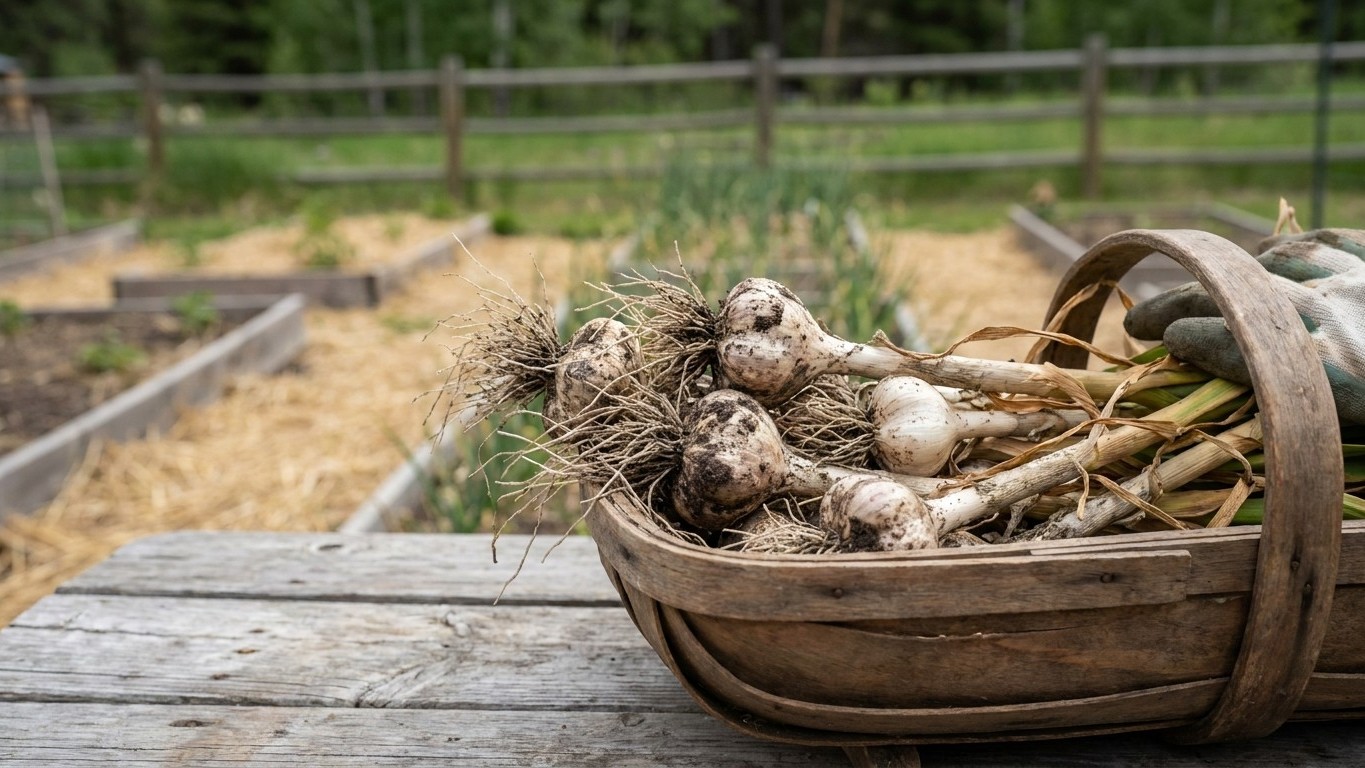

September is when Montana garlic goes into the ground, and cold is barely part of the decision — nearly any hardneck on this list, from Bavarian Purple to German White, will shrug off a Montana winter once it’s rooted. What actually decides success is timing: cloves need weeks of root growth before the ground freezes solid, not before the first frost touches the air. That gap between frost and freeze-up is the whole game, and it’s wider than most people planting garlic ever realize.
The short answer for Montana

For most of the state, the answer is straightforward: plant garlic in September, and pick almost any variety on this list, because winter cold is not the limiting factor here. NOAA’s NCEI 1991-2020 Climate Normals put the first fall frost near Billings somewhere between October 1 and October 14, a window built from three decades of freeze probabilities rather than a single date. That range is a midpoint, not a guarantee. In roughly half of all years frost arrives after October 14, and in the other half it comes earlier. Garlic does not care about that exact date the way a tomato does. What matters is that cloves go into the ground with enough time to grow roots before the soil locks up, not before the air first frosts.
Hardneck types bred for cold climates, among them Bavarian Purple, Blue Music, Chesnok Red, Duganski, Fall Festival, Georgian Crystal, Georgian Fire, German Red, German White and Ivan, are the safer default anywhere winter wind strips snow cover off exposed ground. Softneck varieties, including Early Red Italian, Inchelium Red, Italian Late and Lorz Italian, also overwinter here without trouble once mulched, and they tend to store longer in the kitchen once cured. Either group works across most of the state. The choice comes down to storage habits and how exposed your planting bed is, not survival.
| Variety | Type | Set-out window |
|---|---|---|
| Early Red Italian | Softneck | Early September to late September |
| Inchelium Red | Softneck | Early September to late September |
| Italian Late | Softneck | Early September to late September |
| Lorz Italian | Softneck | Early September to late September |
| Bavarian Purple | Hardneck | Early September to late September |
| Blue Music | Hardneck | Early September to late September |
| Chesnok Red | Hardneck | Early September to late September |
| Duganski | Hardneck | Early September to late September |
| Fall Festival | Hardneck | Early September to late September |
| Georgian Crystal | Hardneck | Early September to late September |
| Georgian Fire | Hardneck | Early September to late September |
| German Red | Hardneck | Early September to late September |
| German White | Hardneck | Early September to late September |
| Ivan | Hardneck | Early September to late September |
If you haven’t settled on bed prep and mulch yet, the overview on Growing Garlic in Montana covers that groundwork before you get to variety choice.
Working it out for your own garden
Counting back from your local frost window
Start with the freeze data for your own county, not the Billings figure by default. NOAA’s Climate Normals are recorded station by station, and the October 1 to October 14 window quoted above is measured at Billings specifically. Pull the closest NOAA station’s 1991-2020 normals for your own valley before you fix a planting week, since a neighboring valley thirty miles away can run a week or two ahead or behind it.
Garlic needs roughly four to six weeks in the ground before soil temperatures drop enough to stop root growth, and soil cooling generally trails the air frost by two to four weeks depending on moisture and snow cover. Counting back four to six weeks from a first-frost window of October 1 to October 14 lands you in early-to-mid September, which is why the varieties above are all listed for an early September to late September set-out. The window is wide on purpose, because a single date would be false precision for a state this size.
Adjusting for elevation and open water
Elevation moves the whole calculation. A garden sitting several thousand feet higher than the valley floor cools faster in autumn and holds snow longer in spring, which argues for planting toward the earlier end of that September window rather than the later end. A large body of water works the opposite way. Flathead Lake moderates the air around it enough that frost typically arrives later than in dry benchland at the same latitude, which can buy a grower there a few extra days before the ground stiffens. Neither effect is quantified in the NOAA normals for Billings, so treat both as a nudge on the calendar rather than a fixed number of days.
Dry soil at planting slows root growth further, so a dry September argues for watering in cloves right after planting rather than waiting on fall rain to do it. Whichever week you land on, the fourteen varieties above are all catalogued with the same early September to late September range, so the choice of cultivar and the choice of planting week can be made independently of each other. For the fuller week-by-week breakdown of counting back from frost, see When to Plant Garlic in Montana: Counting Back From the First Frost.
What changes across Montana
Montana’s winter cold is not uniform, and neither is its growing season length. The NOAA station behind the October 1 to October 14 figure sits near Billings, in one of the state’s milder river valleys, and other parts of the state run measurably behind or ahead of it.
Mountain valleys are the clearest exception. Cold air drains downhill and pools in low mountain basins overnight, and a valley bottom can see a frost in any month of the growing season, not just in autumn. A garden on a slope above that cold-air pool, even a modest rise, often stays several degrees warmer on a clear still night than the flat ground below it.
Elevation works against a grower in a more general way too. Higher gardens see their growing season compressed from both ends, with the last spring freeze arriving later and the first fall frost arriving earlier than on the valley floor. A high-elevation garden should plant toward the earlier end of the September window rather than the later end, simply because there is less margin before the ground stops warm enough for root growth.
- River valleys and benchland near larger towns tend to run closer to the Billings pattern of frost timing.
- Mountain valleys and basins pool cold air and can frost outside the normal autumn window entirely.
- Higher ground and open slopes above a cold-air pool often stay warmer overnight than the valley floor beneath them.
The mistakes this climate punishes
Planting too late to root
The most common mistake here is planting too late in the calendar and expecting a hard winter to make up the difference. The cold is real and dependable, but it does nothing for a clove that never grew roots. Garlic set in the ground after the four-to-six-week rooting window has closed often survives the winter but comes up weak and small the following summer, because it spent the cold months as a bare, unrooted clove instead of an established one. Root growth has to happen before the ground freezes, not the air.
Planting too shallow, or skipping mulch
A clove planted at a shallow depth that works in a milder state can heave out of the ground here once freeze-thaw cycles start, especially on bare, wind-scoured benchland with little snow cover. A three to four inch planting depth topped with several inches of straw mulch holds cloves in place and buffers the worst temperature swings, and it matters more in a low-snow winter than a deep-snow one, since snow itself insulates the soil.
Introducing white rot on infected seed stock
Garlic’s most damaging soil disease, white rot, caused by the pathogen Sclerotium cepivorum, grows across a published range of 50 to 75°F, and according to UC IPM’s Onion and Garlic guidelines (UC ANR Publication 3453), Montana’s growing-season air temperature falls inside that range in four months, September, May, June and July, with two of those months near the pathogen’s own optimum. That is an air-temperature figure standing in for a soil measurement, a monthly average hides plenty of colder and warmer days within it, and one reference station does not describe the whole state, so treat it as a signal rather than a forecast. The real risk is not the climate, it is planting infected cloves in the first place. White rot survives in soil for decades once introduced, so buying clean seed stock matters more here than in a place where the disease simply cannot get a foothold. No Montana climate makes this pathogen impossible, only less or more active depending on the month.
Checking this against your county
The figures here are anchored to one NOAA station near Billings, and Montana is too large and too varied in elevation for one frost date to fit every county. Check your own county’s extension office before committing to a planting week, especially if you garden in a mountain valley, at high elevation, or near a large lake that shifts the local frost pattern. Montana Extension, part of the USDA NIFA land-grant system, maintains county offices across the state at montana.edu/extension, and county agents there can point you to the nearest weather station data and any local variety trials. A five-minute call before the September planting window is worth more than a state-wide average.
Common questions
Can I plant garlic in spring instead of fall in Montana?
Fall planting is standard because garlic needs a period of cold to divide into cloves and needs time to grow a root system before winter sets in. Spring-planted garlic in Montana usually produces small, undivided bulbs, since it misses that cold requirement and has a much shorter season to size up before harvest.
Is hardneck or softneck garlic better for Montana winters?
Both survive Montana winters when planted on time and mulched, since the region’s cold season comfortably exceeds what garlic needs to root and divide. Hardneck varieties like Duganski or German Red tend to be the more forgiving choice on exposed, windy sites, while softneck types such as Inchelium Red generally store longer once cured.
What happens if I plant garlic too early in September?
Cloves planted very early, while soil is still warm, can send up green shoots before winter instead of just rooting underground. That top growth is more vulnerable to dieback in a hard freeze, though the clove itself usually survives. It just costs the plant some stored energy it could have saved for spring growth.
Do I need to test my soil for white rot before planting garlic?
There is no routine home test for Sclerotium cepivorum, the fungus behind garlic white rot, so the more practical safeguard is sourcing seed garlic from a supplier who inspects for it rather than testing the ground yourself. If a bed has grown onions or garlic with rot symptoms before, UC IPM’s guidelines note the pathogen can persist in soil for decades, so it is worth rotating away from that bed rather than replanting it.