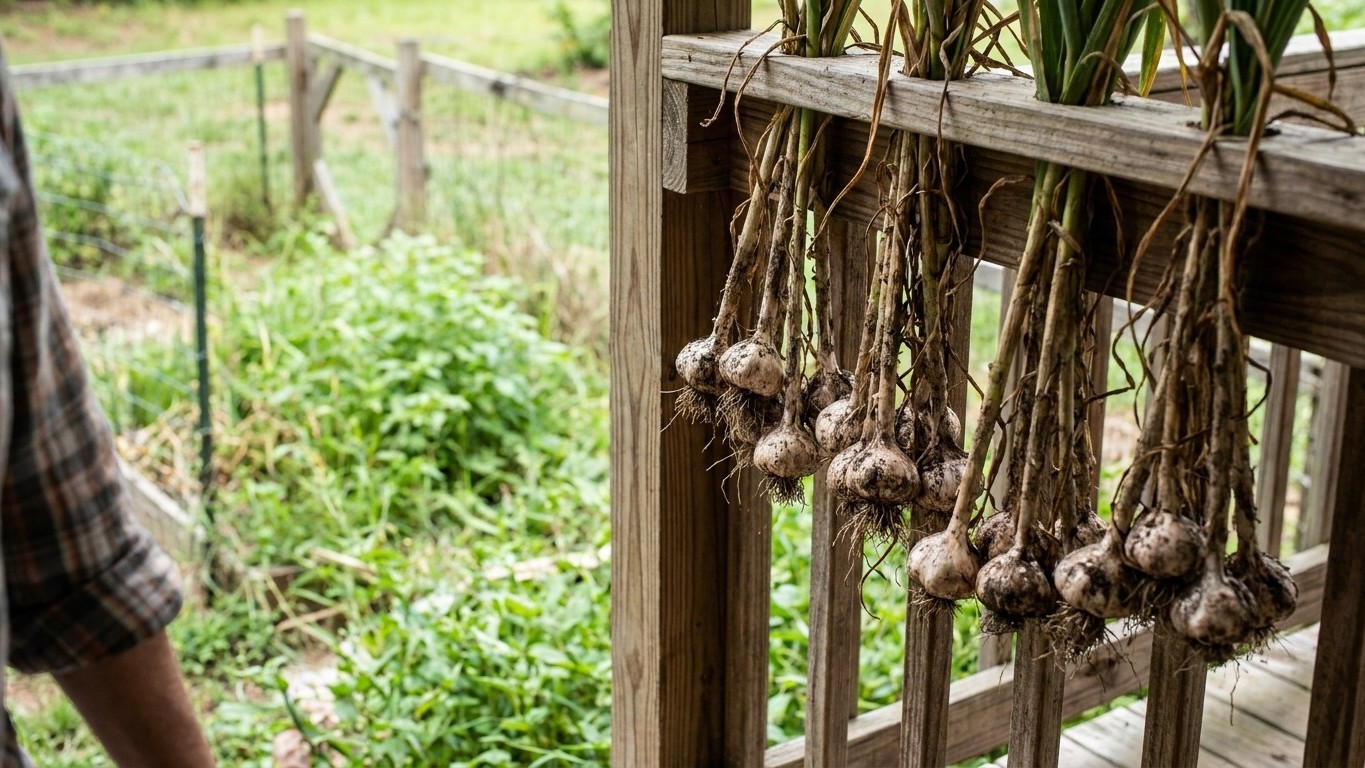

Lift garlic in New Brunswick once the bottom third to half of the leaves have turned brown, typically from mid-July into early August. Pull a test bulb, check the wrapper and clove definition, then cure the whole crop for two to four weeks in a shaded, airy spot before trimming, cleaning, and moving it to cool, dark storage for winter.
When garlic is ready to lift in New Brunswick
Garlic planted the previous fall spends the winter dormant underground, then pushes up through the thaw and builds its bulb over the following summer. That long lag between planting and harvest means the calendar alone won’t tell you when to dig. The plant itself gives the signal: watch the lower leaves. When roughly five to six of the bottom leaves have gone brown while the upper ones are still green, the bulb has usually finished sizing up and started separating into distinct cloves under the skin.
Pulling one test bulb from the row is the most reliable check. Cut it in half. If the cloves look plump and are wrapped in several intact papery layers, the rest of the bed is likely close behind. If the cloves are still thin and the wrapper feels thin and translucent, give it another few days.
Why timing shifts from year to year
A cool, wet spring pushes the whole cycle later. A dry, warm stretch in June and July can pull it earlier. That’s normal, and it’s the reason a fixed date on a calendar is less useful here than reading the plant. Beds with uneven drainage often mature unevenly too, so don’t be surprised if one end of a row is ready before the other.
Pulling too early leaves you with small, underdeveloped bulbs that shrink further in storage. Waiting too long is worse: the wrapper layers start splitting, the cloves loosen inside the skin, and those bulbs are prone to rot within weeks rather than lasting through winter. If more than half the leaves have already died back by the time you check, dig immediately rather than waiting for a “perfect” day. A slightly early harvest cures and stores far better than a bulb left too long in wet soil.
Curing it, and where to hang it here
Curing is what turns a freshly dug bulb, still carrying moisture in its outer layers, into something that will keep for months. Skip this step and even a well-timed harvest will soften and mold within weeks in storage.
Leave the roots and stalks attached and don’t wash the bulbs. Brush off loose soil by hand, then move the whole plants somewhere shaded, dry, and well ventilated. A garage with the door cracked, a covered porch out of direct sun, a shed with a window open, or a barn loft all work, provided air moves through and rain or dew can’t reach the bulbs. New Brunswick summers run humid enough that a small fan aimed across the bulbs, rather than directly at them, speeds drying and cuts down on the risk of mold setting in on the outer wrappers.
Spread bulbs in a single layer on a screen or hang them in loose bundles of six to eight plants, stalks up, with space between bundles so air can circulate around every bulb. Crowding them together traps moisture right where you don’t want it.
Curing generally takes two to four weeks. You’ll know it’s done when the outer wrapper is fully dry and papery, the neck where the stalk meets the bulb has tightened and dried out, and the roots are brittle rather than fleshy. That whole process happens in summer, well ahead of the first frost, which averages October 2 at the Moncton climate station according to Environment and Climate Change Canada’s 1981-2010 Canadian Climate Normals. That figure is a midpoint, not a safe date: in one year out of two, frost actually arrives later than that average. It matters less for curing timing than for planning next fall’s planting, but it’s worth keeping in mind if your harvest and curing run later than usual.
Once fully cured, trim the roots close to the base and cut the stalk down to about an inch, or braid softneck stalks together if you prefer to store them that way. This is also the moment to brush off any remaining loose soil and set aside bulbs with soft spots or bruising. Those won’t hold through winter and should be used first, not stored.
Storing it through a New Brunswick winter
Once cured and trimmed, garlic needs a storage spot that’s cool, dark, dry, and has some airflow. A basement corner away from a furnace, an unheated pantry, an insulated porch, or a root cellar-style space all work, as long as temperatures stay above freezing and humidity doesn’t climb high enough to encourage mold. Skip the refrigerator: the cold, humid environment inside a fridge tends to trigger sprouting rather than prevent it.
Mesh bags, loosely woven baskets, or cardboard boxes with air holes punched in the sides all let bulbs breathe. Braided softneck garlic can simply hang. Whatever the container, avoid sealed plastic bags or airtight containers, which trap the humidity that leads to rot.
Hardneck and softneck, side by side
Most garlic grown in New Brunswick gardens is hardneck, chosen for its reliability through cold winters in the ground. That trait carries a trade-off in the pantry.
| Type | Cold hardiness at planting | Typical storage behavior |
|---|---|---|
| Hardneck | Well suited to New Brunswick winters | Shorter storage life than softneck; use earlier in the season |
| Softneck | Less reliably hardy in colder pockets of the province | Generally holds longer in storage; often braided |
Check stored bulbs every few weeks. A single soft or moldy bulb left in a bag or basket can spread rot to its neighbors, so pull it out as soon as you spot it. Set aside the largest, firmest bulbs from this year’s harvest as seed stock for fall planting rather than eating them, since those are the genetics that will carry your best traits forward.
What goes wrong here
The most common failure isn’t a pest, it’s moisture. New Brunswick’s humid summers and damp falls mean garlic that goes into storage even slightly under-cured will soften, discolor, or mold within a month. If a bulb feels at all cool or damp to the touch after what you thought was a full cure, give it another week in a drier spot before boxing it up.
Uneven harvest timing across a bed causes its own headache. Bulbs pulled too early from the shadier or wetter end of a row won’t cure the same way as bulbs from a well-drained, sunnier stretch, so sort and cure by maturity rather than treating the whole harvest as one batch.
On the pest side, the University of Maine Cooperative Extension documents cabbage maggot and seedcorn maggot (Delia platura) as pests that attack the below-ground parts of allium plantings and young seedlings in this bordering region, which is relevant for garden beds that rotate garlic with other crops. Neither shows up after harvest; both are a planting-season and early-growth concern rather than a storage one, so scouting happens well before curing ever enters the picture.
For broader planting and rotation guidance suited to this climate, the federal Agriculture and Agri-Food Canada site is a useful starting point when the provincial department’s own pages aren’t accessible.
Common questions
Can I harvest garlic before the leaves fully brown in New Brunswick?
Yes, and often you should. Waiting until every leaf has died back usually means the bulb has already split its wrapper and loosened its cloves, which shortens storage life. Five to six brown lower leaves with green ones still standing is the better signal.
How do I know if garlic cured properly?
The outer skin should be dry and papery rather than damp or shiny, the neck should feel tight and brittle, and the roots should snap rather than bend. If any of that still feels soft or cool to the touch, it needs more time before storage.
What’s the difference between curing and storing?
Curing is a two-to-four week drying period right after harvest, done in a shaded, ventilated spot to remove surface moisture. Storing is the longer-term phase that follows, in a cool, dark, dry space, once the bulbs are fully dried and trimmed.
When should I plant garlic in New Brunswick for a summer harvest?
Garlic goes into the ground in fall, well ahead of hard freeze, so it can establish roots before winter dormancy and resume growth the following spring for a summer lift. Since the average first fall frost at the Moncton station runs October 2, and that date can fall later in half of all years, planting earlier in the fall window rather than waiting for a frost warning gives the crop more time to root in before the ground locks up.