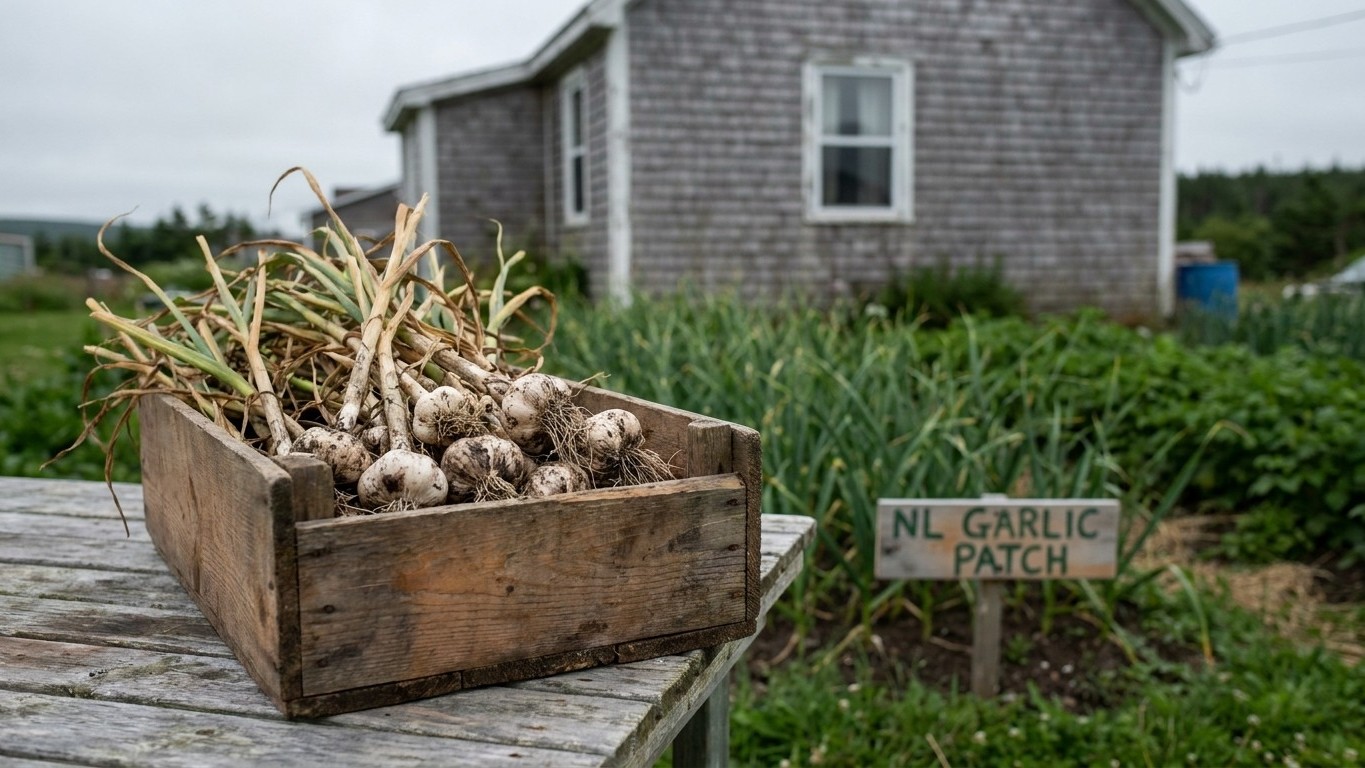

Softneck garlic planted on a whim in a St. John’s backyard has a bad habit of rotting quietly under the mulch by February, the cloves never dividing because the bulb never got the cold it needed in a form it could use. Growers lose the whole bed and blame the seed, when really it was the wrong type for a coast that freezes hard and stays wet. Hardneck garlic, chosen and planted at the right time, skips that failure almost entirely.
The short answer for Newfoundland and Labrador

Hardneck garlic is the safer default here, because it handles cold soil and a short, damp summer better than most softnecks, and the province’s winters give it far more chilling than it needs to divide properly. That said, softneck garlic is not a bad choice on the Avalon Peninsula or anywhere the coast keeps winter lows a little less extreme, provided the bed is mulched before the ground locks up.
Hardneck varieties for a cold, damp climate
Among the hardnecks worth ordering for Newfoundland and Labrador gardens are German Red, German White, Chesnok Red, Duganski and Georgian Fire. All of these are catalogued as fall-planted hardnecks meant to go into the ground in late September in this territory, which lines up with the season’s chill and gives the roots a real head start before the ground stiffens.
Softneck varieties that still work
Softneck options include Inchelium Red and Lorz Italian, along with Early Red Italian and Italian Late, neither of which carries a page link here but both of which are planted on the same late September schedule. Softnecks generally store longer in the kitchen than hardnecks, which is worth weighing if a long root cellar season matters more to you than a slightly hardier crop in the ground.
Every one of these dates is anchored to one figure: Environment and Climate Change Canada’s average first fall frost of October 17 at the ST JOHN’S A climate station. That is a mean drawn from the 1981-2010 normals, not a safe date. In one year out of two, the actual first frost lands later than October 17, and in the other half it lands earlier. Late September planting is timed to beat the earlier half of that range, not to hit the average exactly.
| Variety | Neck type | Note for this climate |
|---|---|---|
| Bavarian Purple | Hardneck | Set out late September, same window as the other hardnecks |
| Blue Music | Hardneck | Handles a long cold season without special protection |
| Georgian Crystal | Hardneck | Fall-planted, benefits from a heavier mulch layer |
| Fall Festival | Hardneck | Fall-planted on the same late September timetable |
| Ivan | Hardneck | Fall-planted, no page link available yet |
Working it out for your own garden
The arithmetic
Garlic planted in fall needs enough time rooted in the ground before a hard freeze sets in, which is why every variety in the catalogue for this territory is timed to go in during late September rather than on a fixed calendar date. Work backward from Environment and Climate Change Canada’s average first fall frost of October 17 at St. John’s, and late September gives roots a few weeks to establish while soil temperatures are still workable. Count back from your own local frost history if you have it, rather than treating the St. John’s figure as universal, since a single station thirty minutes down the road can run a week ahead or behind.
Adjusting for elevation, coast and water
Newfoundland and Labrador is not one climate zone stretched over a map. Elevation, a large lake nearby, or direct coastal exposure can each shift your effective planting window by roughly two weeks in either direction from the St. John’s normal. A garden set back from the shore and up a slope typically cools faster in autumn than one right on the water, because open water holds heat longer into the season and moderates the first hard frost nearby. If your garden sits well inland or at higher elevation than St. John’s, treat late September as your outer limit rather than your starting point, and consider planting in the first half of the month instead.
For the week-by-week version of this reasoning, including how to build your own planting window rather than borrowing the St. John’s figure outright, see When to Plant Garlic in Newfoundland and Labrador: Counting Back From the First Frost. That guide assumes you have already chosen a variety, which is the decision to settle first.
What changes across Newfoundland and Labrador
The Avalon Peninsula and the coast
St. John’s and the rest of the Avalon Peninsula sit close to open ocean, which moderates temperature swings and tends to push the first hard frost later than it would fall further inland.
Labrador and the interior
Labrador and inland districts away from the coast run colder and see their growing season close earlier than the Avalon figures suggest, because they lack the moderating effect of a large body of open water nearby. Gardeners in these areas should treat late September as a late planting date rather than an ideal one, and lean toward the earlier end of any range. The province does not publish a single frost date for every district, so if you garden away from St. John’s, your own observed frost history is worth more than any figure quoted here.
The mistakes this climate punishes
Timing errors
The most common mistake in this climate is planting too late, on the assumption that October 17 is a safe cutoff rather than a midpoint. Since frost arrives earlier than that average in roughly half of all years, cloves planted in early October can be caught by cold before they have rooted, which weakens the bulb that forms the following summer. Planting too shallow, or skipping mulch altogether, compounds this: exposed cloves are more likely to heave out of loosened soil during the freeze-thaw cycles common here in late fall and early spring.
Assuming cold means disease-free
It is easy to assume that a climate this cold has no soil-borne disease risk, and that assumption is a mistake. Infected seed garlic carries pathogens like white rot (Sclerotium cepivorum) and fusarium basal rot (Fusarium oxysporum f. sp. cepae) into a garden regardless of how cold the winters run, according to the University of California’s Pest Management Guidelines for Onion and Garlic (UC ANR Publication 3453). Reading air temperature data at one reference station, mean air temperature in this growing season falls inside white rot’s published 50-75°F range in three months (September, June and July, one of them at the pathogen’s own optimum), and inside fusarium basal rot’s 59-90°F range in one month (July). Those are published soil-temperature thresholds compared against air averages, which lag and swing less than soil does, and a monthly average hides days both warmer and colder than the mean. None of this means either disease is guaranteed, and a month falling outside the range does not mean the disease is impossible either. The real safeguard is buying certified, disease-tested seed garlic, not counting on the climate to do that work.
- Planting later than late September without checking your own frost history first
- Leaving cloves unmulched through the first hard freeze-thaw cycles
- Choosing a softneck for a district known to run colder than the Avalon Peninsula
- Buying cheap, untested seed garlic instead of certified disease-free stock
Checking this against your county
Every date and figure here is drawn from data measured at or near St. John’s, and other parts of the province run on a different schedule. For district-level guidance closer to your own garden, contact Newfoundland and Labrador’s Department of Fisheries, Forestry and Agriculture, which is the provincial extension service. If you are still deciding whether garlic is worth growing in your particular yard at all, the overview at Growing Garlic in Newfoundland and Labrador is the place to start before you commit to a variety.
Common questions
Can I plant garlic in spring instead of fall here?
You can, but expect smaller bulbs. Garlic planted in spring misses most of the cold period it uses to divide into cloves, and in a climate that already runs well past the six to eight weeks needed for that process, fall planting in late September makes better use of what the season offers.
Will hardneck garlic survive a Newfoundland winter with no mulch at all?
It might, but it is a bad bet. Mulch protects against the freeze-thaw heaving that is common here through late fall and early spring, and skipping it is one of the more avoidable ways to lose part of a planting even when the variety itself is cold-hardy.
Can I just plant garlic from the grocery store?
Grocery store garlic is often treated to prevent sprouting and is rarely sold with any disease testing, which matters given that soil-borne pathogens like white rot travel in on infected cloves regardless of climate. Certified seed garlic from a known supplier costs more but avoids introducing a problem that can persist in a garden bed for years.
Why do all the garlic varieties share the same planting date?
Because the planting date is set by the frost window, not by the variety. Hardneck and softneck garlic both need to go into cold soil in fall to vernalize properly, so every cultivar listed here, whatever its neck type or eventual bulb size, is timed to the same late September window drawn from the same October frost average.