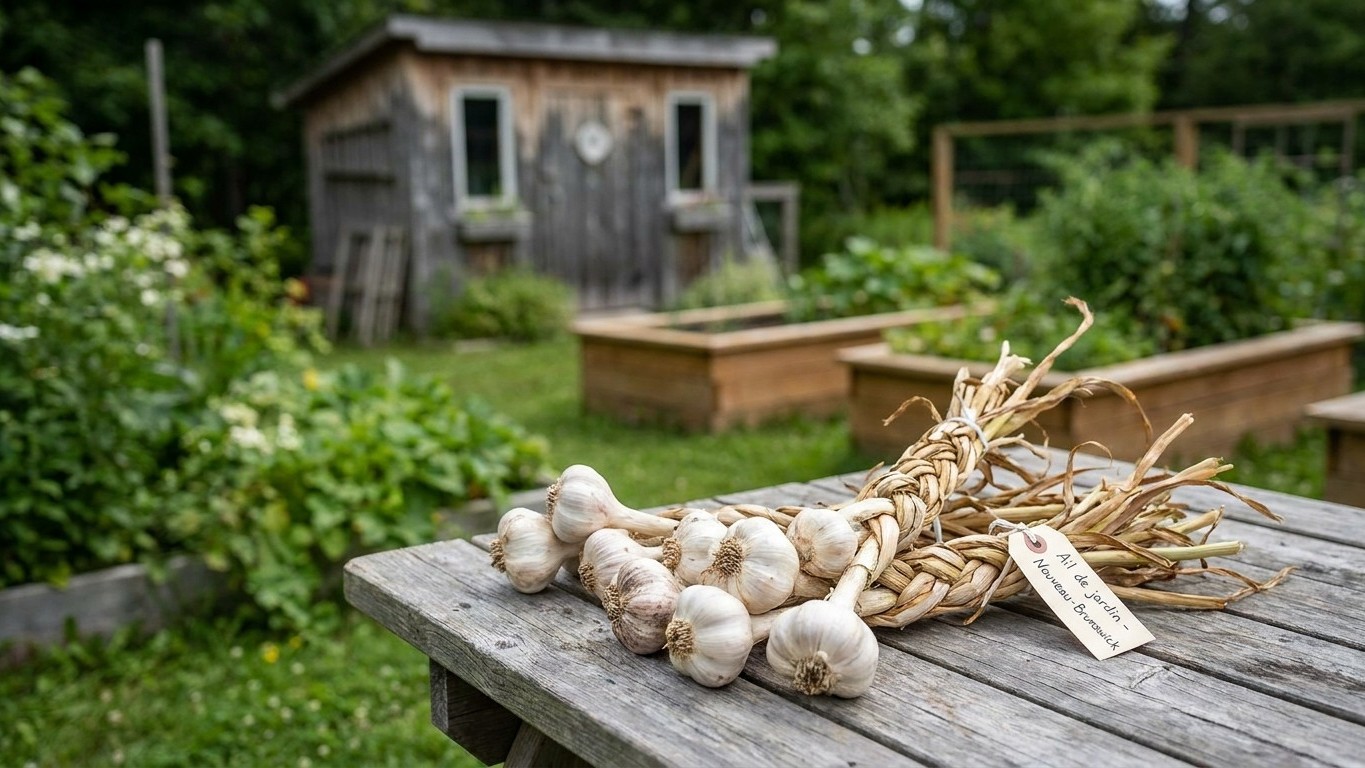

Garlic grows well in New Brunswick, and the province’s long, cold winter is exactly what the crop needs to split one clove into a full head. Environment and Climate Change Canada’s 1981-2010 climate normals put the average first fall frost at Moncton at October 2, and the season that follows runs cold for months, more than enough to satisfy garlic’s dormancy requirement. Check When to Plant Garlic in New Brunswick for details, but as a rule plant cloves in mid-September so they root before the ground locks up, and lean toward a hardneck variety unless you have a specific reason to plant softneck.
Will garlic get the cold it needs in New Brunswick

October 2 is the average date of first fall frost at Moncton, and that single number tells you most of what you need to know about garlic’s cold requirement here. New Brunswick winters hold their cold for months, not the six to eight weeks garlic asks for, so there’s no real risk of falling short. The date itself is a midpoint, though, not a promise — inland gardens tend to freeze earlier, sheltered coastal pockets later, and that gap matters more than it looks.
The cold requirement, checked against this territory
New Brunswick clears that bar without much drama. Environment and Climate Change Canada’s 1981-2010 normals put the average first fall frost at Moncton at October 2, and the months that follow, deep into winter, stay cold far longer than the six to eight weeks the crop needs. This is not a marginal climate for garlic’s cold requirement the way parts of the Gulf Coast or coastal California are. A Maritime winter, once it sets in, holds cold for far more than two months.
That October 2 date is worth reading carefully, though, because it is a mean, not a guarantee. In roughly one year out of two, the first fall frost at Moncton arrives later than that date, and in the other half it arrives earlier. Treat it as the midpoint of a window rather than a line you can plan against exactly, and remember that a single station cannot describe the whole province. Upland districts and anywhere well inland of Moncton typically see frost earlier than this figure, while a few sheltered coastal pockets may run a little later.
What to do if your own site runs mild
If you garden in one of those unusually sheltered spots, close to open water where winter temperatures moderate more than they do a few miles inland, you have two real options rather than one. You can hold your seed garlic in the refrigerator for four to six weeks before planting to force the cold treatment artificially, which is the standard fix growers in warm-winter states use. Or you can lean on softneck varieties, which need less cold overall and tolerate a mild winter far better than hardneck types do — a look at Garlic Varieties That Suit New Brunswick Winters can help you pick the right one. For the great majority of New Brunswick gardens, though, neither workaround is necessary. The winter here does the vernalizing on its own.
When to put the cloves in
Garlic planting date is not set by the calendar month, it is set by two things happening at once: the soil needs to be cool enough to root the clove without pushing much leaf growth above ground, and the clove needs time to establish roots before the ground freezes solid. Plant too early, in warm soil, and you get soft green top growth that then gets hammered by the first hard freeze. Plant too late, into soil that is already close to freezing, and the clove never puts down the root system it needs to survive winter and start growing early the following spring.
Anchoring the window on frost, not the calendar
Environment and Climate Change Canada’s 1981-2010 normals put the average first fall frost at Moncton at October 2. Working back from that mean date, most growers in this territory plant garlic roughly two to four weeks ahead of it, which lines up with the mid-September planting window given for the varieties below. That gives the clove enough time to root into cooling soil before the ground shuts down for winter, without giving it so much warm soil time that it sends up vulnerable green shoots.
Remember that the October 2 figure is a mean date from one station, not a safe date for the whole province. Frost arrives later than that in about half of all years at Moncton, and considerably earlier in colder inland or upland districts. If your garden sits well away from the coast, at higher elevation, or near a large body of water that moderates temperature, adjust the window accordingly rather than planting to a fixed date on the calendar. A large lake or the Bay of Fundy coastline can push your local frost later than Moncton’s average, while an inland valley that pools cold air can bring it forward by a couple of weeks.
Garlic itself is not harmed by a light frost once it is in the ground. The plant tolerates cold well below freezing once established; what matters is root development before the ground freezes hard, not avoiding frost altogether. That is a different concern from a tender vegetable transplant, and it is why garlic planting dates are pegged to the season’s cooling trend rather than to the exact day of first frost.
Which types suit New Brunswick
Hardneck and softneck garlic are not interchangeable here, and the choice is not really about taste or convenience. It comes down to winter. Hardneck garlic wants a real cold season to perform well and rewards it with the biggest cloves, a scape you can harvest as a bonus crop, and often more complex flavor. Softneck garlic tolerates mild winters that would leave a hardneck variety poorly divided, and it stores considerably longer in the pantry, but it does not need New Brunswick’s cold the way hardneck does.
Hardneck varieties for a cold winter
Given how comfortably this territory clears garlic’s cold requirement, hardneck types are the natural fit. From the catalogue, German Red and German White are both reliable cold-climate hardnecks, set out in mid-September here. Chesnok Red and Duganski are two more hardnecks worth growing in a genuinely cold winter, along with Georgian Crystal and Georgian Fire, both known for strong, hot flavor. Bavarian Purple and Blue Music round out the hardneck options, alongside Fall Festival and Ivan, both also planted in mid-September in this territory.
Softneck as a backup, not the default
Softneck varieties remain worth knowing even here, particularly if you want longer storage or you garden in one of the milder coastal pockets discussed above. Inchelium Red and Lorz Italian are both softnecks in the catalogue, along with Early Red Italian and Italian Late, all set out in mid-September in this territory as well. A gardener in Newfoundland and Labrador faces a broadly similar cold-winter calculation, and the reasoning laid out on Growing Garlic in Newfoundland and Labrador: Planting Dates, Varieties and Winter Cold follows the same logic from a different frost date.
| Variety | Type | Set-out in this territory |
|---|---|---|
| German Red | Hardneck | Mid September |
| Chesnok Red | Hardneck | Mid September |
| Georgian Fire | Hardneck | Mid September |
| Inchelium Red | Softneck | Mid September |
| Lorz Italian | Softneck | Mid September |
Soil and bed preparation
Garlic sits in the same patch of soil for nine or ten months, through freeze, thaw, and spring mud, so the bed has to be right before you plant, not fixed afterward. Drainage comes first. A clove sitting in cold, waterlogged soil through a New Brunswick winter will rot long before any disease organism gets to it. If your planting site holds water after a heavy rain, raise the bed six to eight inches or move to a spot that drains faster, because there is no mulch or fungicide that fixes a poorly drained garlic bed.
Work in a couple of inches of finished compost or well-rotted manure before planting, turning it into the top eight inches or so of soil. Garlic is a heavy feeder over its long season in the ground, and building fertility into the bed now is easier than trying to correct a deficiency once the crop is growing under snow cover. Break up any compacted soil at the same time. Garlic bulbs push outward as they divide, and dense, compacted ground distorts bulb shape and makes the crop harder to lift cleanly at harvest.
Clear the bed of the previous crop’s residue and any perennial weeds before planting, since anything left in place over winter gives pests and disease organisms somewhere to overwinter alongside your garlic. A soil test taken a few weeks ahead of planting will tell you whether pH and major nutrients need adjusting, and most provincial extension programs will run one for a modest fee, which is worth doing at least every few years on a bed you use repeatedly for garlic.
What the climate here favours, and what it does not
Disease pressure on garlic tracks temperature closely, and the published thresholds from UC IPM’s Pest Management Guidelines for Onion and Garlic (UC ANR Publication 3453) let you see roughly where this territory sits without turning that into a diagnosis. One caution before the numbers: those published thresholds are soil temperatures, while the figures used here are monthly mean air temperatures, so this section describes a tendency in the climate, not a measurement of what is actually happening in your soil.
White rot and fusarium basal rot
White rot, caused by the fungus Sclerotium cepivorum, has a published occurrence range of 50 to 75°F. In this territory’s growing season, the mean air temperature falls inside that range in three months, September, June, and July, which means the climate here does not rule white rot out during those windows. Fusarium basal rot, caused by Fusarium oxysporum f. sp. cepae, has a wider published range of 59 to 90°F, and the mean air temperature here falls inside it in two months, June and July.
Neither of those counts is a forecast, and a monthly average hides a lot of daily swing: a month that averages in range easily includes days well outside it in both directions. What actually brings either disease into a garden is infected seed garlic or contaminated soil, not the weather on its own. Buy clean seed garlic from a reputable source and avoid replanting cloves from a bed with a known history of either disease, regardless of what the season’s temperatures are doing.
Southern blight and pink root
Southern blight, caused by Sclerotium rolfsii, has a published optimum of 86 to 95°F, and no month of the growing season here reaches a mean air temperature inside that range. Pink root, caused by Setophoma terrestris, has a published optimum of 75 to 85°F, and the same is true there: no month’s mean falls inside it. That is genuinely reassuring for a New Brunswick garden, since both diseases favor conditions considerably warmer than this climate typically delivers. It does not mean either disease is impossible here. Falling outside a published optimum range means the disease is less active, not absent, and infected planting stock can still carry either pathogen into a garden regardless of the local climate.
Getting it through the winter
Winter protection is where a cold Maritime climate and a mild one part ways most sharply, and New Brunswick sits firmly on the cold end of that spectrum. Once the ground starts to freeze, spread four to six inches of loose mulch, straw or shredded leaves both work well, over the planted bed. The mulch is not there to keep the clove warm in the way a blanket warms a person. It is there to keep the soil temperature stable and to stop the freeze-thaw cycles that heave a shallow-planted clove partway out of the ground over the course of the winter.
Timing the mulch matters almost as much as the depth. Lay it too early, while the soil is still warm, and you trap heat that encourages the kind of soft top growth you were trying to avoid by waiting to plant. Wait until the ground has started to cool hard and a light frost or two has already passed, then mulch heavily and leave it in place through the winter. A garden in a genuinely extreme winter climate, such as the one described on Growing Garlic in Yukon: Planting Dates, Varieties and Winter Cold, needs even heavier mulch and closer attention to snow cover as insulation, but the same basic principle of stabilizing rather than warming the soil applies here too.
In spring, pull the mulch back gradually rather than all at once, once new green shoots are visibly pushing through and the hardest frosts have passed. Leaving the full winter mulch in place too long into spring keeps the soil cooler and wetter than the young plant wants, and can encourage rot right at the point where the clove is trying to put on its strongest early growth.
Harvest and curing here
Garlic tells you when it is ready far more reliably than the calendar does. Watch the leaves, not the date. When the lower third to half of the plant’s leaves have turned brown and dried while the upper leaves are still green, the bulb has finished sizing and it is time to lift. Pull a test bulb or two before committing to a full harvest, and check that the cloves have separated cleanly inside a papery wrapper. Waiting too long past that point causes the wrapper to split and the cloves to separate in the ground, which shortens storage life considerably.
Curing for a Maritime summer
Curing is the step that loses gardeners a crop they already harvested safely. Once lifted, garlic needs three to four weeks of warm, dry, well-ventilated air out of direct sun before it is ready to trim and store, and a humid summer stretches that timeline out compared to a dry one. In a Maritime climate where summer humidity can run high, hang garlic in loose bunches or lay it in a single layer on screens with a fan moving air across it, rather than piling it in a bin where trapped moisture invites mold before the wrappers have fully dried. Check bulbs partway through curing, and pull out any that show soft spots or discoloration before they affect the rest of the batch.
Local help
For county-level planting guidance and soil testing services, contact your provincial agricultural office or start with Agriculture and Agri-Food Canada at agriculture.canada.ca, which can point you to the resources and testing labs relevant to your part of the province.
Common questions
Can I Plant Garlic in spring instead of fall in New Brunswick?
You can, but you will lose most of the yield. Garlic needs the extended cold period described above to divide into a full head of cloves, and spring planting skips most or all of that cold, typically producing small, poorly divided bulbs. Fall planting, timed to the frost window discussed here, is standard practice for a reason.
Do I need to remove garlic scapes on hardneck varieties?
Cutting the scape, the curling flower stalk hardneck varieties send up in early summer, redirects the plant’s energy into bulb growth rather than the flower structure at the top. Most growers cut scapes as soon as they curl, and the scapes themselves are edible, with a mild garlic flavor good in cooking.
How many cloves do I need for a given size garden?
Plant one clove per planting spot, spaced roughly six inches apart in rows a foot or so apart, and each clove grows into one full bulb by harvest. A pound of seed garlic typically plants somewhere between forty and sixty cloves depending on variety and clove size, so plan seed quantity around your bed’s actual dimensions rather than a general rule.
My garlic sent up green shoots before winter. Did I plant too early?
Likely yes, or the fall was unusually warm. A few inches of green top growth before hard frost is not fatal, since the leaves may die back while the roots and clove survive underground, but heavy top growth uses up energy the clove needed for winter survival. Adjust your planting date closer to the window discussed above next season.
Is it worth buying seed garlic locally instead of ordering online?
Locally grown seed garlic that has already adapted to this climate and been screened for disease by the grower is generally a safer bet than an unknown source, particularly given the white rot and fusarium basal rot pressure discussed above. Whatever the source, inspect cloves before planting and skip any that show soft spots, mold, or unusual discoloration.