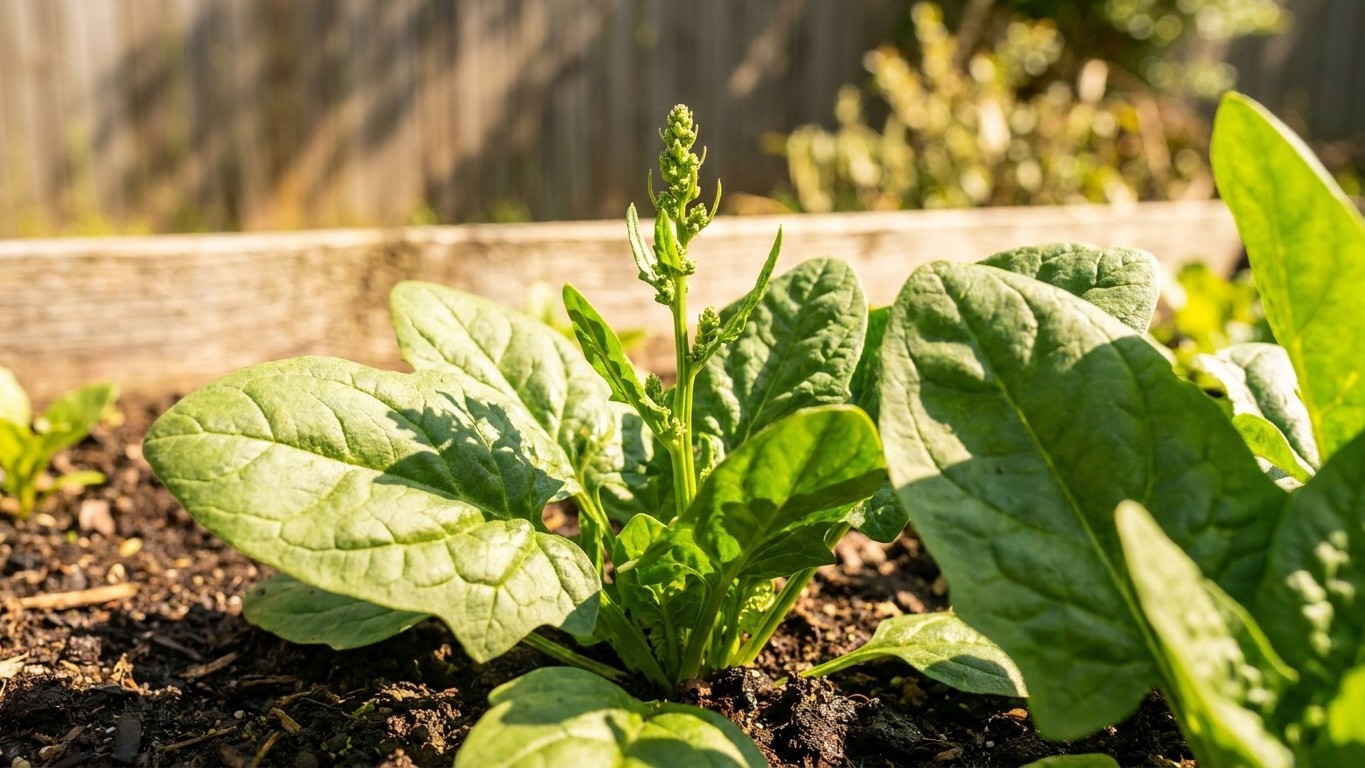

Five of the ten pests Colorado State University Extension tracks for vegetable gardens actually bother spinach: flea beetles, cutworms and seedcorn maggots, grasshoppers, spider mites, and slugs. Each one shows up at a different point in the season, tied to soil temperature, heat load, and how long the days have gotten rather than to a calendar month. The rest of the list belongs to other crops entirely.
Which pests attack spinach in Colorado

Colorado State University Extension documents ten pests across the state’s vegetable gardens: corn earworm, cutworms and seedcorn maggots, flea beetles (Phyllotreta and Epitrix spp.), grasshoppers (Melanoplus spp.), harlequin bug, slugs, spider mites (Tetranychus urticae), spotted cucumber beetle, squash bug (Anasa tristis), and tomato/potato psyllid. That’s the full documented list for the state, and it doesn’t grow just because a gardener spots something unfamiliar on a leaf.
Half of that list has no real business on a spinach bed. Corn earworm goes after corn ears and tomato fruit, not leafy greens, so a caterpillar in the spinach almost certainly isn’t this one. Harlequin bug is a cabbage-family specialist, feeding on kale, broccoli, and mustards, and it largely bypasses spinach sitting a few feet away. Spotted cucumber beetle and squash bug are both tied to cucurbits, squash, cucumber, melon, vines that don’t share much with a spinach leaf’s chemistry. Tomato/potato psyllid feeds on nightshades. None of these five have a documented reason to touch spinach specifically.
That leaves cutworms and seedcorn maggots, flea beetles, grasshoppers, spider mites, and slugs as the ones actually worth watching in a Colorado spinach bed. All five are generalists. They don’t specialize in spinach the way harlequin bugs specialize in cabbage, they just take it along with whatever else is growing nearby. Spider mites lean toward the driest, hottest stretch of the growing season, the same weeks that make up the state’s average of 39.6 days a year at 90 F or hotter, while cutworms and seedcorn maggots operate underground before a plant even has true leaves. Knowing which of the five you’re dealing with matters less than knowing when each one is active, because the timing narrows the list fast.
When each one shows up, and what it does first
Spinach seed usually goes into the ground while soil is still cold, well ahead of Colorado’s last spring frost window of May 1 to May 11. Cutworms and seedcorn maggots are active in that same cool, damp soil, and they hit before a plant ever gets a chance to leaf out. The first sign isn’t a chewed leaf, it’s a row where seeds simply never came up, or a seedling that’s toppled over with the stem severed cleanly at the soil line rather than shriveled or discolored.
Once true leaves unfold, flea beetles move in. The first sign is a scatter of small, round holes across the youngest leaves, sometimes described as looking peppered or shot through, and the damage tends to ease off as the plant gets bigger and tougher.
As the season pushes toward the hottest stretch, the one that averages 39.6 days a year at 90 F or above, grasshoppers wander in from drying grass and weeds around the garden, and spider mites build on the undersides of leaves where heat and dust favor them. Grasshopper damage shows up as large, ragged chunks missing from leaf edges, while spider mite injury starts as fine, pale stippling that’s easy to mistake for dust until a hand lens reveals webbing on the leaf’s underside.
Denver’s longest day of the year runs about 14 hours and 50 minutes of daylight, and that number matters more than any insect during summer, because spinach bolts under long days and warm temperatures together, not because a cool summer somehow buys extra weeks. Much of what looks like decline in a Colorado spinach patch by midsummer is the plant’s own biology, not a pest at all.
Fall sowing resets the clock. Utah State University Extension frames it as planting 50 to 75 days before the date you want to harvest, and that window only opens once soil temperature drops below the point where germination starts to fail, around 80 F. Once cool, damp weather returns, slugs become the pest to watch again, showing up as ragged holes and silvery slime trails, usually worse right after irrigation or rain.
Telling the damage apart from everything else
Spinach fails for plenty of reasons that have nothing to do with insects, and confusing the two wastes time better spent elsewhere. Utah State University Extension notes spinach grows best where temperatures stay under 75 F, and that same number works as a bitterness threshold. A patch that turns bitter and starts flowering in warm weather is reacting to heat and day length, not to a pest or a nutrient shortage, and no amount of scouting will find an insect responsible for it.
| What you see | What it might be | What actually tells them apart |
|---|---|---|
| Small round holes across young leaves | Flea beetles | Tiny beetles jump when the plant is disturbed; damage eases as the plant matures |
| Seedling down, stem missing at the soil line | Cutworms | The cut is clean; damping-off disease leaves a water-soaked, collapsed stem instead |
| Large, ragged sections gone from leaf edges | Grasshoppers | Insects are usually visible nearby; hail damage appears suddenly overnight across unrelated plants |
| Pale, stippled or dusty leaves | Spider mites | Fine webbing on the leaf underside; drought stress causes curling without any webbing |
| Ragged holes plus a silvery trail | Slugs | The slime trail is the tell; leaf-spot disease shows defined round lesions with no slime |
| Bitter taste, yellowing, early flowering | Neither, it’s heat and day length | This is the 75 F ceiling and long days at work, not a pest |
None of this replaces an actual look at the plant. A photo or a sample taken to the local extension office beats guessing from a symptom list every time, especially when two very different problems can leave a similar-looking hole in a leaf.
What actually works here, and what is a waste of time
Colorado’s spinach window is short on both ends, cold soil in spring and rising heat by midsummer, so timing does more work than any treatment applied after the fact. Getting seed into the ground well before the frost window closes gives the plant its best shot at bulking up before flea beetles and heat both arrive in force. A physical barrier laid over the row at seeding keeps flea beetles and early grasshoppers off young leaves, and it can stay in place longer on spinach than on crops that need pollinators, since spinach is harvested for leaves, not fruit. A simple collar pushed into the soil around a transplant stops a cutworm from reaching the stem at all.
Slugs respond better to habit changes than to anything sprayed or scattered. Watering in the morning rather than the evening leaves the soil surface drier by nightfall, when slugs are most active, and a shallow trap set at soil level catches far more of them than most gardeners expect.
What doesn’t work is reaching for a broad treatment once a plant has already started to bolt or turn bitter from heat. Once spinach crosses that 75 F ceiling and long days trigger flowering, no spray or treatment brings the leaf quality back, because the plant’s chemistry has already shifted. Money and effort spent there would have gone further two or three weeks earlier, at planting. Any specific product decision, what’s registered for use on spinach in Colorado and how it’s applied, belongs with the local extension office rather than a general guide, since registrations and rules vary by state.
Where to check this for your own county
Colorado State University Extension is the source for every pest named on this page, and its county offices are where the statewide list turns into something specific to one yard. A garden on the Eastern Plains, one in a mountain town, and one on the Western Slope can share a state but not much else: growing seasons differ enough that a mountain garden can see frost in July while a plains garden further east is still weeks from its own last freeze.
What’s documented for Colorado as a whole doesn’t confirm what’s actually feeding on one specific row of spinach. Pest pressure moves around within a state for reasons as small as a neighboring field going to seed or a wet spring that favored slugs two yards over but not one street away. A statewide list is a starting point for narrowing down possibilities, not a diagnosis.
The most useful next step is a call or a visit to the county extension office, ideally with a photo or a sample of the damaged leaf in hand. That’s the fastest way to turn a symptom into an actual answer, and it’s the one step none of the general information above can replace.
Common questions
Do all five pests show up in every Colorado garden?
No. Colorado State University Extension documents them at the state level, but actual pressure varies by county, elevation, and what’s growing around a given yard. A garden can go a whole season without seeing one of the five while dealing heavily with another.
Can spinach be planted a second time later in the season?
Yes. Utah State University Extension frames fall sowing as happening 50 to 75 days before the date a gardener wants to harvest, and that window only opens once soil temperature drops below the point where germination starts to fail, around 80 F.
Are the named spinach varieties resistant to any of these pests?
Bloomsdale, Melody, Teton, and Olympia are named among common spinach varieties, but no pest-resistance or performance data for any of them is published in the sources behind this page.
Is spider mite damage really common on spinach, or mostly on other crops?
Spider mites are generalists, and Colorado’s heat load, averaging 39.6 days a year at 90 F or above, favors them broadly across many crops, spinach included. They’re less closely tied to spinach specifically than flea beetles or cutworms are, but they’re still documented for the state and worth watching during the hottest stretch.