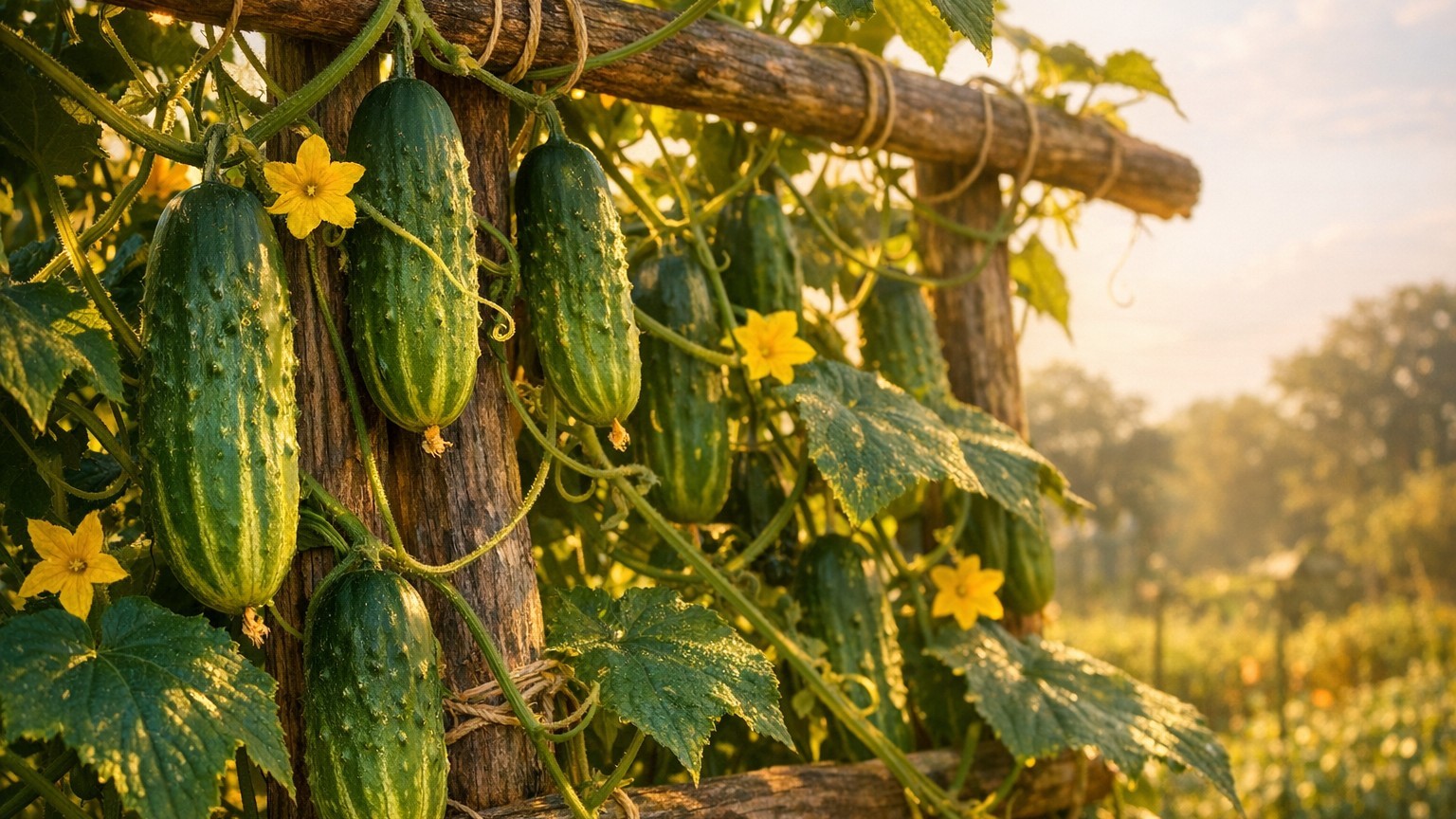

Missouri’s frost-free window runs long enough, and its summers hot enough, to grow nearly every type of cucumber on the market. Short-season pickling types, slicing cucumbers for the table, burpless and parthenocarpic types for containers or shaded trellises: all of them fit somewhere in the state’s growing calendar. The type that struggles is the one bred for cool, short summers.
The short answer for Missouri
Start with the numbers that actually decide this. The frost-free stretch in the reference Kansas City area runs from roughly April 6-20 (last spring frost) to October 18-29 (first fall frost), which works out to somewhere between 181 and 206 days depending on where in that probability band a given year lands. That is a generous window for cucumbers, which typically need only a fraction of a season to produce. It leaves room for a spring planting, a second succession sowing in early summer, and in many years a third round if the first vines wear out from disease or heat stress.
The heat load matters just as much as the length of the season. Kansas City averages 32.7 days a year at or above 90F. That is not a mild summer with a few hot spikes; it is a full month of genuine heat stress spread across the growing season. Cucumbers set fruit poorly once daytime highs push consistently into the 90s, and the plants respond to that stress with blossom drop and misshapen or bitter fruit. Heat stress should drive the type decision more than any other single number.
Given that combination, a Missouri gardener has three practical choices, and none of them requires a specific brand name to make sense. First, look for parthenocarpic types, meaning they set fruit without needing pollination. They tend to keep producing through the stretch of summer when pollinator activity drops off in the heat, and they do well under row cover or in a hoop house extension at either end of the season. Second, favor burpless or slicing types described as heat-tolerant on the seed packet or in extension trial notes, since these hold up better once the mercury climbs past 90F repeatedly. Third, choose bush types for small spaces, patios or containers, and vining types for anyone with a trellis or fence line, since getting the vine up off the ground matters more here than in a drier state (more on that below).
None of this replaces a look at your local University of Missouri Extension variety trial list, which will name the specific cultivars that performed best in real Missouri conditions over recent seasons. The type of cucumber that suits Missouri’s climate is a question this can answer. It cannot tell you which named variety to buy, because that answer changes from one seed catalog and one growing season to the next.
What will not work here

Two Missouri numbers work against each other in a way that trips up a lot of gardeners: plenty of heat, but not an overwhelming amount of rain to match it. Summer rainfall averages about 14.1 inches across June, July and August, with August dropping to just 4.24 inches, the driest of the three summer months. Combine that dip with 32.7 days above 90F and you get a stretch of late summer where evaporation is running high right when rainfall is running low. A cucumber type that demands frequent, even moisture to avoid bitter or misshapen fruit will punish anyone watering on a once-a-week schedule during an average Missouri August. This is less about the variety and more about the watering habit, but some types are simply less forgiving of moisture swings than others, and those are the ones that disappoint here.
Humidity is the second trap. Missouri summers pair heat with enough atmospheric moisture that fungal pressure, powdery mildew and downy mildew especially, builds fast once the canopy gets dense and airflow drops. A cucumber left to sprawl on bare ground, with leaves packed tight and no trellis, sits in exactly the conditions those diseases favor: warm, still, and often damp from either rain or a soaker hose. Vining types trained up a trellis or fence get better air movement and drier foliage, which matters more in Missouri’s climate than it would in a drier western state. This is not an argument against vining cucumbers; it is an argument against growing them flat on the ground here.
Long-season types bred for cooler, longer summer climates (parts of the Pacific Northwest, for instance, where heat load is a fraction of Missouri’s) are the other mismatch. They are not adapted to sustained 90-degree stretches and tend to shut down fruit production mid-summer, right when a Missouri garden should be at its most productive. Extension trial data, not a seed rack description, is the reliable way to sort those types out before planting.
Finally, cucumber beetles thrive in the same warm, humid conditions the plants themselves enjoy, and they spread bacterial wilt efficiently through a densely planted patch. Tight spacing that might work in a drier, less buggy climate becomes a liability here, since it slows airflow and makes it easier for beetles to move plant to plant.
What changes across Missouri
Missouri is not one climate, and the USDA Plant Hardiness Zone Map puts the state across a 5b-7b range, built on the average annual extreme minimum winter temperature. That is a wide spread for one state, and it shows up directly in the frost dates that set the cucumber planting window. A gardener near the northern border, closer to the 5b end of that range, should expect the later end of the last-frost probability band, closer to April 20, and the earlier end of the first-fall-frost band, closer to October 18. A gardener in the southern part of the state, nearer 7b, gets closer to the April 6 and October 29 ends of those same ranges, which stretches the usable season by close to a month compared to the north.
That month matters more than it sounds. It is roughly the difference between fitting in two solid succession plantings of cucumbers and fitting in three, or between a second sowing in early July feeling comfortable versus feeling like a gamble against an early fall frost. Southern Missouri gardeners have more room to experiment with longer-maturing slicing types and later succession sowings. Northern Missouri gardeners are better served leaning toward quicker-producing types and getting the first planting in as soon as soil conditions allow, rather than waiting.
Elevation and local terrain shift this further within any given county, since a low spot that collects cold air can run noticeably colder at night than a slope or ridge just a mile away. The reference station used for these Missouri frost dates sits north of Kansas City itself; the downtown station runs about five days earlier in spring, and southern Missouri overall runs milder still. None of that can be resolved from a state-level page. The zone map exists precisely so a reader can look up their own location rather than guess from a regional average.
Where to check this for your own county
A county recommendation is a different, more useful thing, and it comes from one place: University of Missouri Extension. That is the address to use, not a search result that promises the same information secondhand.
Two things are worth looking for once there. The first is a local planting calendar specific to your part of the state, which will translate the statewide frost-date range into something closer to your actual county, accounting for the north-south spread already discussed above. The second is a list of cucumber varieties that have actually been trialled in Missouri conditions, ideally with notes on disease resistance and heat performance, since those trial results carry more weight than a seed catalog description written for a national audience.
Extension offices also run soil testing services, which matter here because the same rainfall total behaves differently depending on whether a garden sits on sandy or clay soil, something no state-level rainfall average can tell a reader.
The extension service exists specifically to narrow a broad range down to what works in one county, and that narrower answer is the one worth acting on.
Checking this against your own garden
Every date and average describes what usually happens at a reference station, not what is happening in a specific backyard this particular spring. Three direct observations settle that gap better than any calendar.
Soil warmth by feel is the first and most reliable check. Cucumber seed sits and sulks in cold soil no matter what the calendar says; if the soil still feels cool and slightly damp rather than warm to the hand a few inches down, it is not yet cucumber-planting time, regardless of the frost-date range cited above.
The first flush of male flowers is the second signal. Cucumbers produce male flowers before female ones, and a plant covered in male blooms with no female flowers yet (the ones with a tiny swollen cucumber shape behind the petals) is still a week or two from actually setting fruit. That gap tells you whether pollinator activity or heat stress is likely to be the bottleneck this season.
The first true leaves, the ones that appear after the initial rounded seed leaves, are the third marker. Their size and color say more about whether the plant has enough warmth and nutrients than any date on a calendar. Small, pale true leaves point to soil that is still too cool or too poor; broad, dark green ones mean the plant has what it needs and the planting timing was right for that particular spot.