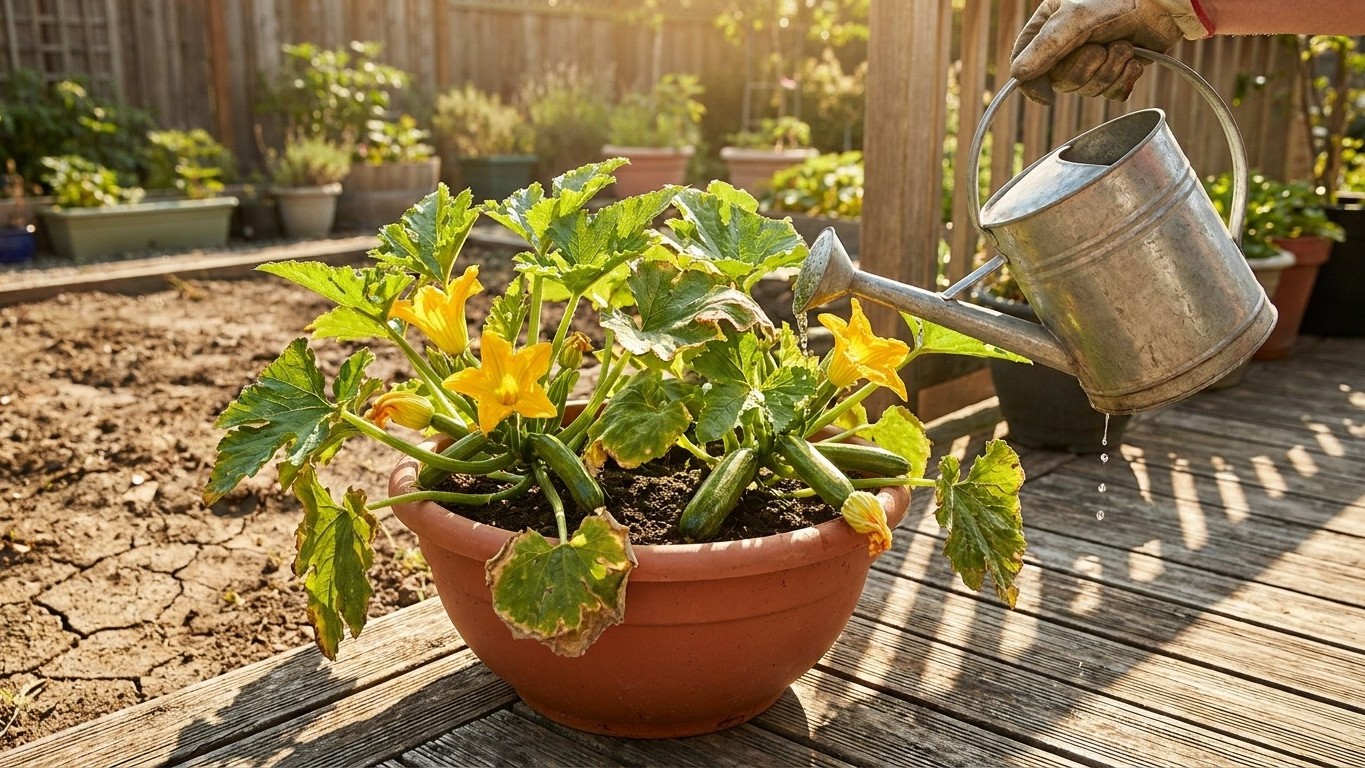

A five-gallon pot grows lettuce. A summer squash plant wants closer to fifteen to twenty-five gallons of root room, a spot that gets six or more hours of direct sun, and a watering schedule that doesn’t slip even once the fruit starts setting. Skip any one of those three and the plant survives, but it stops producing.
What is actually going on
Squash roots don’t creep the way a vine looks like it should. They spread wide and shallow first, then push down once the top few inches of soil start drying out between waterings. In open ground, that root system can wander two feet in every direction looking for moisture. A container caps that search radius at the width of the pot. So the plant compensates the only way it can: it draws down whatever water is already in the soil, fast, and it does that every single day once fruit is forming.
That’s the mechanism worth understanding before anything else on this page: a fruiting squash plant in a container is running a water reserve, not a water supply. On a hot, dry afternoon, a fifteen-gallon pot with one productive plant in it can lose enough moisture to wilt the plant by evening. Wilt once from drought and the plant usually bounces back overnight. Wilt two or three afternoons in a row and something different happens: the plant aborts blossoms, drops small fruit, and shifts into survival mode instead of production mode. It doesn’t recover its earlier vigor even after watering resumes. That’s the part gardeners underestimate, the setback is not proportional to the stress. A short dry spell costs more than the hours it lasted.
Soil volume is doing double duty here. It’s the water reservoir, and it’s also the nutrient bank. Squash is a heavy feeder by garden standards, and a container’s soil volume can’t replenish nutrients the way garden soil does through microbial activity and mineral weathering. Whatever’s in the pot when you plant is close to what’s available until you supplement it, so container squash typically needs more frequent, lighter feeding than the same plant in a bed. None of this makes container squash a bad idea. It makes it a different plant to manage than the one growing in a backyard row, and the difference comes down almost entirely to how much buffer the roots have against heat and dry air. Bigger pot, more forgiving. Smaller pot, less room for a missed watering day.
In the garden
Not every squash type behaves the same way in a container, and the growth habit matters more than the variety name on the seed packet. Bush types, bred to stay compact rather than trail, are the better fit for a pot because they put less energy into vine and more into fruit, and they don’t need the sprawling space a vining type demands. Semi-vining types can work in a large container if you’re willing to let growth spill over the rim or train it up a stake. True vining types are possible but they push the container’s water demand even higher, since you’re now supporting more leaf surface with the same root volume.
Container size is the variable most gardeners guess wrong on, usually by going too small because the plant looks modest as a young seedling. Here’s roughly how that plays out:
| Setup | What usually happens | What to do instead |
|---|---|---|
| One plant in a 5 to 10-gallon pot | Fast early growth, then wilting and blossom drop once fruit starts forming | Move up to 15 gallons minimum per plant, or reduce to a smaller root ball only for a container-bred dwarf type |
| One plant in a 15 to 25-gallon container, watered on a fixed schedule | Fine in mild weather, stressed the moment a heat spell hits and the schedule doesn’t flex | Check soil moisture by hand daily during fruiting instead of watering on a set calendar |
| Two plants sharing one large container | Root competition shows up as smaller fruit and slower recovery from any dry spell | One vigorous plant per container is the safer default |
| A vining type left untrained in a container | Vines sprawl over nearby plants and shade the container’s own soil surface unevenly | Choose a bush type for a pot, or stake and prune a vining type deliberately |
The watering rhythm a container imposes is the other half of the equation, and it’s not the same rhythm as garden soil follows. During active fruiting, checking the top two to three inches of soil daily, and watering deeply enough that it drains from the bottom of the pot, keeps the reserve from running dry between checks. Mulching the surface of the container soil slows evaporation and buys a bit of margin on a hot day. A self-watering container or a simple drip line on a timer removes some of the guesswork, though neither replaces an occasional hand-check when the weather turns unusually hot. Feeding on a lighter, more frequent schedule than an in-ground plant, rather than one or two heavy feedings for the season, matches how quickly a limited soil volume gets depleted. For guidance on choosing between the growth habits, the summer squash variety guides on this site go into more depth on what separates a bush habit from a vining one.
What it depends on where you are
Everything above is mechanism, and mechanism travels. How often you’ll actually need to water, how long the fruiting window lasts, and whether a container plant even makes it through a full season are questions this page can’t answer for a specific address. Season length sets how many weeks of harvest are realistically possible before cooler weather ends fruit set. Summer heat sets how fast a container dries out, and in a hot, dry climate that can mean daily watering versus every other day somewhere milder. Summer rainfall changes how much of that watering job nature does for you versus how much falls on the hose.
A container in full sun in a hot, arid region loses moisture at a different rate than the same container in a humid region with regular afternoon showers, even if both gardeners are growing the identical type on the identical planting date. Wind exposure matters too, since a pot on an exposed deck or balcony dries faster than one tucked against a house wall. None of that is guesswork you should have to do alone. This site’s state-by-state summer squash guides break down the regional side of timing and heat tolerance, and they’re built specifically to fill in the gaps a general mechanism page like this one leaves open.
Beyond this site, a local Cooperative Extension office is the most reliable source for what actually performs in containers in your specific county, because extension staff run variety trials under real regional conditions rather than generic ones. The USDA’s National Institute of Food and Agriculture keeps a directory of these offices by state, and a quick call or visit to a local office will typically get you a list of squash types trialled locally, along with realistic guidance on planting windows for that area. That’s a level of local knowledge no general article, including this one, can responsibly substitute.
The mistake that costs the most
The single costliest mistake with container squash isn’t the pot being slightly too small or the fertilizer schedule being slightly off. It’s treating the watering check as a once-a-day chore instead of a condition-based one. A gardener sets a routine, water every morning before work, and that routine holds up fine through a mild stretch. Then a heat wave arrives, or the plant hits peak fruiting and its water demand roughly doubles, and the fixed schedule quietly stops being enough. The plant doesn’t announce this loudly. It wilts a little by afternoon, perks back up overnight, and the gardener assumes everything’s fine because the plant looks normal again by the next morning’s check.
That repeated afternoon stress is what actually costs the harvest. Each wilt-and-recover cycle pushes the plant further into survival mode, and blossom drop follows within days, often before the gardener connects the dots back to watering. By the time yellowing leaves or stalled fruit make the problem obvious, the plant has already spent a week or two operating under stress it never fully recovered from.
The fix isn’t a stricter schedule. It’s replacing the schedule with a check: press a finger two to three inches into the container soil before deciding whether to water, and do that check daily once flowering starts, twice daily during a genuine heat spell. Water until it runs from the drainage holes, not just until the surface looks damp. This single habit shift, from calendar-based to condition-based watering, does more for a container squash plant’s productivity than any change in pot size, soil mix, or feeding schedule. Get the water reserve managed on the plant’s actual terms, and the rest of what this page covers becomes a lot easier to get right.