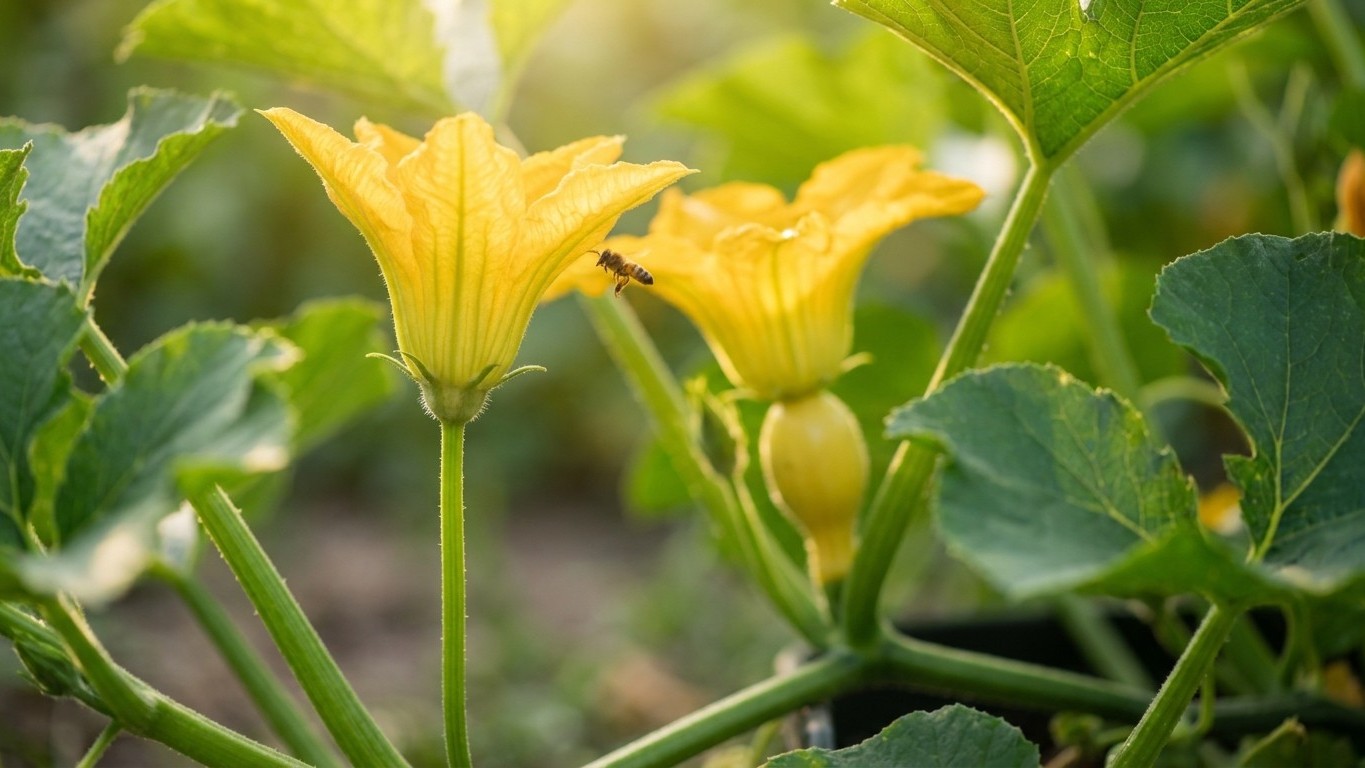

A summer squash plant loaded with blossoms but no fruit almost always comes down to timing, not disease or poor soil. Squash produces separate male and female flowers on the same plant, and the male flowers typically open first, sometimes by a week or more. No females means no fruit yet. The fix, once you know what you’re looking at, takes about ten seconds with a small paintbrush or a fingertip.
What is actually going on
The thing to understand here is that the first flush of blooms on a young squash plant is usually male. That’s not a flaw in the plant, it’s the plant’s normal sequence. Male flowers show up first and in greater numbers, partly to build a pollinator population around the plant before the female flowers, which are more metabolically expensive to produce, start opening. A gardener staring at a plant covered in yellow blooms and zero baby squash is often just looking at week one of a two-stage process.
The female flower is easy to identify once you know the trick: look at the base, right behind the petals. A female flower carries a miniature fruit already there, a tiny swollen bump shaped like the squash it will become. A male flower has a plain, thin stem behind it. No swelling, no shape, nothing but a straight stalk. That swelling is the ovary, and it only develops into an actual squash if pollen makes it from a male flower to the female’s stigma, usually carried by bees.
Squash flowers open for roughly one morning. That’s the whole window. If the local bee population is thin, if weather keeps pollinators grounded, or if the male and female blooms simply don’t overlap on a given day, the female flower closes unpollinated by afternoon and the tiny fruit behind it yellows and shrivels within a few days. This is the second most common panic of the season: a baby squash that seems to be growing, then rots at the tip and drops off. That’s not a disease. That’s an unpollinated flower doing exactly what an unpollinated flower does.
Bee traffic matters more than most gardeners assume. Native bees and honeybees both work squash blossoms, but cool mornings, heavy rain, or a scarcity of pollinators in a given yard can all reduce the odds of a successful visit. A state extension service can point to which pollinator populations are typical in a given region and season, since this varies by state and even by neighborhood. What doesn’t vary is the biology: no pollen transfer, no fruit, regardless of variety or growing method.
In the garden
Once the difference between male and female flowers is clear, the rest is mostly patience and, when needed, a little manual help. Here’s how the sequence typically plays out, and what each stage means if something looks off.
| What you see | What it means | What to do |
|---|---|---|
| Lots of flowers, no swelling behind any of them | Still in the male-only phase | Wait. Female flowers usually follow within one to two weeks |
| A few flowers with tiny fruit behind them, but the fruit shrivels and drops | Female flowers opened but weren’t pollinated | Hand-pollinate the next round; check for pollinator activity nearby |
| Fruit sets and grows steadily | Pollination succeeded | Nothing needed; keep watering and monitoring for pests |
| Fruit grows a little, then rots from the blossom end while still small | Partial pollination, not enough pollen transferred | Hand-pollinate more thoroughly, covering the whole stigma |
| Very few flowers of either kind, plant otherwise healthy | Often heat stress or uneven watering suppressing bloom | Keep soil moisture consistent; flowering usually resumes as conditions ease |
Hand pollination itself is simple. Pick a freshly opened male flower in the morning, strip back its petals, and dab the pollen-covered center directly onto the center of an open female flower, the part surrounded by the tiny fruit. A small paintbrush works just as well if handling the flower feels awkward. One male flower can typically pollinate two or three females if pollen is applied carefully. Do this in the morning, since that’s the only window most squash flowers stay open.
A plant that sets fruit for a while and then stops, even though it looked healthy all season, is usually not failing. Many squash types shift their male-to-female flower ratio as the season goes on, and a lull in fruit set often means a lull in female flowers rather than a pollination problem. If flowers keep opening and fruit keeps rotting at the tip despite regular female blooms, that’s the signal to start hand-pollinating rather than waiting on the bees. For guidance on which squash types are performing well in a given climate, a state extension service publishes regionally tested recommendations, since that information changes by growing zone in ways a general guide can’t specify.
What it depends on where you are
Some of this is universal biology. Male flowers first, female flowers with a tiny fruit behind them, a single-morning bloom window, pollen transfer required for fruit to set: that sequence plays out the same way whether the plant is in a raised bed in New England or a field row in the Southwest. What varies by location is everything around that sequence, and this page genuinely doesn’t know which conditions apply to a specific reader’s yard.
Season length changes how much margin there is for a slow start. A region with a long, warm growing season can absorb two or three weeks of male-only flowering without much consequence, since there’s plenty of time left for female flowers and fruit to catch up. A region with a short season has less room for that delay, which is part of why timing of planting matters so much and why local guidance beats a generic calendar.
Summer heat affects flower production directly. Extended stretches above certain temperatures, which vary by squash type and by how well a plant is watered, can cause flowers to abort or drop before opening at all, male or female. That’s a regional and even a week-to-week issue, tied to a specific summer’s weather rather than a fixed rule. Similarly, humidity and rainfall patterns influence pollinator activity: heavy, sustained rain during the bloom window keeps bees from flying, and that effect is far more common in some states than others.
Native pollinator populations differ by region too, shaped by local land use, pesticide patterns in the surrounding area, and the mix of wild bee species present. A state’s extension service tracks these conditions and adjusts its guidance accordingly, including which squash types have performed reliably in local trials. That’s a better source for the specifics of a particular growing zone than any general article can be. The other pages in this series on summer squash cover planting windows and variety selection in more depth, and pairing that state-level guidance with the pollination mechanics here fills in the picture completely.
The mistake that costs the most
The single most expensive mistake is treating a fruitless, flower-covered plant as a sign of disease or poor care and reacting with more fertilizer, more water, or an unnecessary spray. Nitrogen-heavy feeding in particular tends to push a plant toward more leaf and flower growth without doing anything to solve a pollination gap, and in some cases it can actually delay the female flowers a grower is waiting for by encouraging vegetative growth over fruiting growth.
The better response is almost always to look closely before acting. Check the base of a handful of open flowers for that telltale swelling. If every flower on the plant is male, the answer is patience, not intervention. If female flowers are present and fruit is starting but rotting at the tip, the answer is hand pollination, not a trip to buy a treatment for a disease that isn’t there. Blossom-end rot on tiny, unpollinated fruit looks alarming, dark and shriveled, but it’s a pollination failure, not the calcium-related blossom-end rot that affects tomatoes, and treating it as the latter wastes time and money on the wrong fix.
Patience paired with a five-minute daily check of the flowers, morning is best while they’re open, solves the overwhelming majority of these cases without spending a dollar. For a grower who wants extra insurance against a bad pollinator year, hand pollination costs nothing but a few minutes and works regardless of what’s happening with local bee populations that season. It’s worth doing even when bees seem plentiful, since a single missed morning per flower is enough to lose that fruit. Beyond that, matching squash type to the local growing season, using the state extension recommendations mentioned earlier, does more for a healthy fruit set than any fertilizer or treatment ever will.