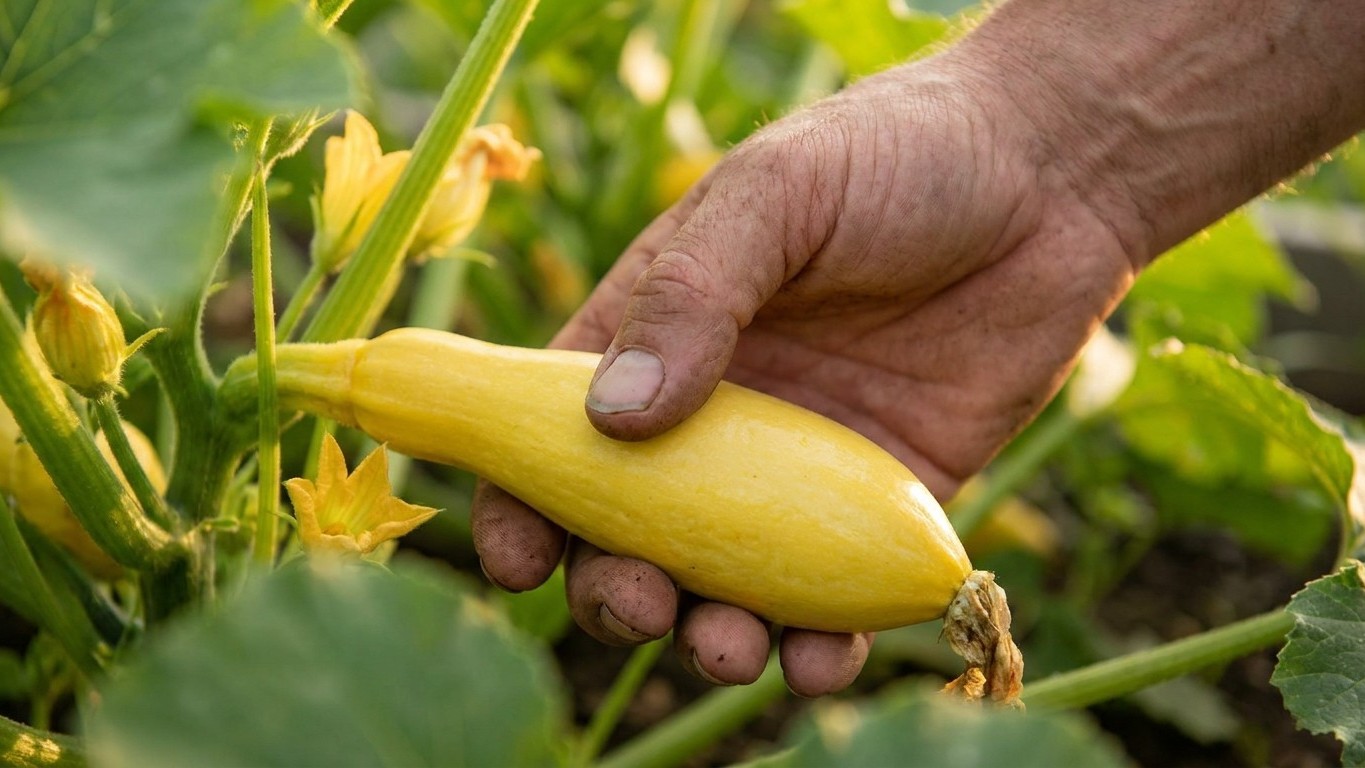

Pick summer squash when it’s still immature: skin easily pierced with a fingernail, seeds barely formed, size smaller than what you’d expect from a grocery store shelf. Check the plants daily during peak season, because a fruit that looks perfect on Monday can turn fibrous and bloated by Thursday.
What is actually going on

The thing to understand here is that a maturing squash sends a signal back to the plant, and that signal says stop. Summer squash, like other cucurbits, produces hormones tied to seed development. Once a fruit is allowed to swell and its seeds start hardening inside the cavity, the plant redirects energy toward finishing that fruit rather than setting new female flowers. Leave two or three squash to balloon on the vine and you’ll often see blossoms drop or simply fail to open at all. The plant thinks its job is done.
That’s the biology behind the folk wisdom that picking often “keeps the plant producing.” It’s not a myth or a gardening superstition. It’s a direct feedback loop between fruit maturity and flowering, well documented in horticultural physiology research on cucurbit crops. A gardener who picks small and picks daily is, in effect, tricking the plant into thinking it hasn’t finished reproducing yet, so it keeps trying.
The texture change follows the same logic. Early on, the flesh of a summer squash is mostly water held in tight, thin-walled cells, with a seed cavity so small you barely notice it. As the fruit ages, those cells thicken their walls and the seed cavity expands, filling with harder, more developed seeds. That’s why an oversized squash feels spongy near the skin and almost woody at the core. It isn’t spoiled, exactly. It’s just built differently than it was three days earlier, and no amount of cooking technique fully undoes that shift.
Skin toughness follows a similar curve. A young summer squash has a skin so thin it disappears when cooked. Left on the vine, the skin thickens as a protective layer, partly to guard the maturing seeds inside. That thickened skin is a big part of why an overgrown squash tastes bitter or bland to some people; the ratio of tender flesh to tough exterior has flipped.
None of this depends on which type of summer squash you’re growing, whether it’s a straightneck, a scallop type, or a zucchini-style variety. The mechanism is shared across the group because they’re all immature fruit of the same species harvested before full seed development, unlike winter squash, which is left to mature and cure. For guidance on which types perform well in a given region, a state Cooperative Extension office is a far more reliable source than a seed catalog description, since local trial data reflects actual growing conditions rather than marketing language.
In the garden
Timing and technique matter more than most gardeners assume, and small mistakes at the cutting stage cause problems days later. The table below breaks down the main decisions and what tends to go wrong when they’re handled carelessly.
| Decision | What to do | What happens if you get it wrong |
|---|---|---|
| Size to pick at | Harvest when the fruit is still small relative to its mature potential, skin glossy and easily marked with a fingernail. | Wait too long and the plant slows new fruit set; the picked squash turns fibrous and watery inside. |
| How to cut | Use a clean knife or pruning snip to cut the stem about half an inch above the fruit, rather than twisting or pulling. | Twisting tears the stem tissue, leaving an open wound that invites rot organisms into the main vine, sometimes killing the whole plant. |
| Frequency of checking | Walk the rows daily, or every other day at minimum, during peak summer growth. | Skip a few days in warm, humid weather and fruit that was pickable-sized balloons past its window without warning. |
| Handling after cutting | Set harvested squash somewhere shaded and cool rather than leaving it in direct sun in a bucket. | Sitting in full sun for hours softens the skin further and speeds up moisture loss, making the flesh mushy sooner than expected. |
Hidden fruit is the most common source of overgrown squash, not neglect. Wide leaves shade the base of the plant, and a fruit tucked under foliage can go from pickable to marrow-sized without ever being seen. Lifting leaves gently during each check, rather than scanning from a standing distance, catches fruit that would otherwise get missed for days.
A fruit that got away isn’t necessarily wasted. A squash that’s grown past its ideal picking window, sometimes called a marrow at that stage, still has uses. The seeds can be scooped and dried for next season’s planting, provided the parent plant wasn’t a hybrid where seed won’t reliably reproduce the same traits. The flesh, while too coarse for quick sautéing, works reasonably well grated and squeezed dry for baking, or hollowed out and stuffed, since longer cooking times soften the denser texture. It’s not the same eating experience as a young squash, but it isn’t compost either, unless the skin has cracked or shows soft rot, in which case discarding it is the safer call.
One detail that trips up new gardeners: scallop-type and round summer squash types mature differently in appearance than the long, cylindrical types, so “small” looks different depending on shape. Rather than judging by a size in inches learned from a general guide, judge by feel: skin that resists a fingernail press even slightly is a sign the fruit has moved past its best window, regardless of shape or type.
What it depends on where you are
How often a plant needs checking, and how fast a fruit moves from ready to overgrown, has almost nothing to do with technique and almost everything to do with local weather.
Season length changes how much slack a gardener has. In regions with a long, warm growing season, plants keep setting fruit over many weeks, so missing a picking window on one plant is less costly overall since more flushes follow. In areas with a short season, every fruit set matters more, and losing productive weeks to an oversized, hormone-signaling fruit left on the vine has a bigger effect on total harvest.
Heat is the other major variable, and it works in both directions. High summer heat speeds up fruit development, sometimes dramatically, meaning a squash can move from pickable to overgrown in a day or two rather than three or four. But extreme heat can also stress plants into dropping blossoms or producing misshapen fruit regardless of picking habits, which is a separate issue from harvest timing. Cooler regions see slower fruit development, which gives more forgiving margins between checks, but also generally shorter overall growing windows.
Rainfall and humidity influence a different part of the equation: disease pressure at the cut stem. In humid climates, the open wound left by harvesting is more exposed to fungal and bacterial issues, which is part of why clean, non-tearing cuts matter more in the Southeast or the humid Midwest than in a dry, low-humidity region where cut surfaces dry out and seal faster.
None of these variables are fixed rules, because “warm” and “humid” mean different things in different states, and even within a state, a coastal garden and an inland garden can run on different clocks. A state’s Cooperative Extension Service tracks local trial data, frost dates, and regional pest and disease pressure specific to that area, and is a far better source for the specifics than a generalized national guide. The USDA’s Cooperative Extension System directory is the fastest way to find the right office. For type-specific advice within this site, the state guides linked from the summer squash hub break down regional planting windows and locally trialed types in more depth than a general harvesting page can.
The mistake that costs the most
The single costliest error isn’t picking too small, too big, or even cutting wrong. It’s letting one or two fruit mature fully “just to see” or because a gardener assumes the plant can spare it. That one decision resets the plant’s signal from actively producing to winding down, and the effect isn’t limited to that one fruit.
Gardeners often treat an overgrown squash as an isolated loss: one fruit gone soft, no big deal, plenty more coming. But the mechanism described earlier means that fruit sitting on the vine, seeds hardening, actively tells the plant to slow new flower production. The real cost isn’t the one squash. It’s the flush of smaller fruit that never sets because the plant redirected its energy toward finishing the one it thinks is done.
This mistake compounds because it’s invisible in the moment. A gardener doesn’t see fewer blossoms forming; they just notice, a week or two later, that the plant “isn’t producing like it used to.” By then the connection to that one overlooked fruit is easy to miss entirely, and the instinct is often to blame the weather, the soil, or the type of squash rather than the missed harvest days earlier.
The fix is straightforward and doesn’t require any special technique: treat every mature fruit as a cost, not a bonus. If a squash is found that’s already past its ideal window, cut it off anyway, even if it’s headed straight for the compost pile rather than the kitchen. Removing it still sends the “keep producing” signal back to the plant, even though the fruit itself won’t be worth eating fresh. Waiting to remove it “since it’s already too big to matter” is exactly the reasoning that turns one missed fruit into a plant that stalls out weeks before the season’s actual end.
Daily or near-daily checks matter less because of any single perfect harvest and more because they prevent this exact scenario from happening unnoticed. A missed fruit found on day three is a minor loss. The same fruit found on day ten, after quietly suppressing new flowers the whole time, is the difference between a productive plant and a disappointing one.