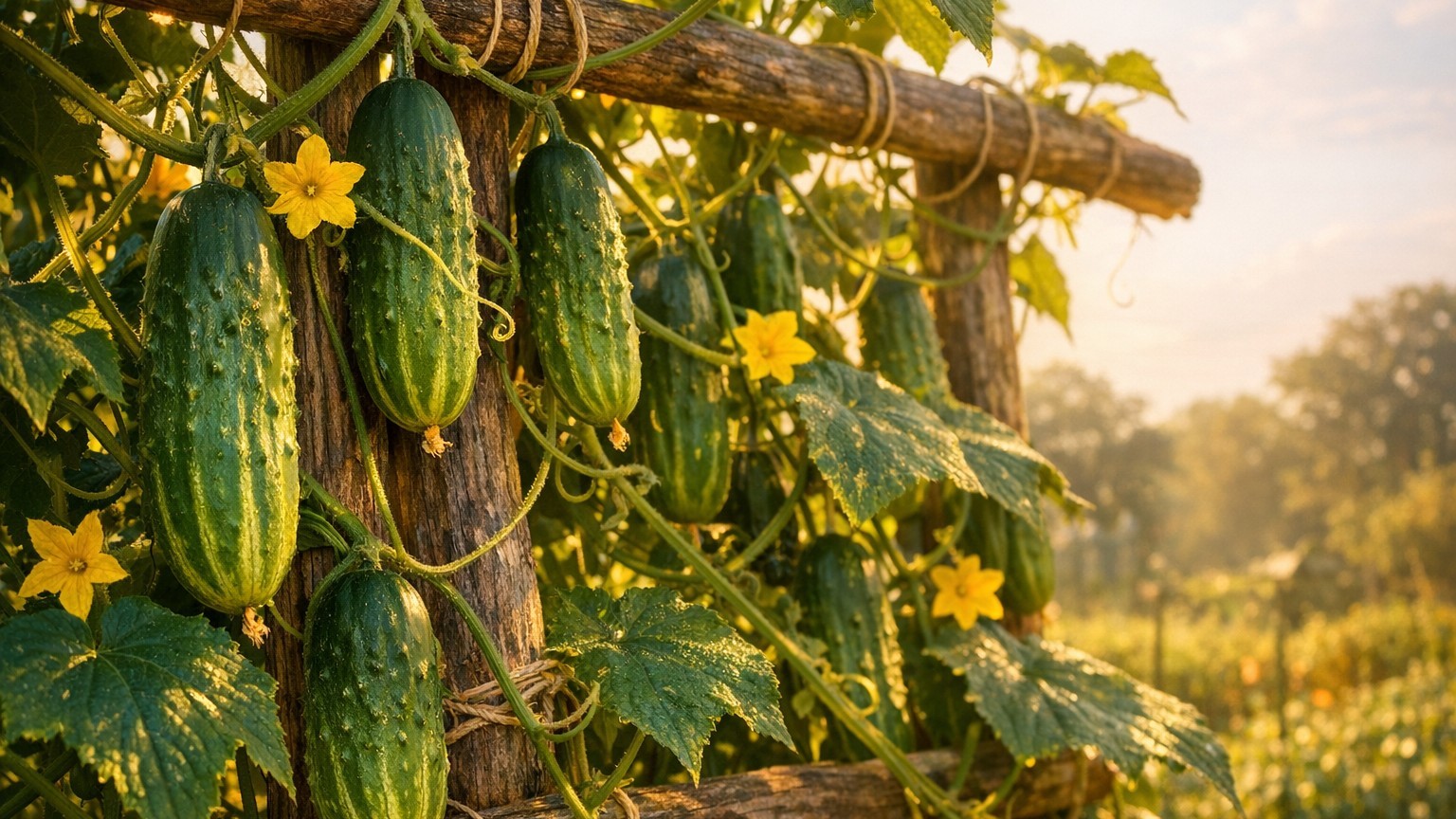

New Hampshire’s growing season runs long enough at low elevation for most cucumber types, but its cool summers change the calculus. Vining slicers and pickling types both work if the soil is warmed early; bush and parthenocarpic types make more sense at altitude or in the North Country, where the frost-free window shrinks fast.
The short answer for New Hampshire
The frost-free window at the reference station (Manchester) runs from a last spring frost of April 16 to April 27, out to a first fall frost of October 13 to October 26. Take the conservative ends of both bands, and the safe planting-to-harvest window is roughly 170 days. That is long by cucumber standards, since the crop typically needs somewhere between seven and ten weeks from transplant to first harvest depending on type. Season length, is not what limits a New Hampshire cucumber patch. Heat is.
The reference station averages just 10.9 days a year at or above 90F. That is a modest heat load, well below what cucumbers get in the mid-Atlantic or the Southeast, and it means the soil stays cooler into June than a seed packet written for a national audience assumes. Cucumbers germinate and set fruit poorly when soil sits below the mid-60s Fahrenheit, so the practical decision in New Hampshire is less about which type and more about how you get heat to the row early: black plastic mulch, row cover pulled back on warm days, or raised beds that drain and warm faster than flat ground.
Within that constraint, both major fruit types have a place. Slicing cucumbers, grown on a trellis to keep the fruit clean and straight, do well anywhere in the state below about 1,500 feet as long as the bed was warmed before transplant. Pickling types, generally more compact and quicker to size up, suit gardeners who want a shorter window between planting and first harvest, or who are gardening at higher elevation where the season runs tighter than the state average. Burpless and parthenocarpic types, which set fruit without pollination and often carry better resistance to leaf disease, are worth considering specifically because New Hampshire summers combine moderate rainfall with cool nights, a combination that favors fungal disease on standard varieties left to sprawl on damp ground.
Bush types earn their keep in two situations: small raised beds or containers on a deck, and the shorter seasons of northern counties or hill towns where a vining type planted at the normal date risks running out of warm days before it finishes. None of this replaces a look at your own county’s trial data, covered further down, but as a starting frame: trellised slicers and pickling types for the Merrimack Valley and seacoast, bush or parthenocarpic types for the North Country and anywhere gardening above roughly 1,200 feet.
What will not work here
Two failures show up again and again in New Hampshire cucumber patches, and both trace directly to the numbers above rather than to bad luck.
Heat-hungry types planted on schedule but in cool soil
With only 10.9 days a year above 90F, the state simply does not deliver the sustained heat that some vining slicer types, bred and popularized in hotter regions, use to size fruit quickly and keep vines vigorous through midsummer. Direct-seeded into soil that has not been warmed, these plants sit and sulk for two or three weeks rather than germinating promptly, then push flowers into a June that is often still cool at night. The fix is not a different variety so much as a different start: pre-warm the bed with black plastic for a week or two before the last frost date passes, or start seed indoors and transplant once night temperatures are reliably above 55F.
Ground-trailing vines in a wet July
Summer rainfall averages about 10.7 inches across June, July and August, with July, the driest of the three, still delivering 3.3 inches. That is enough moisture, combined with New Hampshire’s humid air, to keep foliage wet for long stretches when vines sprawl on bare soil. Powdery and downy mildew move fast under those conditions, and a planting spaced too tightly on the ground, with leaves touching and no airflow, can go from healthy to yellowed and defoliated within two weeks in a wet stretch. Trellising solves most of this by lifting foliage into moving air and letting morning dew burn off faster. Tight spacing is the other half of the problem: a bed planted at seed-packet spacing for a drier state will be overcrowded here.
A third, smaller failure: relying on a single planting date. Because the frost date bands span an 11-day window at each end of the season, a planting timed to the earliest end of the safe range can still meet a late frost in a cooler-than-average year. Succession planting, two weeks apart, both spreads risk and spreads harvest.
What changes across New Hampshire
New Hampshire is not one garden, and the hardiness zone range makes that plain: the state spans USDA zones 3b through 6a, one of the widest spreads of any state on the map. That is the difference between a growing season long enough for two successions of vining cucumbers and one where a single bush planting barely finishes before frost.
The reference figures used above, both the frost dates and the heat-day count, come from the Manchester station in the state’s warmer, lower-elevation south. A garden in the Connecticut River valley or the seacoast lowlands likely tracks close to those numbers. A garden in Coos County, the White Mountains, or any hill town sitting several hundred feet above its valley floor is very likely gardening several zones colder, with a last frost that can run two to three weeks later than Manchester’s and a first fall frost that arrives correspondingly earlier. At that end of the range, bush and fast-maturing types, plus black plastic mulch and row cover as standard practice rather than backup, are less a preference than a requirement.
There is no single planting date or single variety type that fits the whole state, and any page, including this one, that gives one is speaking for the reference station, not for every county. The practical move is to treat the numbers here as the southern, low-elevation case and to shift everything later and shorter as elevation and latitude increase: later transplant dates, earlier expected fall frost, and a bias toward bush or short-season types the further north or higher you garden.
Where to check this for your own county
This page gives the state-level picture, built from one reference weather station and one statewide hardiness zone range. A county recommendation will beat it every time, because it accounts for the frost dates, soil types and elevation of your actual garden rather than an airport thirty or eighty miles away.
The University of New Hampshire Cooperative Extension is the source to check next. Look specifically for two things once there. First, a county-level or regional planting calendar, which will translate the statewide frost bands into a date range for your actual location rather than the Manchester reference station used in this article. Second, any variety trial results or vegetable production guidance published for New Hampshire conditions, which will name cucumber types actually tested for disease resistance and yield performance under the state’s climate rather than a generic seed-catalog description written for a national market.
Cooperative Extension offices also run master gardener programs and often field direct questions by phone or email during the growing season, which is useful if your garden sits at a noticeably different elevation than the rest of your county or in a known frost pocket. Nothing on this page substitutes for that local check. The frost dates and hardiness zone range cited here describe New Hampshire in aggregate; they were never meant to describe one particular hillside in Coos County or one particular yard in Rockingham County, and the extension service is where that gap gets closed.
Checking this against your own garden
Frost dates and hardiness zones are averages built from decades of weather station data. Your own garden, on a given year, will not match them exactly, and three simple observations will tell you more than any date on this page.
Soil warmth by feel comes first. Push a finger a couple of inches into the bed in mid-morning, a few days in a row. If it still feels cold rather than cool, cucumber seed will sit rather than germinate, regardless of what the calendar says about the last frost having passed. Waiting an extra week for soil that feels reliably warm through the day usually outperforms planting on schedule into cold ground.
The first flush of male flowers is the second signal. Cucumbers produce male blooms before female ones, sometimes by a week or two, and an early wave of males with no fruit-set is normal, not a sign of failure. It tells you the plant has moved past the vegetative stage and pollination is about to start mattering, which is useful information if you are deciding whether to add row cover back for a cool night.
Third, watch the first true leaves, the ones that appear after the rounded seed leaves. Their size and color say more about your particular bed’s fertility and drainage than a soil test taken elsewhere in the county. Small, pale true leaves point to a bed that needs more organic matter or a nitrogen boost; broad, dark green ones mean the bed is doing its job and the planting date you chose was sound for that spot.