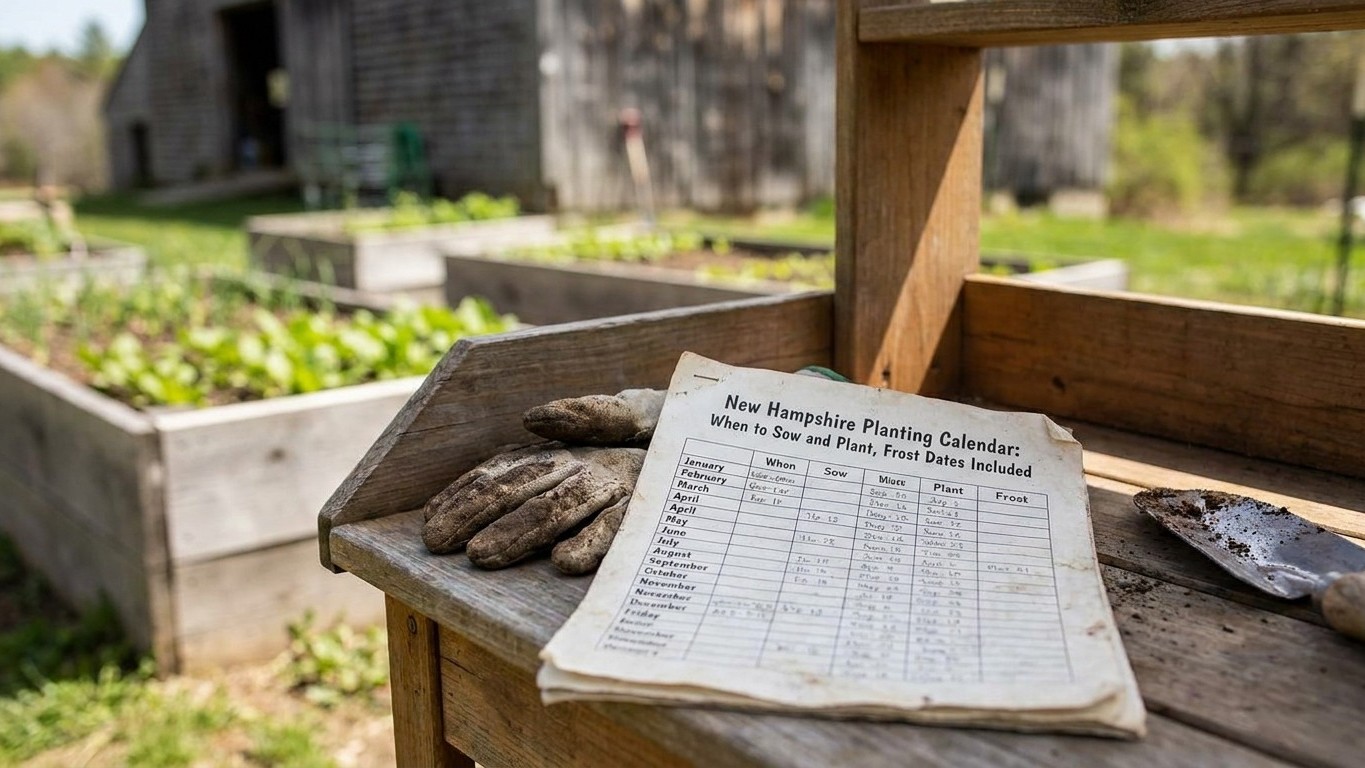

New Hampshire’s growing season runs from the last spring frost to the first fall frost, and at the Manchester airport station NOAA’s 1991-2020 climate normals put those dates at April 16 to April 27 in spring and October 13 to October 26 in fall. That’s a season of roughly five and a half to six months in the mildest part of the state, shorter almost everywhere else. Check your own town’s typical frost dates against Manchester’s before you commit a single planting date to paper.
The frost window in New Hampshire

New Hampshire’s frost dates decide this whole calendar, and the Manchester answer — last frost April 16 to 27, first fall frost October 13 to 26 — is only a starting point, not your town’s number. If you garden in Berlin, the Lakes Region, or anywhere north of the Whites, push those dates a week or two later in spring and earlier in fall. Start there: pin down your own town’s frost dates against Manchester’s before you write down a single planting date.
This is a single weather station’s record, not a state-wide promise. Manchester sits in the Merrimack Valley, one of the milder pockets in New Hampshire, and the pavement and buildings around the airport hold heat that a farm field ten miles away does not. Gardeners in the Lakes Region, the Monadnock area, or anywhere north of the White Mountains should expect the last frost to arrive later and the first fall frost to arrive earlier than the Manchester figures, often by one to two weeks, and considerably more at elevation. A garden at 1,500 feet in Coos County can lose several weeks of season compared to a valley garden thirty miles south, which is worth keeping in mind well before the growing season begins, when you check What to Plant in New Hampshire in January to start planning indoors, then when you check What to Plant in New Hampshire in March before the season even opens, then again when you check What to Plant in New Hampshire in April against your own local frost dates, then What to Plant in New Hampshire in May as the season gets fully underway, again a couple months later when you plan What to Plant in New Hampshire in June, once more when you check What to Plant in New Hampshire in July as summer peaks, later still when you check What to Plant in New Hampshire in August as the height of the season gives way to fall, and finally once the garden has gone quiet, when you check What to Plant in New Hampshire in December to plan the year ahead its later plantings, then when you check What to Plant in New Hampshire in September as the season starts winding down, again as the first frosts approach when you check What to Plant in New Hampshire in October, and once more at the other end of the year when you check What to Plant in New Hampshire in November as the frost closes the season back down.
Subtract one range from the other and the frost-free season at Manchester runs from a little under 170 days, if you pair the latest possible spring frost with the earliest possible fall frost, up to nearly 190 days if the two land on their earlier and later ends instead. That’s the arithmetic worth doing for your own town: find your county’s typical dates through UNH Extension, then run the same subtraction. Compare that to a state with a genuinely long season: South Carolina’s planting calendar works with a frost-free window that stretches months longer, which is why its transplant dates and crop list look so different from New Hampshire’s.
That season length is the reason crop choices differ so much across the state. A gardener in Manchester or along the Seacoast can push slower long-season crops close to their limit, while the earliest of that work still starts with a look at What to Plant in New Hampshire in February. A gardener in Berlin or the Great North Woods works with a season closer to the shorter end of that range, and does better sticking to fast cultivars and covering plants with row fabric on either end of the season.
Cool-season crops
Peas, spinach, lettuce, brassicas and most root crops tolerate a light frost and germinate in cold soil, so they go into the ground well before Manchester’s April 16-27 last-frost window closes, not after it.
Peas and spinach can be direct-sown as soon as the ground can be worked, sometimes four to six weeks ahead of the last frost date, because both germinate in soil that’s still cold and both shrug off a hard freeze once they’re up. Lettuce and other leafy greens follow a similar rule. They can go in two to four weeks before the last frost under a floating row cover, earlier than most new gardeners assume, because a few degrees of frost damages outer leaves at worst and the plant recovers within days.
Brassica transplants, meaning broccoli, cabbage, kale and their relatives, handle the same early window but do best started indoors first. A transplant four to six weeks old goes outside around the same time as the peas, two to three weeks before the last frost, and shrugs off a night in the high twenties that would kill a tomato outright.
Root crops and the soil test
Carrots, beets, radishes and turnips are direct-sown rather than transplanted, so their planting date depends on when the soil is workable more than on the frost date itself. In practice that’s often the same early window as peas, sometimes a week or two later for carrots, which germinate more slowly in cold soil than radishes do. A soil test through UNH Extension before this first planting tells you whether the bed needs lime or amendment, which matters more for root crops than almost anything else, since a compacted or acidic bed forks and stunts the roots as they grow.
Warm-season crops

Tomatoes, peppers, squash, beans and corn all die at temperatures that cool-season crops shrug off, so they wait until well after Manchester’s last-frost window rather than going in right at its edge. Soil temperature matters more than the calendar date. Cold, wet soil rots seed and stalls transplants even on a night that never dips to freezing.
Beans and corn germinate poorly in soil that’s still cold from winter, and squash and cucumbers want it warmer still. Waiting one to two weeks past your local last-frost date, rather than planting the moment it passes, usually means the difference between seed that rots in the ground and seed that comes up within a week. A gardener working from New Jersey’s planting calendar, where the frost window opens weeks earlier, would find New Hampshire’s warm-season start dates surprisingly late by comparison.
Tomato transplant dates, worked backward
Tomato varieties are rated in days to maturity from transplant, not from seed, and that count assumes a full season of warmth after the plant goes into the garden. Because Manchester’s last frost falls between April 16 and April 27, and NOAA’s normals put the first fall frost between October 13 and October 26, the safe transplant window for tomatoes across most of the state runs from late April to mid May, and the same rough window works for peppers and other frost-tender transplants.
Count backward from that transplant window to find the seed-starting date indoors. Most tomato cultivars need six to eight weeks of indoor growth before they’re ready to go out, which puts the indoor sowing date somewhere around early to mid March for a late-April transplant, and a little later into March for a mid-May one. Start too early and the seedlings get leggy waiting for the ground to warm.
The table below uses that same late April to mid May transplant window for every cultivar and shows each one’s margin, the number of days left before Manchester’s first fall frost window opens once the fruit starts ripening. A shorter-season cultivar like Sakura banks 100 days of margin. A long-season paste tomato like San Marzano II banks 77, which still clears the fall frost window comfortably but leaves less room for a cold, wet spring that delays transplanting.
| Variety | Days to maturity (from transplant) | Habit | Disease resistance | Margin before fall frost |
|---|---|---|---|---|
| Sakura | 55 | Indeterminate | Nematodes, ToMV, Fusarium 1&2 | 100 days |
| Edox | 55 | Indeterminate | Nematodes, ToMV, Fusarium 1&2 | 100 days |
| Valentine | 55 | Indeterminate | Early Blight | 100 days |
| Glacier | 55 | Determinate | None listed | 100 days |
| Sun Gold | 57 | Indeterminate | TMV, Fusarium 1 | 98 days |
| Supersweet 100 | 60 | Indeterminate | Verticillium, Fusarium 1 | 95 days |
| Juliet | 60 | Indeterminate | Late Blight, Early Blight | 95 days |
| Amalfi | 68 | Determinate | Nematodes, Late Blight, Early Blight | 87 days |
| Cherokee Purple | 72 | Indeterminate | None listed | 83 days |
| Big Beef Plus | 72 | Indeterminate | Nematodes, Gray Leaf Spot, ToMV | 83 days |
| Tiren | 75 | Indeterminate | Verticillium, ToMV, Fusarium 1 | 80 days |
| Granadero | 75 | Indeterminate | Nematodes, Verticillium, ToMV | 80 days |
| San Marzano II | 78 | Indeterminate | None listed | 77 days |
| Celebrity Plus | 78 | Determinate | Nematodes, Gray Leaf Spot, ToMV | 77 days |
Peppers, squash, beans and corn follow the same logic even though they’re not in the table above. Check the days-to-maturity on the seed packet, add it to your local transplant or direct-sow date, and confirm there’s enough runway before the first fall frost window opens. A packet’s days-to-maturity figure is measured under the trial farm’s own conditions, and it usually runs a week or two behind schedule in a Coos County garden compared to one on the Seacoast.
The fall planting window
Working backward from the first fall frost is the same arithmetic as counting forward from the last one, just aimed the other direction. Manchester’s first fall frost falls between October 13 and October 26, according to NOAA’s 1991-2020 normals, so a fall crop needs its full days-to-maturity, plus extra time for the shorter, cooler days of September, to finish before that window opens.
Add roughly two extra weeks onto the seed packet’s days-to-maturity figure for anything sown for a fall harvest. A packet that says 30 days for a baby lettuce mix, sown at the height of summer, is a more honest 40 to 45 days by the time September’s shorter daylight and cooler nights slow it down. Count back from the earlier end of Manchester’s fall frost window, October 13, to leave margin for a cold September in the parts of the state that run behind the reference city.
What to plant again, and what improves with frost
Lettuce, spinach, peas, and quick brassicas like bok choy can all go in for a second round once the summer heat that would otherwise bolt them starts to ease. Root crops sown for fall, like carrots, beets and turnips, are worth the wait. A light frost converts starches to sugars in the root, and carrots or parsnips left in the ground past that first frost taste noticeably sweeter than ones pulled in August.
Kale and Brussels sprouts do the same thing above ground. Both hold in the garden through several frosts and taste better afterward, so there’s little reason to rush their fall harvest once they’ve reached a usable size. Tender crops go the opposite direction. Any tomato, pepper, squash or bean still in the ground when the first fall frost window opens needs to be picked or covered, since none of them tolerate the freeze the way leafy and root crops do.
This is exactly what the margin figures in the tomato table above are measuring: the gap between a plant’s expected ripening and the point where frost ends its season. A fall crop’s margin works the same way, just counted from a late-summer sowing date back to the October frost window instead of forward from a May transplant.
Reading a planting calendar properly
A state-wide planting calendar, including this one, is a starting point built from a single weather station. It cannot know whether your garden sits in a frost pocket at the bottom of a slope, on a warm south-facing hill, or next to a lake that moderates both spring and fall temperatures.
Elevation is the biggest factor after the Manchester baseline. Every rise in elevation delays the last spring frost and hurries along the first fall frost, so a garden in the White Mountains or the North Country works with a noticeably shorter season than the Manchester figures suggest, sometimes by several weeks rather than days. Lake effect works the other way in narrow bands near large bodies of water, where the water holds heat into fall and delays the first frost locally, and does the same in reverse come spring.
What to track instead of the calendar
Urban heat matters too. Manchester’s airport station sits near pavement, buildings and heat-retaining infrastructure that a rural field forty minutes away does not have, which is part of why the NOAA figures should be treated as an anchor point, not a guarantee, for any garden outside the immediate city.
The most reliable fix is to watch your own garden rather than trust any single date. Keep a written record of your last spring frost and first fall frost for a few years running, note which parts of the yard frost first and which stay clear longest, and use that record instead of a regional average once you have three or four years of it. A late cold snap after weeks of warm weather is the single most common way gardeners lose a full planting of tomatoes or peppers, and it happens most often to gardeners who planted by the calendar date instead of watching the forecast that particular week.
Local help
For frost dates specific to your own county, along with soil testing that tells you what a bed actually needs before you plant, contact UNH Extension. Its county offices track local conditions that a single Manchester weather station can’t, and a soil test costs far less than a season of stunted roots or yellowing brassicas from a pH problem caught too late. Browse our other New Hampshire guides for more region-specific planting and soil advice.
Common questions
Can I just plant tomatoes on Memorial Day and be safe?
Usually, but Memorial Day is a habit, not a frost figure. NOAA’s Manchester normals put the last frost as early as April 16 in some years, meaning transplants could safely go out well before the holiday, while a garden running behind the reference city might still see frost risk into late May. Check your own last-frost pattern rather than the calendar page on the wall.
What if I don’t know the last frost date for my exact town?
Contact UNH Extension’s county office, since they track local variation that the single Manchester station can’t capture. Short of that, keep your own log for a couple of seasons, noting the date of the last frost you actually observed in your yard.
Is it too late to start a garden if it’s already June in New Hampshire?
No. Warm-season crops like beans, squash and shorter tomato cultivars can still be planted into June and mature before the fall frost window, and cool-season crops like lettuce and peas can go back in for a fall crop later in summer.
Do I need to cover plants if a frost is forecast after I’ve already transplanted?
Yes, for anything frost-tender. A bedsheet, row cover or overturned bucket over tomatoes, peppers or squash overnight is usually enough to get them through a light frost, since the goal is just blocking direct exposure to the cold air, not insulating against a hard freeze.
Why did my tomatoes take longer to ripen than the seed packet said?
Days-to-maturity on the packet is counted from transplant under the breeder’s trial conditions, and it shifts by a week or two with a cooler spring, a late transplant, or a garden that runs behind the Manchester baseline. Treat the packet number as a target, not a guarantee, especially in the first year you grow a new cultivar in your own soil.
Related guides
- Maine Planting Calendar: When to Sow and Plant, Frost Dates Included
- Vermont Planting Calendar: When to Sow and Plant, Frost Dates Included
- New Jersey Planting Calendar: When to Sow and Plant, Frost Dates Included