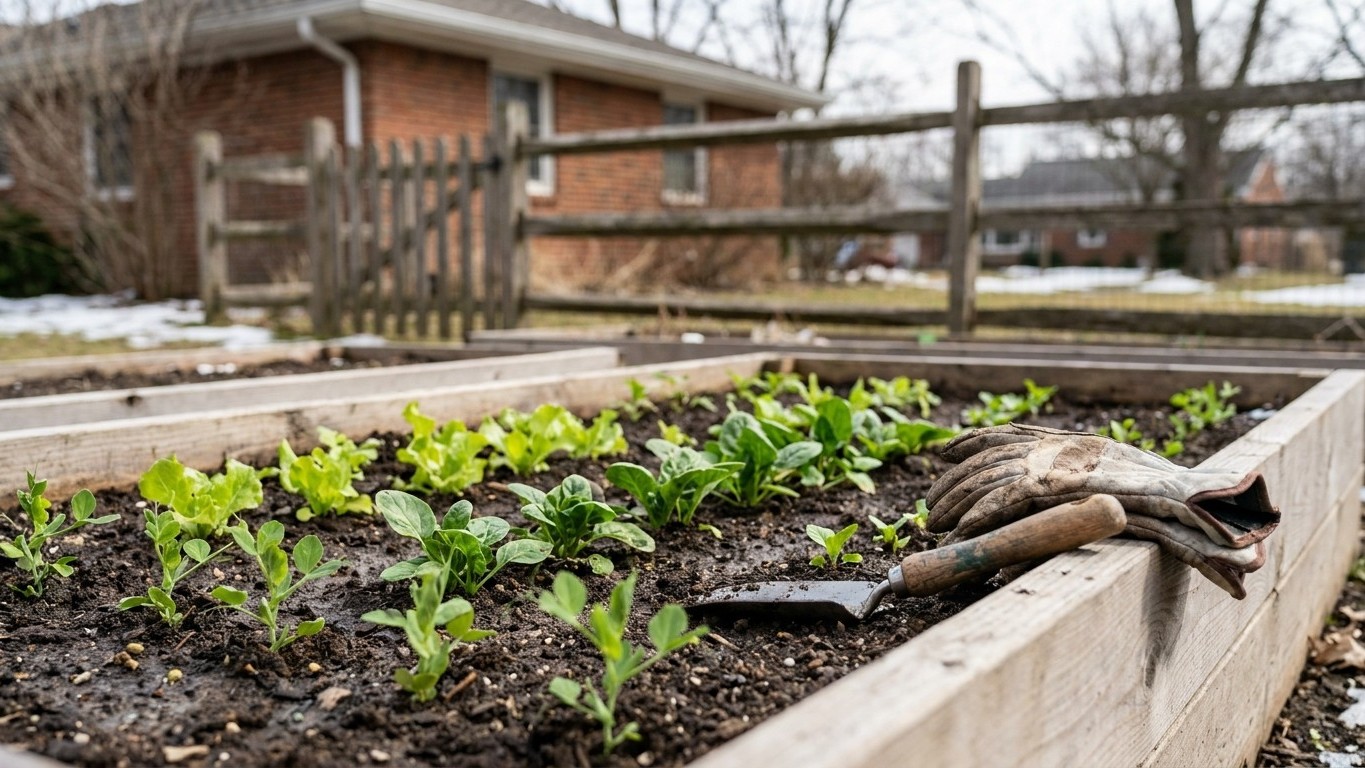

Late winter in New Hampshire means the ground is still shut for business. With average last spring frost falling between April 16 and April 27 across the state, March planting is mostly about bare-root stock, cold frames, and indoor starts, not open-ground sowing.
What goes in the ground in March

Soil temperature decides what survives here, not the page on the calendar. Most vegetable seeds need soil in the 40s or 50s Fahrenheit to germinate reliably, and New Hampshire dirt in March is often still frozen a few inches down, waterlogged from snowmelt, or both. The state’s USDA hardiness zones run from 3b in the North Country to 6a along the Seacoast, a range built on average extreme winter minimum temperatures, not on how fast ground thaws. That spread matters: a gardener in Keene or Nashua may see workable soil by late March in a mild year, while someone in Coos County is still looking at snowbanks.
Given the last-frost window of April 16 to April 27, direct-sowing tender crops this month is a gamble that almost always loses. What actually belongs in the ground now is narrower and more specific.
- Bare-root fruit trees and cane fruit (apples, pears, raspberries, currants) can go in once the ground is workable in the southern tiers, while it is dormant and before buds break
- Asparagus crowns, planted in a trench, tolerate cool soil better than most perennials
- Garlic and shallots missed in the fall window can still be pushed into workable soil early, though fall planting gives better bulb size
- Cold-frame and low-tunnel greens such as spinach, mache, and claytonia, sown under cover where soil warms faster than open beds
- Forced rhubarb and chicory, dug crowns brought into a dark basement or covered with a forcing pot to produce tender early stalks or Belgian endive
Peas are the borderline case. They tolerate cold soil better than almost any other vegetable, but “workable” is the operative word: if the bed is still frozen or a puddle, wait rather than force it.
What to start under cover
Seed-starting math works backward from the frost window, not forward from a fixed date. With last frost landing April 16 to April 27, count back from whichever end applies to a specific county, and always round toward the later date if the exact microclimate is unknown.
| Crop | Weeks before last frost | Approximate indoor start |
|---|---|---|
| Onions and leeks (from seed) | 10 to 12 weeks | Late January to early February; a March start produces smaller transplants |
| Peppers | 8 to 10 weeks | Early to mid-March |
| Tomatoes | 6 to 8 weeks | Mid to late March |
| Cabbage, broccoli, and other brassicas | 6 to 8 weeks | Mid to late March |
The two ways this goes wrong are opposite mistakes with the same result: a weak plant. Start tomatoes or peppers in early February for an April 16-27 transplant date, and the seedlings sit indoors so long they get leggy, rootbound, and stressed before the ground is even ready. Wait until the first week of April to start peppers, and there is not enough time left to build a stocky, productive transplant before the season narrows. The window on this table is not padding; missing it by three weeks in either direction shows up in yield later.
What is ready to pick
Outdoors, March harvests are thin to nonexistent across most of New Hampshire, and pretending otherwise does not help anyone plan a meal. What is realistic falls into three categories. Overwintered crops that were heavily mulched in the fall, kale, leeks, parsnips, and Brussels sprouts among them, can sometimes be dug once the ground softens enough to get a fork in, and a hard frost or two actually sweetens the flavor of parsnips and kale left in place. Cold-frame greens sown back in late winter, spinach and mache especially, are often ready for a first light cutting by late March if the frame has held heat. Indoors, sprouts and microgreens on a windowsill or under a grow light fill the gap in as little as a week to ten days from seed.
The other job this month is inspection, not harvest. Stored squash, potatoes, and onions from the cellar or root cellar need a walk-through: soft spots on squash mean it needs to be used now, potatoes throwing long pale sprouts should be de-sprouted or moved to the compost if they’ve gone rubbery, and onions with wet necks or mold at the base need pulling before they spread rot to the rest of the bin.
The jobs that matter this month
March carries more weight than its harvest list suggests, because several jobs here have hard deadlines tied to plant biology, not preference.
Pruning and structure
Dormant pruning of apple and pear trees, blueberry bushes, and bramble canes should happen before buds swell and sap starts moving. Cut now and the plant heals cleanly over the dormant wound; wait until leaves emerge and every cut becomes a stress event and an entry point for disease. Spring-flowering shrubs like lilac and forsythia are the exception, since pruning them now removes the flower buds already set from last season.
Soil, seed, and stored crops
This is also the moment to send a soil sample to a testing lab, since results and any recommended lime take months to fully adjust pH, and lime applied in March has time to work before summer planting. Popular seed varieties, particularly heirloom tomatoes and specialty peppers, sell out from suppliers by late winter, so ordering now beats discovering a favorite variety is gone in May. Turning the compost pile, sharpening and oiling pruners and hoes, sterilizing seed-starting trays, and repairing raised bed frames or fencing all belong on this month’s list precisely because there is less competing field work than there will be once the ground opens up. None of it is filler; skipping the pruning window or the seed order has consequences that show up months later.
What not to do in March
The most common mistake is trusting a warm afternoon over the calendar of frost data. A 60-degree day in mid-March does not mean the soil has caught up, and direct-sowing beans, squash, or corn now, weeks or months ahead of the April 16 to April 27 frost window, means either rot in cold wet soil or a seedling killed by the next hard freeze.
Pulling mulch off perennial beds or opening cold frames wide after one mild stretch is the second trap. New Hampshire’s hardiness zones are built on average extreme minimum temperatures, which means occasional sharp cold snaps are baked into the climate even in a generally mild season. Strip protection too soon and a late cold snap can undo months of overwintering work in a single night.
Heavy nitrogen feeding, whether on lawns or on perennial beds, is the third misstep. Nitrogen pushes soft, fast top growth, and that new growth has no cold hardiness. Feed now and a following frost can burn back exactly the growth the fertilizer produced. Hold nitrogen applications until growth is already underway and the frost risk has genuinely dropped.
Checking this against your own county
A single frost window for the whole state is a starting point, not an instruction. Elevation alone can push a last frost date back by a week or two for every thousand feet of gain, and areas near large water bodies, Lake Winnipesaukee or Great Bay among them, often see a milder, later spring than inland spots at the same latitude. The gap between the North Country and the Seacoast, reflected in that 3b to 6a hardiness range, routinely runs three to four weeks in either direction on real planting dates.
For a county-level read, the University of New Hampshire Extension service publishes local planting guidance that accounts for these differences far better than a statewide average can.
Common questions
Can I plant grass seed in New Hampshire in March?
Ground is usually still too cold and wet for good seed-to-soil contact this early. Most guidance points to a window closer to the last frost period or later, once soil has warmed and firmed up.
Is it too early to start tomato seeds indoors in March?
Early March is on the early side for most New Hampshire counties given the April 16-27 frost window; mid to late March keeps transplants from getting leggy before it’s safe to move them outside.
Can I still plant garlic in March if I missed the fall window?
Yes, once the soil is workable, though bulbs from a spring planting tend to be smaller than fall-planted garlic, which has a longer root-development period before dormancy.
Why is my region colder than the state average frost date suggests?
Elevation, distance from large lakes, and position in the North Country versus the Seacoast all shift local frost timing, sometimes by several weeks compared with the reference station average.