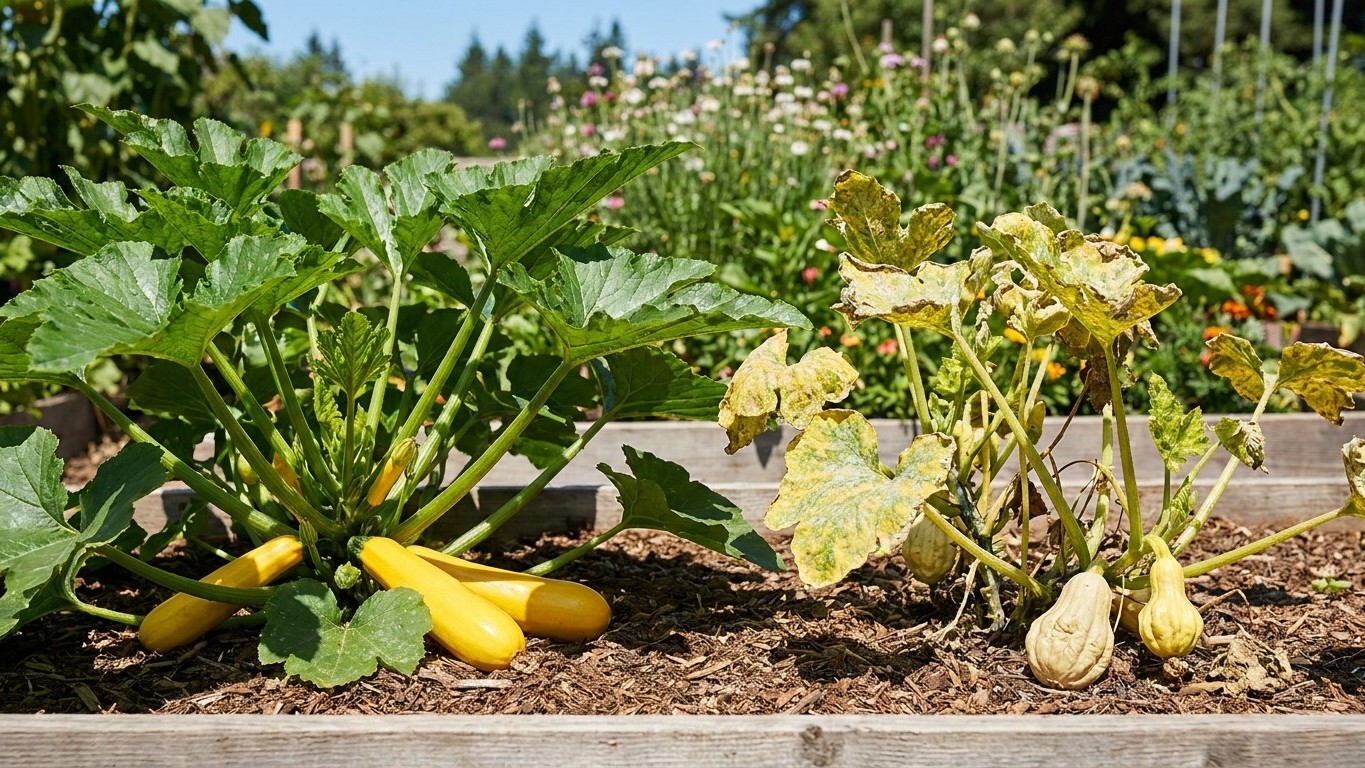

Summer squash burns through its own productivity fast. A single spring sowing gives a heavy few weeks of picking, then a slow, disappointing collapse into misshapen fruit, pale mildewed leaves, and stems chewed hollow by borers. Sowing a second round of the same crop, timed so it takes over right as the first one fades, keeps squash coming steadily until frost instead of one big harvest followed by months of nothing.
What is actually going on
The thing to understand is that a squash plant declines on a schedule of its own, no matter how well it’s watered, fed, or mulched. It isn’t a failure of care. It’s the biology of a fast-growing annual vine that spends everything it has on a short, intense burst of fruiting and then runs out of steam. Understanding that timeline is what makes succession sowing make sense, rather than feeling like extra work for no reason.
Why the plant gives up
A squash plant sets fruit almost continuously once it starts, and each fruit is a heavy draw on the plant’s resources. Early on, the plant has fresh leaves, an expanding root system, and stems still soft enough to move water and nutrients efficiently. A few weeks into heavy picking, that changes. The main stem toughens and partially hollows with age, older leaves get shaded out and stop pulling their weight, and the plant is asked to ripen fruit while also trying to keep growing new flowers. Yield per plant tapers off gradually at first, then drops off a cliff. This happens on the same rough timeline whether the summer has been kind or brutal, which is why gardeners who feed and water aggressively still watch a healthy-looking plant slow down.
Why pests and disease pile up
The second half of the mechanism is biological pressure, not plant fatigue. Squash vine borers lay eggs at the base of stems early in the season, and by the time a home gardener notices sawdust-like frass and a wilting stem, the larvae have already been feeding inside for weeks. Squash bugs build their populations over the same stretch, laying egg clusters on the undersides of leaves in numbers that climb as the season goes on. Powdery mildew works differently but arrives on a similar clock: it needs time to establish and spread across leaf surfaces, and it tends to show up in force right as nights start cooling in mid-to-late summer, which is exactly when an aging first planting is least able to fight it off. None of this is really about one bad practice. It’s cumulative pressure meeting a plant that’s already past its peak.
A second sowing sidesteps both problems at once. A younger stand of plants, started weeks later in a different patch of ground, is still building strength and setting its first flowers right as the original planting is losing the fight to borers, bugs, and mildew. The garden ends up with overlapping waves of vigor instead of one long fade.
In the garden
The practical question is when to start that second sowing. The answer is counted backward from the first fall frost date for a given area, not forward from spring planting, because what matters is that the new plants have enough time to mature and produce before the season ends. A rough rule that works across most of the country: figure out how many weeks a squash type needs from seed to first harvest (check the seed packet or a state extension trial report for the specific type being grown), add a few weeks of cushion for a slower fall ramp-up, and count that total backward from the average first frost date. That gives a sowing window, not a single day.
| Step | What it looks like | What happens when it goes wrong |
|---|---|---|
| Pick the sowing window | Count backward from the local first frost date, using the seed’s maturity time plus a few weeks of buffer | Guessing a date from memory or from a neighbor’s schedule in a different climate zone often lands too late, and the second planting never finishes before frost |
| Choose a new spot | Move the second sowing to a different bed or at least several feet away from the first planting | Sowing right next to the aging first crop lets vine borers and squash bugs walk straight over, and the “fresh start” is infected or infested within days |
| Sow, don’t transplant if possible | Direct-seed into warm soil, since squash resents root disturbance | Starting seedlings indoors and transplanting late in the season often sets them back for a week or two, eating into the already tight window before frost |
| Watch the first planting’s decline | Keep picking the original plants right up until they truly stop producing | Pulling the first planting too early wastes fruiting weeks it still had left; leaving it too long lets pest pressure build and spread to the new bed |
| Adjust if frost is early or late | Treat the sowing date as a target, and be ready to use a lightweight row cover if an early cold snap threatens young plants | Treating the date as fixed rather than a guide means one unusually cold September can wipe out a second planting that was only days from producing |
The overlap is the point. Done well, the first planting is still limping along with a few fruit a week while the second planting is just starting to flower, so the kitchen never really goes without. Done poorly, either the sowing happens too late and frost gets there first, or it happens right next to the collapsing first planting and inherits the same pest problems within a week or two.
What it depends on where you are
Some of this advice is genuinely national, and some of it isn’t, and it’s worth being honest about which is which. The mechanism itself, plants slowing down after a few weeks of hard fruiting, pest pressure building over the season, mildew arriving as nights cool, holds true almost everywhere squash is grown. What doesn’t hold true everywhere is the calendar.
Season length is the biggest variable. A short growing season leaves a narrow window between “soil warm enough to sow” and “first frost,” which can squeeze out room for a true second sowing entirely, or shrink the buffer to almost nothing. A long, warm season can sometimes support a third sowing, not just a second, because there’s enough time on both ends. Summer heat changes things too: in regions where midsummer temperatures regularly climb into the high 90s, squash flowers can drop without setting fruit during the hottest stretches, which shifts when the “productive window” for a sowing actually falls. Summer rainfall and humidity matter just as much, since powdery mildew and other fungal problems spread faster and earlier in humid regions than in dry ones, which can push the practical value of a second sowing earlier in the calendar than the frost-date math alone would suggest.
None of that can be answered generically, and this page isn’t going to invent a date, a zone, or a temperature for a specific place. The state-level guides on this site cover growing-season length and summer conditions in more useful detail for a given region, and a state extension service (usually tied to the state’s land-grant university) publishes frost date averages and variety trial results specific to that state’s climate. Those two sources, together, turn the general timing rule above into an actual date a gardener can put on a calendar.
The mistake that costs the most
The single most expensive mistake with succession squash isn’t picking the wrong sowing date. It’s waiting to sow the second round until the first planting visibly starts failing. By the time yellowing leaves, hollow stems, or a dusting of mildew make the decline obvious, several weeks of the sowing window are already gone, and there often isn’t enough time left before frost for a new sowing to mature.
The decline happens on a schedule the plant follows regardless of how it looks from the outside, and that schedule starts well before the visible symptoms do. Waiting for the evidence means reacting to a problem that’s already several weeks old.
The fix is simple, even if it feels counterintuitive: sow the second round on a calendar date decided in advance, based on the local first frost date and the maturity time of the squash type being grown, regardless of how healthy the first planting still looks. If the first planting happens to still be productive when the second one starts flowering, that’s not wasted effort, it’s the overlap that keeps the harvest steady. Marking that sowing date at the start of the season, rather than deciding it in the moment, is what actually makes a second sowing work the way it’s supposed to.