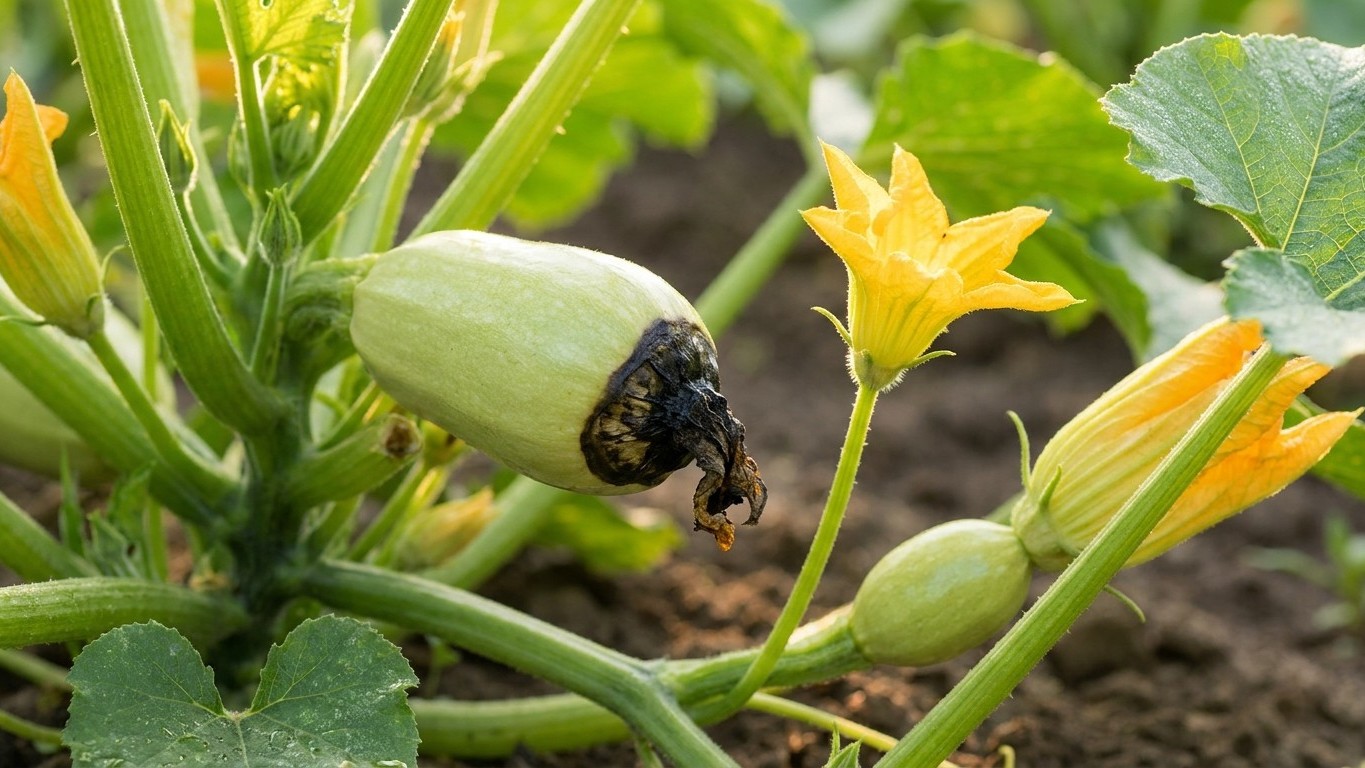

A young summer squash that shrivels and blackens at the tip almost always means one thing: the flower was never fertilized, and the plant is quietly abandoning a fruit it has no intention of finishing. The rot that follows is decay moving in on dead tissue, not a disease attacking a healthy one. The fix is rarely a spray. It’s usually about bees, timing, or a hand pollinating in the morning.
What is actually going on
Summer squash plants produce two kinds of flowers on the same vine: male flowers on long thin stems, and female flowers with a tiny swollen bulge behind the petals, that bulge is the ovary, the future fruit. If a bee never moves pollen from a male flower to that female flower within roughly a day of it opening, fertilization never happens. The plant senses this failure and cuts its losses. It stops sending water and sugars to that ovary, and the tissue starts to die from the blossom end inward, the exact spot farthest from the plant’s own supply line.
Rot organisms, common fungi and bacteria already living on leaf and soil surfaces, are opportunists. They move into dying tissue because dying tissue offers no resistance, not because they caused the death in the first place. That’s the order of events worth remembering: abortion first, decay second. A gardener who sprays a fungicide onto a shriveling tip is treating the second event while the first one, the pollination failure, keeps repeating on every new flower.
Several things can break the pollination chain. Cool, wet mornings keep bees in the hive and pollen damp and clumped. A run of very hot days can make pollen less viable even when bees are active. Early in the season many plants open a flush of male flowers before the first females appear, so there’s simply no pollen source yet even though fruit is starting to set. Later, a garden with heavy insecticide use nearby, including on ornamentals a few yards away, can thin out the bee traffic a squash patch depends on. None of this is a flaw in the seed. It’s a mismatch between flower biology and what’s flying through the garden that week.
Different types, same mechanism
Yellow crookneck, straight-neck, zucchini-type, and scallop or patty pan squash all share this same flower structure and the same vulnerability to poor pollination. Some strains set fruit a little more readily under marginal conditions than others, but no catalog description can tell a gardener how a given planting will behave in a specific yard this year. A state extension service that has trialled squash locally is a far better source for which types have performed well in a given region than any general guide can be.
In the garden
The tricky part is that an aborting, unpollinated fruit and true blossom-end rot can look similar at a glance, a dark, shrunken patch near the tip, but they come from different causes and need different responses. The table below separates the two.
| Sign | Likely cause | What happens if ignored | What to do |
|---|---|---|---|
| Fruit stays small (finger-sized), tip turns yellow then brown then black, whole fruit shrivels and softens within days | No fertilization; plant is aborting the ovary | The fruit dries out or turns mushy and drops or has to be pulled off; the plant keeps repeating this on the next few flowers if pollination stays poor | Check for both male and female flowers open the same morning; hand pollinate with a small brush or a picked male flower, or improve conditions for bees |
| Fruit grows to a decent size and shape, but the blossom end develops a dry, leathery, sunken patch while the rest of the fruit looks otherwise normal | Calcium movement disrupted by uneven watering, a classic blossom-end rot pattern more familiar from tomatoes but possible in squash too | The affected fruit stays edible if the patch is cut away, but repeated irregular watering keeps producing more damaged fruit | Even out watering, mulch to hold soil moisture steady, avoid long dry spells followed by heavy soaking |
| Only male flowers open for one to two weeks at the start of the season, no fruit sets at all | Normal early-season flowering pattern, not a fault | Gardener assumes something is wrong and intervenes unnecessarily | Wait; female flowers typically follow within a week or two once the plant matures a bit |
| Fruit sets, swells partway, then develops soft, watery, foul-smelling rot spreading from a wound or from the blossom end | Secondary bacterial soft rot entering through an existing injury or a fully aborted fruit left on the vine too long | Rot can spread to touching fruit or the stem if left in place | Remove and discard affected fruit promptly, avoid working in wet foliage, keep fruit off damp soil |
Hand pollination itself is simple: pick a freshly opened male flower in the morning, strip back the petals, and dab the pollen-covered center directly onto the center of an open female flower. It works best done early, since squash flowers of both sexes typically stay open for only a single morning. Doing this for a week or two, especially early in the season or during a stretch of poor bee weather, is often enough to break the cycle of shriveling fruit without changing anything else about how the plant is grown.
What it depends on where you are
How often this problem shows up has a lot to do with things this page cannot know about any one garden: how long the local growing season runs, how hot and how humid the summer gets, and how reliable pollinator activity is in that particular area. A region with a short, cool growing season may see male-only flushes stretch out longer, delaying fruit set for weeks. A region with long stretches of intense heat can see pollen viability drop even when bees are visiting normally, which produces the same shriveled-tip symptom for a completely different reason. Areas with heavy rainfall through the growing season tend to see more bee inactivity on wet mornings, while drier regions may struggle more with blossom-end rot from irregular irrigation.
Pollinator populations themselves vary block by block, not just region by region. A yard next to a wildflower meadow or a neighbor’s bee-friendly garden usually has denser bee traffic than one surrounded by mowed lawn and pavement. Local insecticide use, even from a neighboring property, can thin out visiting bees without the gardener ever seeing it happen directly.
None of these variables can be answered in general terms with any honesty. The most useful next step for a gardener trying to figure out why their squash keeps aborting is checking the state-specific growing guides on this site for their own region, and contacting their local extension service, which tracks pollinator activity, regional pest pressure, and squash performance for varieties actually trialled nearby. That’s a much sharper source than any national average.
The mistake that costs the most
The single costliest mistake is treating shriveling, blackening fruit as a disease problem and reaching for a fungicide or bactericide before checking whether pollination is the real issue. Spraying does nothing for an unfertilized ovary, the plant has already made its decision to abandon that fruit, and no product reverses that. Meanwhile the actual fix, which usually just means hand pollinating each open female flower for a week or two, or improving bee access to the patch, goes untried while the gardener keeps watching new fruit fail in the same pattern.
This mistake tends to compound itself. A gardener convinced they’re fighting a disease often starts removing “infected” fruit aggressively, sometimes even pulling healthy male flowers mistaken for diseased tissue, which only reduces the pollen supply further and makes the pollination problem worse. Others assume the whole plant is failing and pull it out entirely, when the real issue was a two-week gap in bee activity that would have resolved on its own or with ten minutes of hand pollination each morning.
The better habit is diagnostic patience: before treating anything, check whether male and female flowers are opening on the same days, look at whether bees are visiting the patch at all in the early morning hours when squash flowers are open, and rule out irregular watering if the pattern looks more like a leathery sunken patch than a shriveled, blackened tip. Type of squash matters less here than timing and pollinator access, and no seed packet can fix a pollination gap. A brush and a few minutes each morning usually can.