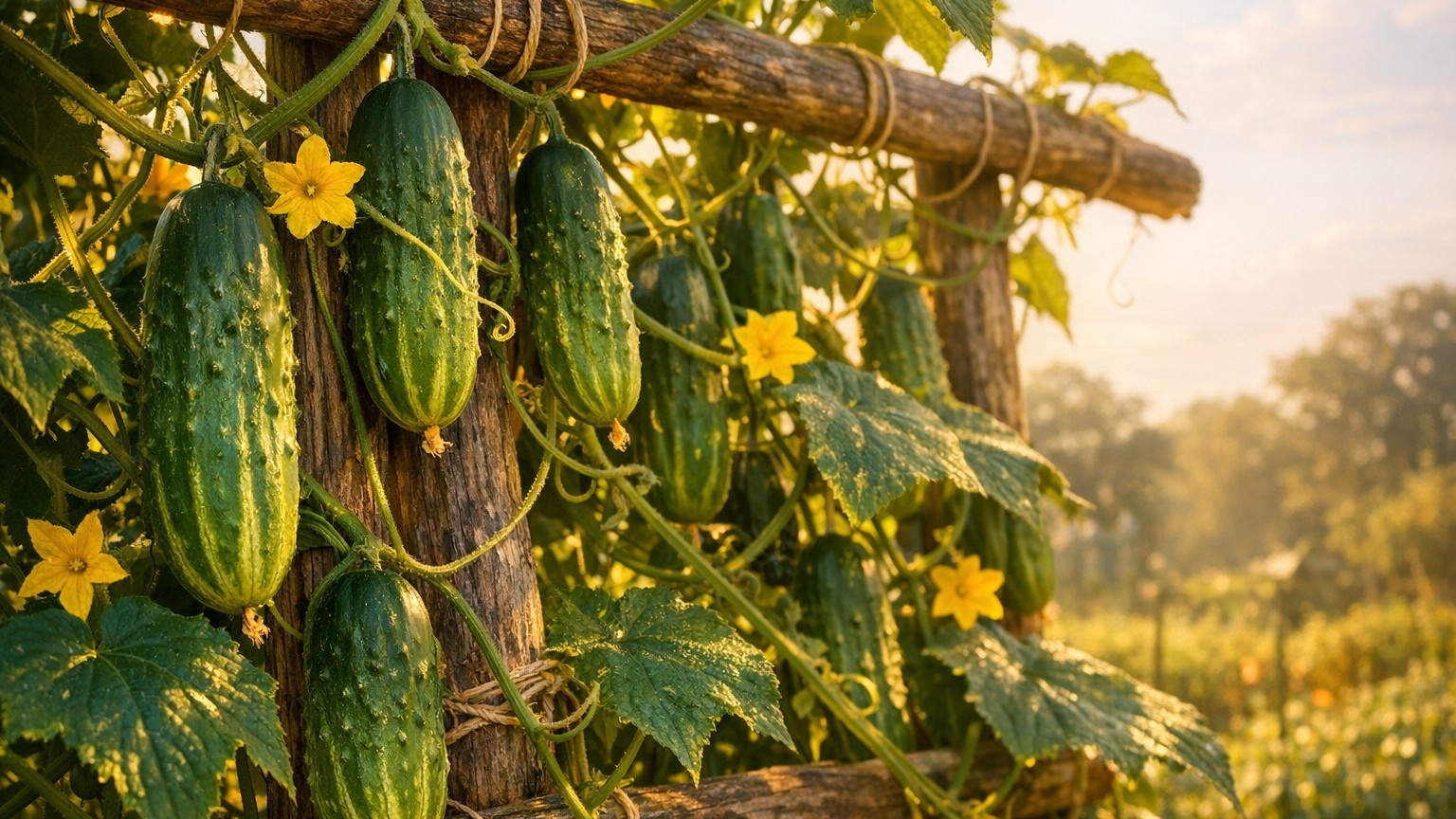

Vermont’s growing season runs short and cool by national standards, so the varieties that thrive here are fast pickling types, compact bush cucumbers, and parthenocarpic (self-pollinating) types bred for covered or early planting. Long-season slicers and heat-loving Asian types are a much tougher bet.
The short answer for Vermont
Start with the numbers, because they make the decision for you. At the Burlington reference station, the last spring frost falls between April 30 and May 10, and the first fall frost arrives between October 3 and October 13. That gives a frost-free stretch of roughly five months at the state’s mildest point, right along Lake Champlain. Away from the lake, in the Green Mountains or the Northeast Kingdom, that window runs substantially shorter. Cucumbers need warm soil to germinate and warm nights to set fruit, so every week of that frost-free stretch matters.
Vermont also runs cool in summer. The reference station averages just 5.4 days a year at or above 90F. That’s a low heat load compared to most of the country, and cucumbers are a warm-season crop that wants heat to push growth fast. A short season paired with modest heat means the plants that succeed here are the ones that don’t need a long, hot stretch to finish.
Which types fit
Pickling types are the safest bet for most Vermont gardens. They’re bred to size up quickly and produce in a compressed window, which matches a state where the growing season doesn’t leave much room for error. Bush-type cucumbers, whether pickling or slicing, are worth prioritizing too: they take up less space, warm up faster in a raised bed or container, and tend to reach harvest sooner than sprawling vine types.
Parthenocarpic varieties, the ones that set fruit without needing a pollinator, are worth knowing about specifically because of Vermont’s climate. They perform well under row cover, which lets a gardener get plants in the ground earlier without waiting for pollinators to be active, effectively stretching the usable season at both ends. Standard slicing cucumbers can still do fine here, but they benefit from every early-start trick available: warmed soil, transplants instead of direct seed, and row cover in the first weeks.
Burpless and Asian-style long slicers are the type to approach with caution. They’re bred for longer, hotter growing regions and often want more cumulative heat than Vermont’s 5.4 days above 90F can reliably deliver. That doesn’t mean they’re impossible, just that they’re a bigger gamble than a pickling or bush type. For the exact cultivars trialled and recommended for your county, the University of Vermont Extension is the source to check, not a general seed catalog description written for a national audience.
What will not work here

The clearest failure mode in a Vermont cucumber patch is choosing a long-maturing variety and expecting it to catch up. With a frost-free window that can run well under five months away from the lake, and barely five days a year of real heat to push growth, a cucumber bred for a 90-day-plus season in a hot climate simply runs out of time. It may flower late, set fruit late, and then get caught by the first October frost before it produces a real harvest.
Direct-seeding too early is another common misstep, and it’s tied directly to Vermont’s cold soil. Cucumber seed wants warm ground to germinate reliably, and in a state spanning USDA zones 3b to 5b, spring soil often stays cold well past the calendar date a gardener might use in a milder state. Seed sown into cold, wet soil rots or germinates unevenly rather than getting a head start. Starting indoors or waiting for the soil to genuinely warm up, rather than following a fixed date, avoids this.
Spacing and moisture problems
Vermont’s summer rainfall runs to about 11.9 inches across June, July and August, with June the wettest month at 4.26 inches and August the driest at 3.54. That’s a meaningful amount of natural moisture, and it comes with a downside: cucumbers planted too closely together, especially vining types left to sprawl on the ground, hold humidity around their leaves in a wet June. That combination of dense foliage and lingering moisture is exactly what encourages fungal disease on cucumber leaves. Wider spacing, or training vines up a trellis so air moves freely around the leaves, addresses this directly.
At the other end of summer, a watering plan built only around “average rainfall” can also fail. August’s 3.54 inches is the driest month of the summer, and if it arrives as a handful of thunderstorms rather than steady rain, much of it runs off instead of soaking into the soil, particularly on sandy ground. A garden that relies on rain alone through August, without a supplemental watering plan, risks a late-summer slowdown right when the crop should be at its most productive.
What changes across Vermont
Vermont is not one climate, and the hardiness zone range makes that plain: the state spans USDA zones 3b to 5b. That’s a wide spread for a state this size, and it comes down almost entirely to elevation and distance from Lake Champlain. The lake moderates temperatures nearby, which is why Burlington sits at the milder end of that range, while higher elevations in the Green Mountains and the colder pockets of the Northeast Kingdom sit much closer to zone 3b.
That spread matters directly for cucumber timing. The frost dates cited for Burlington describe the mildest corner of the state. A garden at higher elevation, or well away from the lake’s moderating effect, should expect a later last frost in spring and an earlier first frost in fall than those dates suggest, which shortens the already tight window further. In practice, that means gardeners outside the Champlain Valley have more reason to lean on the fastest-maturing pickling and bush types, and more reason to use transplants and row cover rather than direct seeding and hoping for the best.
There’s no single planting date or single “best” cucumber for Vermont as a whole, because a recommendation built for the lake shore doesn’t transfer cleanly to a hillside garden forty miles away. The right move for anyone outside the immediate Burlington area is to shift their expectations toward the shorter, cooler end of the state’s range rather than the milder end, and to treat any statewide date as a starting point to adjust, not a fixed rule.
Where to check this for your own county
Everything above is built from statewide and reference-station data, which is useful for understanding the pattern but not precise enough for a specific piece of ground. The University of Vermont Extension is the source built for that next level of detail, and it’s worth going there before finalizing a variety list or a planting date.
Two things are worth looking for specifically once there. First, a local or county-level planting calendar, which will reflect the actual frost timing and soil warming pattern for a specific area rather than the Burlington reference station used above. Second, a list of cucumber varieties that have actually been trialled in Vermont conditions, whether through extension trial gardens, master gardener programs, or county-level advice. That kind of trial data tells a gardener which specific pickling, bush, or parthenocarpic varieties have actually performed well in the state’s short, cool season, rather than relying on a seed packet’s national-average maturity claim.
A county-level recommendation will always beat a state-level one, because a state-level one covers Vermont generally. It’s built to explain the pattern, the reasoning, and the type of cucumber likely to succeed across Vermont generally. It isn’t built to know whether a particular garden sits in a frost pocket, on a south-facing slope that warms early, or at an elevation that pushes it toward the colder end of the state’s zone 3b to 5b range. That’s exactly the gap a county extension office or local master gardener program is positioned to fill.
Checking this against your own garden
Every date and average describes a pattern, not a promise, and a gardener’s own observations settle the question better than any calendar. Three things are worth watching directly.
- Soil warmth by feel: cucumber seed and young transplants want soil that feels genuinely warm to the hand, not just frost-free. Cold, damp soil that feels chilly a few inches down is a sign it’s still too early, regardless of the date on a chart.
- The first flush of male flowers: cucumbers typically produce male flowers before female ones. Seeing that first flush is a sign the plant has settled in and started its reproductive cycle, a more reliable marker of local timing than a generic maturity estimate.
- The first true leaves: the initial seed leaves look different from the true leaves that follow. Once true leaves appear and the plant is clearly growing, not just surviving, that’s a sign the local microclimate, whether a warm raised bed or a cooler open row, has found its own rhythm for the season.
None of these require a thermometer or any equipment beyond attention. Together, they tell a gardener more about their specific patch of Vermont ground than a statewide frost date ever will.