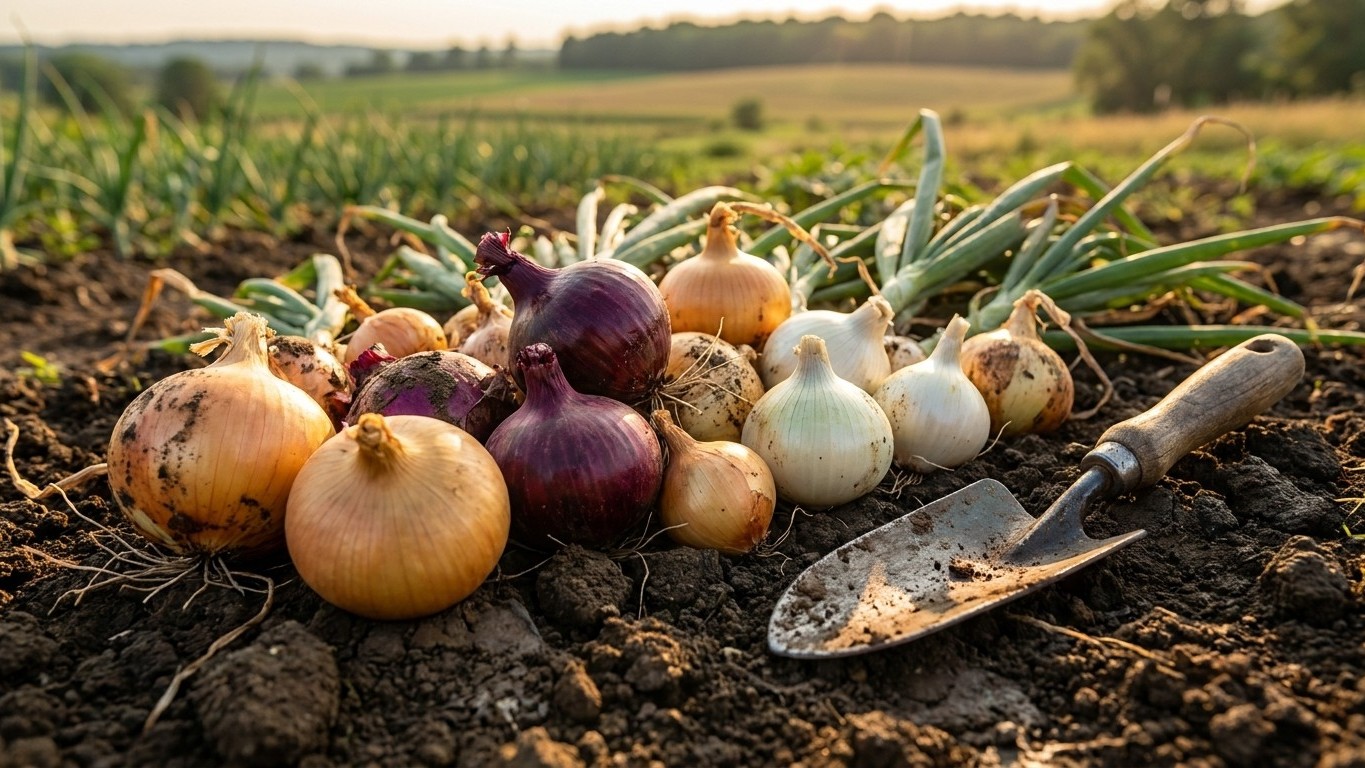

Lift onions when most of the tops have flopped over and turned yellow, which in the low desert means spring. Pull them on a dry day and cure them in shade until the necks are tight and the skins feel papery. Only then do they go into storage. Cured onions keep best between 45 and 55 °F in dry air, but sweet, short-day onions do not store as well as the more pungent types. Those are meant to be eaten within weeks, not held until winter.
Keeping them, and for how long
Clemson Cooperative Extension’s Home & Garden Information Center states the target plainly: “Ideal conditions are between 45 °F and 55 °F, and 50 to 60 percent humidity.” (source.) That is a cool, dry spot. Carrots, beets and other roots want the opposite, cold and damp, so one cellar or one shelf cannot serve both well. Onions kept in damp air sprout and rot at the neck.
Treat any storage duration as a ceiling reached only under those ideal conditions. The best pungent onions, grown in a northern garden and kept just right, can feed a household into March. A bulb that sits a few degrees too warm or in air that is a little too damp will not get there.
Why do onions grown in Arizona store worse than northern onions?
Two things line up against them: day length and flavor chemistry. Onions start making a bulb when the days reach a certain length, and warmth has little to do with it. Phoenix sits at 33.43 degrees north, and its longest day of the year runs 14 h 13 of daylight. A short-day variety begins bulbing at about 12 hours of daylight (a threshold Clemson Extension publishes), so it bulbs early and finishes in spring. A long-day variety waits for 14 to 16 hours and does poorly this far south. That is why northern gardens grow long-day onions and southern ones cannot.
Short-day onions also tend to be the sweet ones, and sweetness costs shelf life. The bite of an onion comes from volatile sulfur compounds, and those same compounds help protect the bulb in storage. University of Missouri Extension (publication G6355) puts it this way: “As a rule, ‘sweet’ onions do not store as well as the more pungent types.” A sweet bulb has fewer of those compounds. It tastes better raw and goes soft long before winter. A southern garden gives you onions to eat soon. A northern garden gives you onions that last until March.
Readers in the high country around Flagstaff, or down near the Mexican border, sit at different latitudes than Phoenix. Look up your own latitude before assuming the Phoenix day length applies. For choosing bulbs that suit your location, see The Best Onion Varieties for Arizona.
What has to happen before onions go into storage?
Curing comes first, always. Bulbs go into storage only once the necks are tight and the skins are papery, never straight from the ground. A bulb with a fat, green, moist neck is an open door for rot. After lifting, spread the onions in a single layer where air moves freely and the sun cannot reach them. Desert sun can scald the exposed shoulders of a bulb. Brush off loose soil by hand rather than washing the onions.
Cure the sweet types too, then eat them first. They will soften well before the pungent ones. Cull any bulb with a soft spot or a damaged neck before it goes anywhere, since one rotting onion spoils its neighbors. Cuts and tunnels often trace back to insects, so it helps to know what eats onion in Arizona, and when.
Where in the house that actually is
A domestic fridge runs colder than the 45 °F floor, and its crisper drawer is humid. That combination is hard on a dry-storage crop. A heated room is too warm, and a house in Arizona is cooled for people, so most of it sits above 55 °F for much of the year. Neither is a good place for onions.
A garage swings with the weather. In a desert summer it can bake well past the safe range. In a winter cold snap it can chill, so a garage is only a sometime solution. An enclosed shed has the same problem, with even less buffer against the heat.
The room that comes closest is usually an interior one: a pantry or closet on an inside wall, away from the oven, the water heater and any sun-facing windows. A seldom-used spare room with the vent closed can work too. The aim is a spot that stays cool and dry on its own without a cooling system fighting it. Airflow matters as much as temperature. Mesh bags, slatted crates or a wire basket let air move around the bulbs, while a closed plastic tub traps moisture.
Do not trust your hand to judge the spot. Leave a min-max thermometer and a humidity gauge there for several days before filling the space, and read the highs and lows rather than a single snapshot. Skipping that check means finding out the hard way, when the bulbs sprout or go soft in a month you expected them to last.
If the best spot you can find runs above 55 °F, shorten your plan. Eat the sweet onions first and set aside only the firmest, most pungent bulbs for later. If you want onions that hold up, grow pungent varieties in the first place.
Common questions
How do I know my onions are ready to lift?
Watch the tops. When most have fallen over and begun to yellow, the bulbs have stopped growing. Lift on a dry day, because wet soil clings to the bulbs and slows curing. In the low desert, short-day onions set in the cool season generally finish in spring, ahead of the worst heat. If a few tops are still standing, give those plants a little more time.
Can I cure onions outdoors in Arizona’s heat?
Yes, but do it in shade. Direct desert sun can scald the bulbs, while shaded, dry air with good airflow dries the necks well. A covered patio or a shaded rack works. Cure the bulbs until the necks are tight and the skins feel papery.
Can I store sweet onions through the winter?
Do not count on it. Sweet onions carry fewer of the sulfur compounds that protect a bulb in storage, so they go soft sooner than pungent types. Cure them, keep them cool and dry, and eat them first. For winter keeping, rely on pungent varieties and hold to the 45 to 55 °F and 50 to 60 percent humidity range as closely as you can.
Can onions and carrots share a storage spot?
They store poorly together. Onions want dry air at 50 to 60 percent humidity, while carrots and other roots want it damp. A single cellar or shelf cannot hold both well, so give them separate spots. For the full picture of growing them here, start with Onions in Arizona.