
California’s growing season for summer squash isn’t set by frost at all in most of the state. Along the coast and through Southern California, freezing temperatures essentially don’t happen, so the calendar is driven by soil warmth, heat load and water instead. Inland and at elevation, in the Central Valley and the Sierra, frost still shapes the calendar, and gardeners there need to check local dates rather than borrow Los Angeles numbers.
When the soil is warm enough in California
The honest answer for coastal and Southern California is that there’s no “after the frost” moment to wait for, because there’s essentially no frost to begin with. NOAA’s 1991-2020 Climate Normals for the reference station used in these figures (USW00023174, in the Los Angeles area) show no computable freeze normal at all: thirty years of daily records with zero days at or below 32°F, and a frost-free season listed as the full 365 days. That’s not a rounded-off “usually mild” claim. It’s what the station data actually shows.
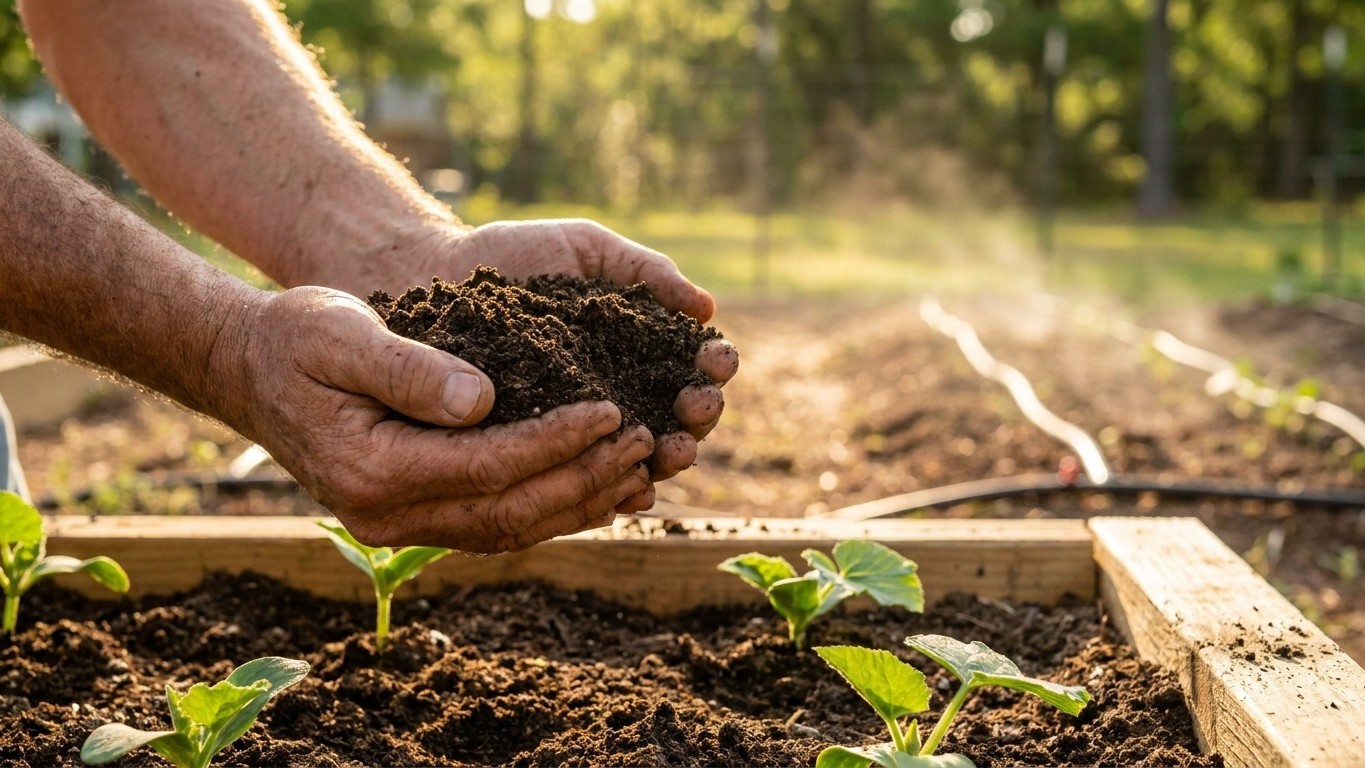
What that means in practice is that frost was never the limiting factor for Summer Squash in this part of the state, and it isn’t now. What matters instead is soil temperature, and soil takes longer to warm than the air does. Squash seed germinates poorly in cold, damp soil regardless of how far frost risk has receded, so the practical test isn’t a date on a calendar but a soil thermometer pushed a few inches down, checked over several mornings, not just once.
This is also where a statewide generalization breaks. The “frost-free” figure above describes the Los Angeles reference station, and it applies reasonably well to the coastal strip and much of Southern California. It does not describe the Central Valley, the foothills, or the Sierra, where winter freezes are routine and where a real last-frost date exists and matters. Those areas simply aren’t covered by the frost-free figure used here, and inventing a date for them would be worse than saying nothing. Gardeners in the Valley or at elevation should pull their own station’s normals or check with their local University of California Cooperative Extension office for a frost date specific to their county.
A probability, not a promise
Even where frost is effectively absent on average, “average” is doing real work in that sentence. A thirty-year normal describes typical behavior, not a guarantee for any single year. An unusually sharp cold snap can still visit low-lying interior valleys even within otherwise frost-free coastal zones. Treat the frost-free normal as very strong odds in your favor, not as a reason to skip watching short-range forecasts before setting out tender transplants.
How long the season lasts here
Because both the last spring frost and the first fall frost come back as “no freeze occurs in an average year” at the reference station, the arithmetic is simple: the frost-free window is the full 365 days. That’s an unusually long runway for a warm-season crop that normally has to squeeze itself between two frost dates measured in a few months.
A season with no frost ceiling doesn’t mean squash grows all year without limits, though. Summer squash still needs warm soil to germinate and warm days to set fruit, so the real constraint shifts from frost to heat and water, which the next section covers. What the long frost-free window does unlock is flexibility in timing. Where a shorter-season territory forces a gardener into one sowing and one harvest window, a frost-free coastal or Southern California garden can support multiple staggered sowings through spring and into summer, spacing out the harvest instead of getting hit with everything at once.
That flexibility is exactly what a succession-sowing plan is built for, and it’s worth reading the site’s dedicated guide to succession sowing for summer squash before deciding how many rounds to plant and how far apart to space them.
For gardeners in the Central Valley or the Sierra, this section of the reasoning doesn’t transfer directly, since those areas do have a real frost-bound season rather than a 365-day frost-free one. Without a documented frost date for those areas in hand, the safer move is to get the local normals from the state’s extension network rather than assume the coastal figure applies. The practical difference matters: a short, frost-bound season usually makes the first sowing the only one that counts, which also changes whether it’s worth transplanting starts (and checking their roots haven’t circled the pot) versus direct-seeding once soil is reliably warm.
Heat and water in California
Here’s where the Los Angeles-area numbers turn out to be a bit surprising. NOAA’s 1991-2020 Climate Normals put the average number of days reaching 90°F or higher at just 2.4 per year at that reference station. That’s a low heat-stress count by squash standards, low enough that pollen viability and fruit set, which suffer once temperatures push into the high 90s, are rarely the bottleneck along the coast and through much of Southern California. Marine influence keeps a lot of the region milder than its reputation suggests.
The water side of the ledger tells a very different story, though, and it’s the one that actually runs this garden. Summer rainfall at the same reference station averages about 0.1 inch total across June, July and August, broken down as roughly 0.08 inch in June, 0.04 inch in July, and 0.0 inch in August, the driest month of the three. For context, that’s set against 12.2 inches of rain across the entire year, meaning almost all of it falls outside summer entirely.
That combination, mild heat but essentially zero natural summer rain, means irrigation isn’t a backup plan here, it’s the entire plan. Summer squash carries large, thin leaves on a comparatively shallow root system, and even without extreme heat, a plant that gets no rain for three straight months will wilt and stall unless someone is supplying the water by hand or by drip line. A rain gauge in the yard will confirm what the normals already suggest: in most summers, it will sit at or near zero, and the garden’s water schedule needs to be built entirely around irrigation rather than rainfall.
One more caveat matters. The 2.4-days figure describes the Los Angeles reference station, not the whole state. Inland areas away from coastal influence, including much of the Central Valley, run considerably hotter in summer, and gardeners there should weight fruit-set heat stress more heavily than this coastal number suggests, while still assuming the same near-total absence of summer rain.
Which summer squash suit California
Given a frost-free or near frost-free window along the coast and through Southern California, there’s little reason to chase the earliest-maturing types the way a short-season gardener elsewhere would. Timing pressure here comes from heat and drought, not from a race against fall frost, so the more useful sorting criteria are drought tolerance, an open growth habit that lets air move around the leaves, and reliable performance under drip or hand irrigation rather than rainfall.
Types bred or selected for open, less sprawling canopies tend to do well in this climate because good airflow reduces the fungal disease pressure that builds up around irrigation lines even in a low-rainfall summer, powdery mildew doesn’t need rain, just humidity at the leaf surface. For gardeners in the Central Valley or foothill areas with a real frost-bound season and hotter summer days, an earlier-maturing type paired with some afternoon shade during the hottest stretches is a more sensible starting point than anything bred for a long, mild coastal season.
What this page won’t do is hand over a specific variety name. Attaching a cultivar to a page like this, without the trial data behind it, is the kind of shortcut that looks helpful and isn’t; the varieties that actually perform well shift by county, by soil, and by which strain of powdery mildew or squash bug pressure a given region deals with. University of California Cooperative Extension runs and publishes exactly that kind of regional variety trial data, county by county, and it’s the only source specific enough to be worth acting on. Checking there before buying seed is a five-minute step that does more for the harvest than any generic type recommendation on this page could.