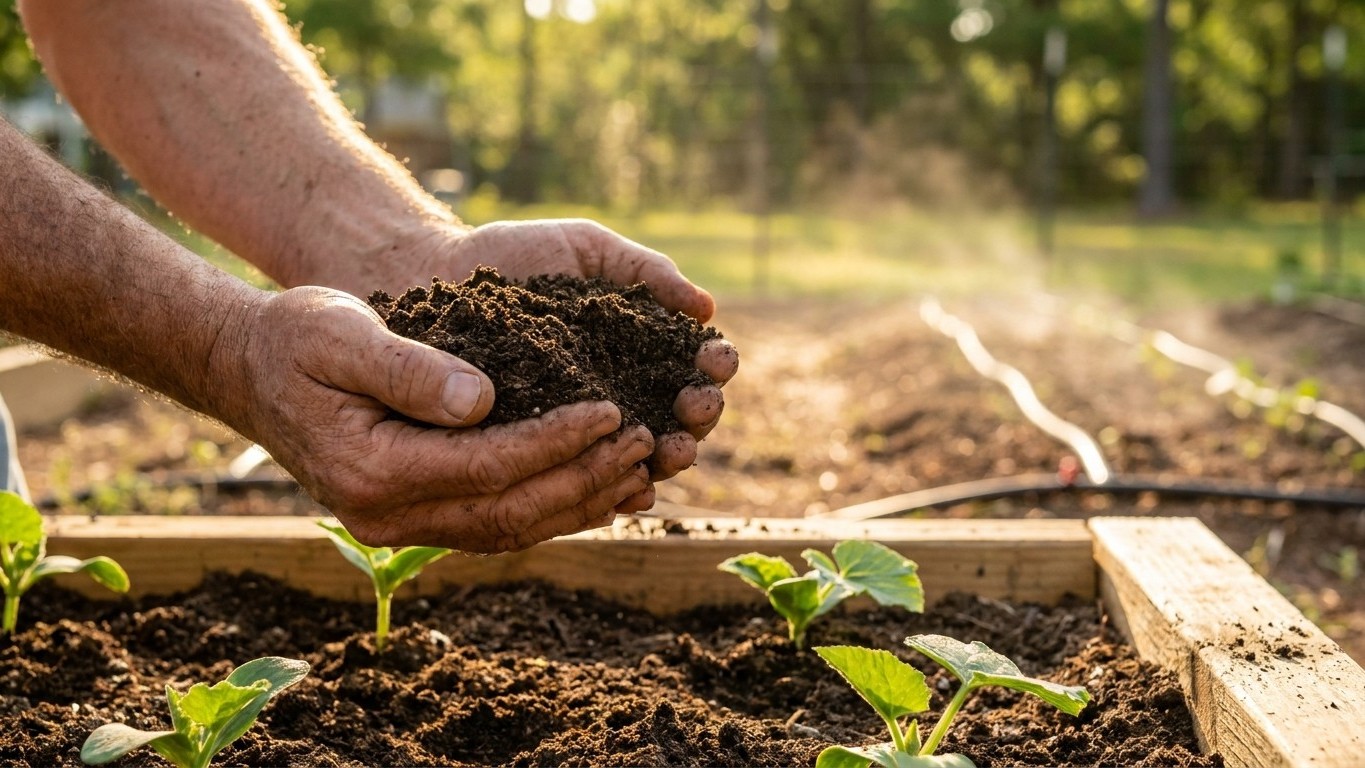

Summer squash goes into Iowa gardens once the soil itself has warmed, not just when frost risk has passed, and that usually lands in mid-to-late May across most of the state. The growing window that follows runs close to six months, long enough for more than one planting, but heat spikes and a dry July can decide whether that window pays off.
When the soil is warm enough in Iowa
The date gardeners actually want is a soil temperature, but the date they usually get is a frost date, and the two are not the same thing. Frost is a proxy. Summer squash seed rots in cold, wet soil long before frost is a concern, and the plant’s real requirement is a soil that has held steady warmth for several days running, not just a calendar square that says spring arrived.
For central Iowa, NOAA’s 1991-2020 Climate Normals put the last spring frost, measured as the date when the probability of a 32F freeze falls into the 30-70% band, between April 12 and April 24. That comes from the Des Moines airport station (USW00014933). Treat that range as a probability, not a promise: even inside it, a late cold snap is not unusual, and a frost after April 24 has happened before.
There’s a second layer worth knowing. Iowa State Extension’s own county-level records, built from 1950-2021 data, tend to run about four days later in spring than the airport figures above. That gap exists because county averages blend rural and urban stations, while the airport sits in a warmer, paved microclimate. Treat the NOAA airport dates as the optimistic end of the range, and lean later if your garden sits in a low spot, near a river bottom, or well outside the Des Moines metro.
Direct seeding versus starting indoors
Because summer squash resents root disturbance, most Iowa gardeners direct-seed once the soil has warmed rather than transplant. If you do start seedlings indoors to gain a couple of weeks, keep the root ball intact at transplant time and harden the plants off gradually, since a sudden move from a warm windowsill to a cool, breezy garden bed stresses the stems more than the cold itself.
Skip any pest spray schedule tied to the calendar. Watch the plant instead: scout the undersides of leaves for early insect activity and treat only what you actually see, using a targeted practice rather than a blanket application. For which squash types have performed well in University trials for your exact county, the reliable source is Iowa State University Extension, not a general planting chart.
How long the season lasts here
Run the two ends of the frost window against each other and Iowa’s frost-free stretch comes out to roughly six months, about 184 to 185 days depending on which end of each probability band you use: from a last spring frost of April 12-24 to a first fall frost of October 14-25, both from the same NOAA NCEI 1991-2020 Climate Normals for the Des Moines reference station. That’s a meaningfully long window for a warm-season crop that typically finishes fruiting in under two months from seeding.
A season that long changes the math on succession sowing. Summer squash plants tend to slow down and get ragged by midsummer, whether from squash vine borer damage, powdery mildew, or simple age, and a six-month window gives Iowa gardeners room to put in a second round of seed in early-to-mid July, timed to replace a tired first planting well before the fall frost risk climbs. In a shorter-season territory, that second sowing wouldn’t have time to mature; here, it usually does.
The same length also affects whether starting seedlings indoors is worth the trouble. With six months of frost-free time on the table, there’s little urgency to force an early start and risk transplant shock on a plant that resents disturbed roots. Direct seeding after the soil has warmed captures most of the available season without that risk. The calculus would flip in a state with a four-month window, where every early week counts and transplants become the only way to squeeze in a full crop.
If you’re weighing whether a second planting fits your particular garden and how to stagger it, the site’s dedicated guide to succession sowing summer squash walks through spacing the plantings so the second one isn’t competing with the first for light and water at the same time.
Heat and water in Iowa
Iowa’s heat load, by NOAA’s 1991-2020 Climate Normals for the Des Moines reference station, averages 18.4 days a year at or above 90F. That’s a moderate figure, not an extreme one. It means Iowa summers get genuinely hot stretches, but they don’t sit in the high 90s for weeks the way parts of the southern Plains do, and summer squash pollen, which loses viability once temperatures push into the high 90s for multiple days running, is only at serious risk during the sharpest heat waves rather than for most of the season.
Rainfall tells a more complicated story. Summer rain across June, July and August averages about 13.2 inches, out of 36.5 inches for the full year. But that total isn’t spread evenly: June brings 5.26 inches, August 4.17, and July, right when squash plants are setting and sizing fruit fastest, drops to just 3.82 inches, the driest month of the growing season. That gap matters more than the seasonal total suggests.
Summer squash carries enormous leaves relative to a fairly shallow root system, so it loses water through those leaves faster than a modest rain can replace it, especially once the plant is fruiting heavily. A dry July layered on top of days near or above 90F is exactly the combination that stresses the crop: wilting by afternoon, fewer female flowers setting, and fruit that stalls rather than sizes up. The fix isn’t complicated, but it is a habit rather than a one-time task: deep, infrequent watering aimed at the root zone, done early in the day, matters more in July than in the wetter bookend months.
Iowa’s summer humidity, driven by that same June rainfall and warm air, cuts the other way too. Where a drier western state worries mainly about pollen failure and scorch, Iowa gardeners are just as likely to lose a plant to powdery mildew or bacterial wilt spread by cucumber beetles, both of which favor humid, still air. Spacing plants for airflow does double duty here: it doesn’t just prevent overcrowding, it’s a real defense against the disease pressure that a wet spring and muggy July bring.
Which summer squash suit Iowa
None of this points to a single named variety, and that’s a deliberate omission rather than an oversight. The types that perform best change from one Iowa State Extension trial to the next as new disease-resistant lines get released, and a name printed on this page today could be outperformed by something else in two seasons. What holds steady is the reasoning behind the choice, and that reasoning comes straight from the numbers above.
A six-month frost-free window means Iowa gardeners aren’t forced into the earliest-maturing types out of necessity the way a shorter-season state would be; there’s room for a full-season type plus a second, faster succession planting later. Moderate heat load, at 18.4 days above 90F a year, means pollen failure from extreme heat is an occasional risk rather than a constant one, so it shouldn’t be the top factor driving variety choice. Humidity and a dry July, on the other hand, push disease resistance and root-zone moisture management to the front of the list, since powdery mildew and bacterial wilt are the more consistent threats across an Iowa summer.
In practice, that means favoring types bred for resistance to powdery mildew and bacterial wilt, giving plants enough spacing for airflow rather than crowding them for a bigger first harvest, and choosing a growth habit, bush or vining, that fits how much you can water by hand during a dry July stretch rather than by how it looks on a seed packet.
The specific types that have actually held up in Iowa trial gardens, tested against real Iowa disease pressure and real Iowa summers rather than a national average, are listed and updated by Iowa State University Extension. That’s the recommendation that means something for a garden in this state; anything more specific from this page would be a guess dressed up as advice.