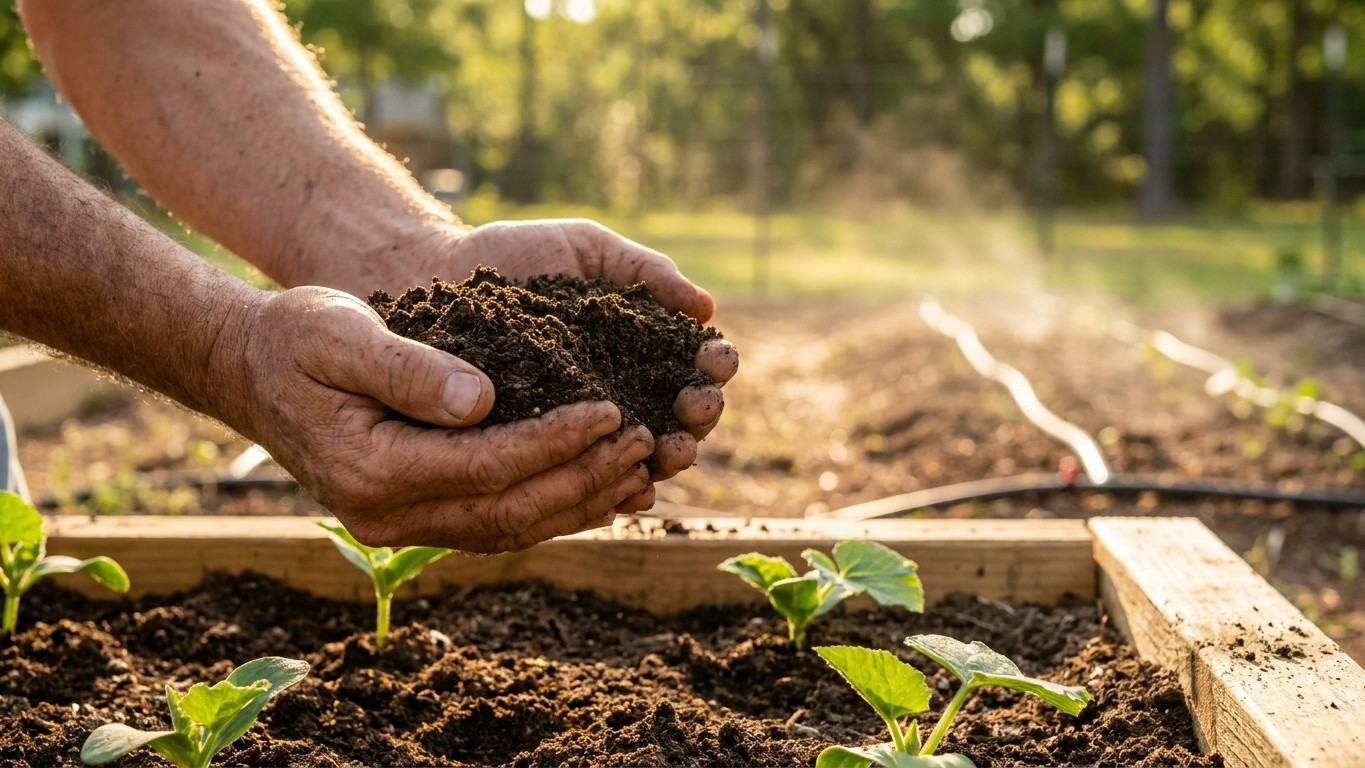

Summer squash goes in the ground in Maine once the soil sits reliably above 60°F, which for most of the state means late May to early June, well after the frost-free window opens. Coastal spots warm first; inland and northern gardens wait longer, and the safest guide is soil, not the calendar.
When the soil is warm enough in Maine
The question every Maine gardener asks in spring is simple: when do I plant? The honest answer starts with frost, but frost is only the first filter, not the finish line. According to NOAA’s 1991-2020 Climate Normals for the Portland reference station (USW00014764), the last spring frost falls somewhere between April 22 and May 1, based on the 30-70% freeze-probability band. That’s a real range, not a single date, and it describes coastal Portland, the mildest corner of the state. Inland valleys and northern counties run substantially later in spring, so a gardener in Aroostook County shouldn’t borrow Portland’s calendar.
Here’s the part that trips people up: summer squash doesn’t care about frost directly. It cares about soil temperature, and soil warms on its own schedule, usually two to three weeks after the last frost risk has passed. A frost date only tells you when the killing cold is statistically unlikely to return, and even that is a probability, not a promise, so treat it as a planning tool rather than a guarantee. Squash seed sown into cold, wet soil either rots or sits dormant, sulking while weeds get a head start. The plant wants soil that’s stayed warm for several consecutive days, which in most of Maine lines up with late May on the coast and into early or mid-June farther inland.
Some gardeners try to shortcut the wait by starting seed indoors and transplanting once the soil catches up. That can work, but summer squash resents root disturbance more than most vegetables, so transplants need to go out young, before the roots circle the container. Direct seeding remains the simpler, lower-risk route for most Maine gardens, especially once soil temperature, not the frost date, gives the green light.
For the varieties actually trialled in Maine conditions, from bush types bred for shorter seasons to vining forms that need more room, the University of Maine Cooperative Extension keeps current, region-specific recommendations. That’s a better source than any general list, because trial data reflects what actually performs under Maine’s soil and disease pressure.
How long the season lasts here
Subtract the two frost windows and you get the real planning number: the frost-free season in Maine runs somewhere between about 161 and 182 days, depending on where in the state you garden and which end of each frost range applies. The first fall frost, per the same NOAA normals, arrives between October 9 and October 21. Stack the earliest fall date against the latest spring date and you get the tightest possible window, about 161 days. Stack the latest fall date against the earliest spring date and you get the roomiest version, closer to 182 days.
That spread matters more than it looks. A gardener working with a 180-day season, likely someone near the coast, has enough room to consider a second sowing of Summer Squash in early to mid-July, timed to bear fruit before the shorter fall days slow things down. A gardener working with a season closer to 160 days, more typical inland or in the north, is often looking at one planting window and no real margin for a do-over if the first sowing fails to germinate evenly or gets hit by a cool, wet spell.
This is also where the transplant question gets decided. In a long season, direct seeding twice is often simpler and less risky than babying transplants, since there’s time to recover from a slow start. In a short season, some gardeners lean on an early transplant to buy a couple of weeks, accepting the root-disturbance risk because there’s no room left for a failed first attempt. Neither approach is universally right; it depends on which end of Maine’s frost range a given garden sits closer to.
Anyone planning a second sowing, or weighing whether their particular window allows one, should look at the site’s succession sowing guide, which walks through timing a follow-up planting against a region’s actual frost dates rather than a generic rule of thumb.
Heat and water in Maine
Summer squash has a reputation as a heat-loving plant, and in much of the country that’s true. In Maine, the numbers tell a different story. The Portland reference station averages just 3.8 days a year reaching 90°F or higher, according to NOAA’s 1991-2020 Climate Normals. That’s a low heat load by national standards, and it changes the risk calculus for this crop. The real danger in Maine isn’t heat stress or pollen failing in extreme temperatures, since that mostly kicks in when temperatures push into the high 90s for stretches at a time, something Maine summers rarely deliver.
What Maine offers instead is a cooler, damper summer, and that comes with its own set of problems. Summer rainfall across June, July and August averages about 11.2 inches at the same reference station, broken down as 4.15 inches in June, 3.43 in July, and 3.57 in August, with July running the driest of the three. Combined with modest heat, that moisture load favors powdery mildew and other fungal pressure on squash leaves, and it can slow ripening when a stretch of cool, cloudy days settles in during midsummer.
This is the opposite challenge from a hot, dry territory where irrigation and afternoon shade decide whether the crop survives. In Maine, the more useful practices are ones that improve airflow around the plant, since dense, wet foliage sitting in still air is what invites mildew. Spacing plants generously, avoiding overhead watering late in the day, and watering at the soil line rather than the leaves all reduce that pressure without needing any product beyond attention to timing and technique.
None of these normals describe a single garden. They’re averages built from three decades of station data, and a slope, a nearby water body, or a low frost pocket can shift things noticeably on a given property. A rain gauge on the actual plot, watched over a season, tells a gardener more than any regional average ever will.
Which summer squash suit Maine
Given Maine’s numbers, the reasoning points toward type rather than a specific name. A shorter season, especially inland or north, favors the earliest-maturing types within the summer squash category, since a plant that reaches harvest sooner has more slack against a late spring or an early fall frost. A damp, moderate-heat summer, meanwhile, makes disease resistance the more urgent trait to look for, since mildew pressure is the more likely failure point in Maine than heat stress ever is.
What this page won’t do is hand over a cultivar name. That’s not caution for its own sake; it’s the correct answer. Variety performance depends on trial data specific to a region’s soil, disease pressure, and season length, and no general gardening page can responsibly stand in for that. A name picked at random, without knowing how it performed under Maine conditions, is worse than no recommendation at all, because it carries false confidence.
The University of Maine Cooperative Extension (extension.umaine.edu) maintains current variety trial results for exactly this kind of decision, weighing maturity speed, disease resistance, and regional performance against each other. That’s the resource worth checking before buying seed, especially for a gardener trying to match a short inland season or manage mildew pressure near the coast.
Maine’s hardiness zones, which run from 3b to 6a across the state under the USDA Plant Hardiness Zone Map, reflect winter extremes rather than summer growing conditions, so they’re not the tool for choosing a squash type. They matter for perennials and overwintering crops, not for an annual vegetable planted fresh each spring. For summer squash, season length, summer rainfall, and heat load, the numbers already laid out here, are what actually decide which type has the best shot at a full harvest.