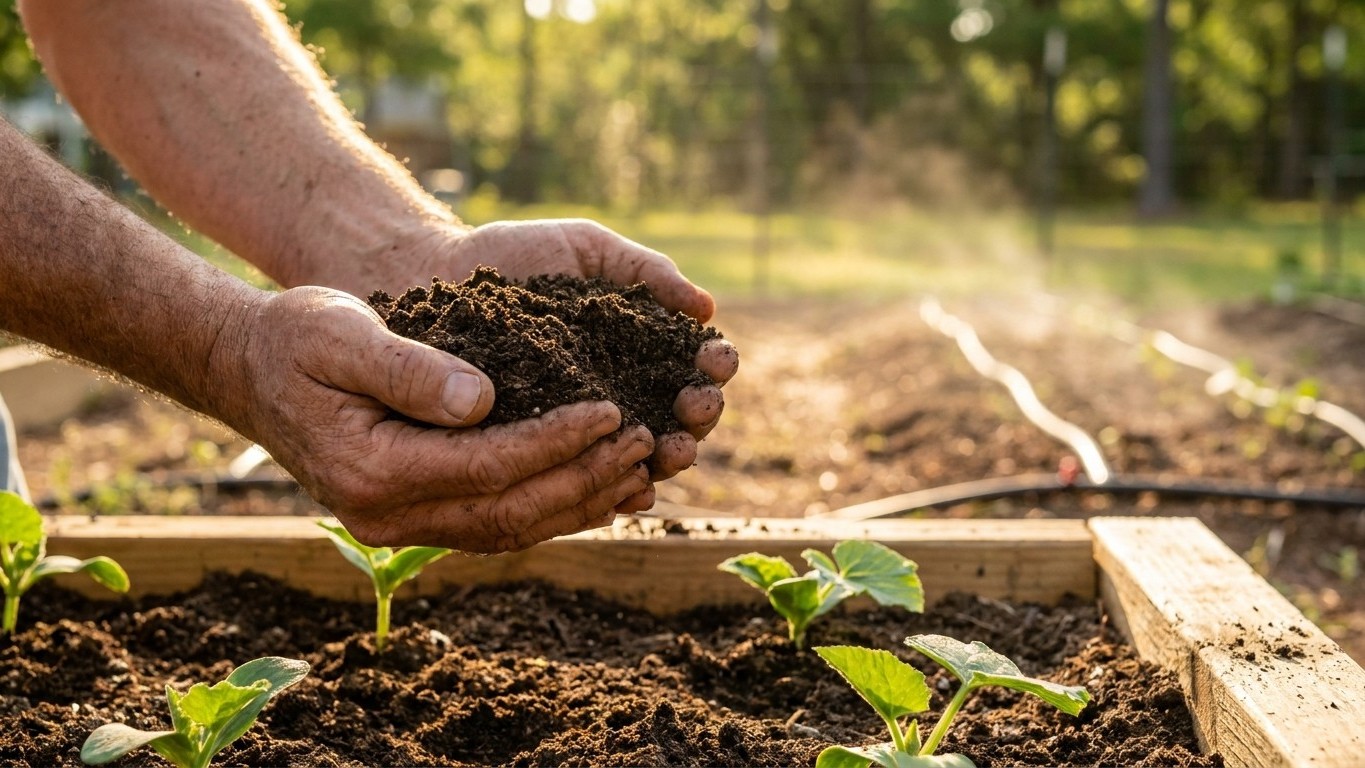

South Dakota gardeners can set summer squash outside once the soil itself has warmed, not just the air, and that usually falls in the first half of May near Sioux Falls. Harvest then runs into September, ahead of the state’s short fall frost window. Zones 3b through 5b, a brief but real heat spike, and modest summer rain all shape how the crop performs here, and each of those factors changes the answer differently.
When the soil is warm enough in South Dakota
Near the reference station used for South Dakota’s climate normals (USW00014944, close to Sioux Falls), NOAA’s 1991-2020 Climate Normals put the last spring frost, the 32°F threshold, somewhere between April 29 and May 9. That’s a 30-70% freeze-probability band, meaning frost is still plausible on either edge of that window, not a hard cutoff. It’s a probability, not a promise, and it’s worth saying only once: plenty of years dodge frost by April 25, and plenty push a freeze into the second week of May.
The frost date matters less than what it’s standing in for. Squash seed sown in soil that’s still in the 50s germinates slowly if at all, and often rots before it sprouts. The air can be frost-free for a week while six inches down, the soil is still catching up from winter. That lag is why the smart move isn’t circling a date on the calendar but checking the ground itself.
Testing the soil, not just the calendar
A simple soil thermometer pushed to planting depth tells you more than any frost date. Summer squash germinates reliably once soil holds in the low 60s and above for several consecutive days, which in South Dakota often means waiting a week or two past that April 29 to May 9 window closes, not planting the moment it opens. Direct seeding into cold, wet soil is one of the most common reasons a squash bed looks empty three weeks after planting.
The frost dates above come from an airport weather station. Suburban yards and rural gardens away from that station typically see the last spring frost later, sometimes by one to two weeks, and gardens at higher elevation lag further still. South Dakota’s hardiness range spans 3b to 5b under the USDA Plant Hardiness Zone Map (2023, built on 1991-2020 normals), and the western part of the state runs colder than the Sioux Falls reference. Check your own county’s data rather than treating the reference-city figures as statewide fact.
For row covers, cutworm collars, and other early-season protection specific to your soil type and county, South Dakota State University Extension keeps locally trialed guidance, and it’s the right first stop before choosing a planting date.
How long the season lasts here
Subtracting the two frost windows gives a rough sense of how much growing time South Dakota actually offers. Using the earliest possible last frost (April 29) against the latest possible first fall frost (October 4), the frost-free stretch can run close to 158 days. Using the more cautious pairing, latest last frost (May 9) against earliest first fall frost (September 24), that shrinks to about 138 days. Both figures come straight from the NOAA NCEI 1991-2020 Climate Normals for station USW00014944, so the range itself is the honest answer: South Dakota’s growing window sits somewhere between 138 and 158 days, depending on the year.
What the window allows
That’s a meaningfully shorter season than states further south, and it changes two practical decisions. First, whether a second sowing makes sense. At 158 days, there’s often room to sow a second round of Summer Squash in early July for a fall harvest before the first frost arrives; at 138 days, that margin tightens considerably, and a poorly timed second sowing risks getting cut off before it produces. Second, it changes whether Transplanting from indoors is worth the trouble. In a short-window year, starting seedlings indoors three to four weeks before the last frost date and setting out sturdy transplants (checked for rootbound roots before planting) buys back time the direct-seeded route would lose to slow spring soil warming. In a longer year, direct seeding after the soil has genuinely warmed often performs just as well with less fuss.
Either way, the decision to plant a second round hinges on tracking your own local frost data, not the statewide range. For the mechanics of spacing a second sowing against the first, the succession sowing guide on this site walks through timing it against your own last frost estimate.
Heat and water in South Dakota
South Dakota isn’t a scorcher by national standards, but it isn’t mild either. The reference station near Sioux Falls averages 13.8 days a year at or above 90°F, per NOAA NCEI Climate Normals 1991-2020. That’s a real but moderate heat load, concentrated typically in July and August rather than spread evenly across the whole summer.
Summer squash pollen loses viability fast once temperatures push into the high 90s, which is why a cluster of hot days during flowering can mean flowers that open, get visited by bees, and still fail to set fruit. At under 14 days a year above 90°F, South Dakota doesn’t face that failure mode constantly, but it does face it in bursts, usually mid-to-late summer, and those bursts are exactly when squash plants are also flowering hardest.
When rainfall doesn’t keep up
Summer rainfall totals about 10.8 inches across June, July, and August, with July running driest at 3.25 inches against June’s 4.23 and August’s 3.34, all from NOAA NCEI Monthly Climate Normals at the same reference station.
| Month | Average rainfall |
|---|---|
| June | 4.23 inches |
| July | 3.25 inches |
| August | 3.34 inches |
That July dip lines up almost exactly with the peak of the hot-day count and the peak of flowering. Squash leaves are large and lose water fast, and the plant’s relatively shallow root plate can’t always keep pace when a hot, dry stretch in July coincides with the driest month of the season. That combination, more than any single number, is what decides whether a South Dakota squash bed needs supplemental water: a rain gauge on your own plot during July is the figure that actually settles it, since a single summer thunderstorm often runs off a dry surface rather than soaking in. Afternoon shade cloth during the hottest stretches and deep, infrequent watering rather than daily sprinkling both help bridge that July gap.
Which summer squash suit South Dakota
None of this points to a single variety, and that’s deliberate. This page can name types, but naming a specific cultivar here would be a guess, and it’s the one kind of guess a gardener notices the moment their plant doesn’t match the description.
Reasoning by type, not by name
South Dakota’s shorter growing window, 138 to 158 days depending on the year, favors summer squash types bred to reach harvest quickly rather than long-season types that need every day of a milder climate’s extra weeks. Its bursty heat, those 13.8 days a year above 90°F concentrated in mid-summer, favors types and spacing that keep airflow around the leaves and shade at the root zone during the hottest stretch, since heat stress at the roots compounds the pollen problem above ground. And because summer rainfall here is moderate rather than heavy, the disease pressure that pushes gardeners toward resistant types in humid states is somewhat less urgent in South Dakota, though a wet spring can still bring the same mildew problems a humid climate deals with all season.
The types trialed and recommended for South Dakota conditions specifically, tested against local soil, local pest pressure, and local seasons, are published by South Dakota State University Extension. That’s the resource worth checking before buying seed, because a variety proven in a trial plot near your own county carries more weight than any general description of a “type” ever could.