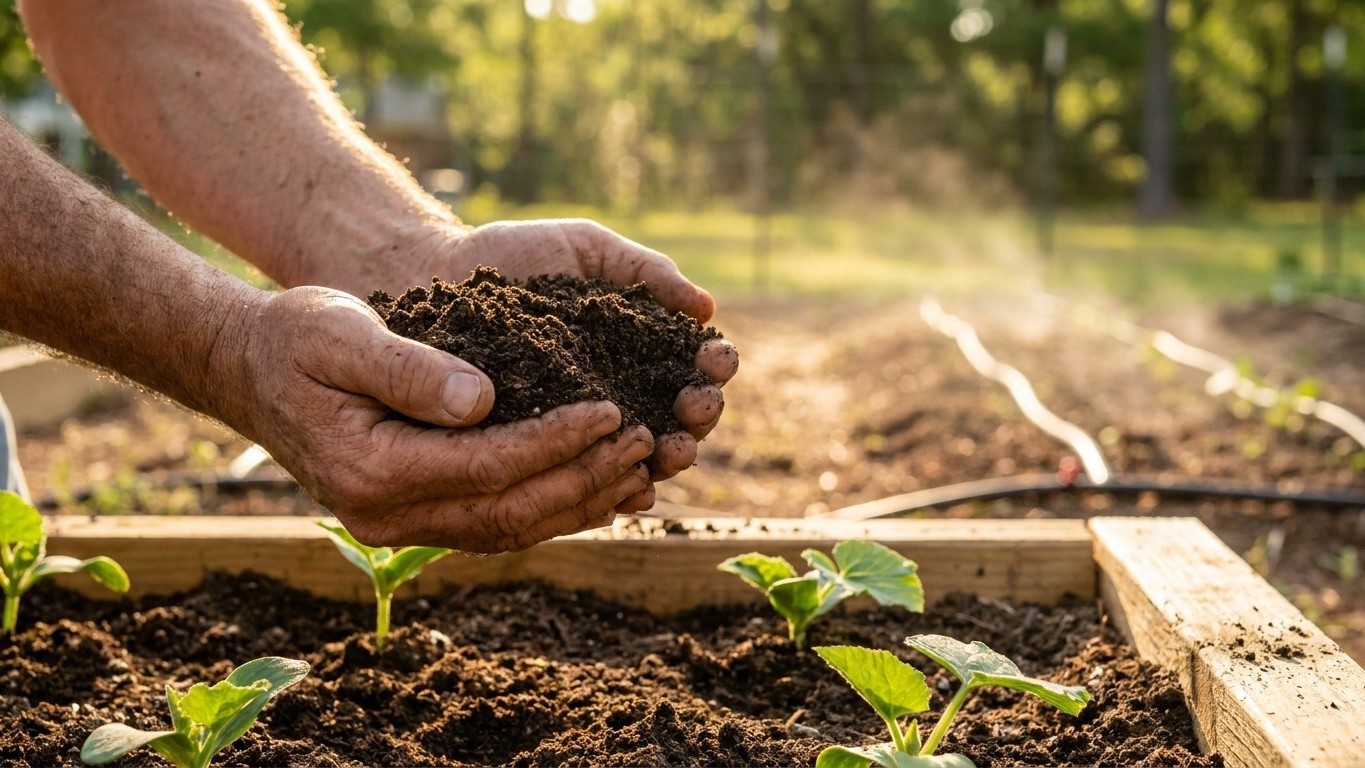

Manitoba gardeners generally get summer squash into the ground around late May to early June, once the soil itself has warmed, not just the air. The growing window runs roughly four months, but heat is scarce and rain is moderate, so the real limits on a Manitoba squash patch are soil warmth at planting and water management during a cool, short summer, not scorching temperatures.
When the soil is warm enough in Manitoba
Everyone wants a single date to circle on the calendar, but summer squash doesn’t care about the calendar. It cares about soil temperature. Seeds sulk and rot in cold, wet ground, and transplants set out too early simply stall, sitting there sullen while the calendar says June. The frost date matters only because it’s the closest thing we have to a public marker for when that soil warming has generally happened.
For the Winnipeg area, Environment and Climate Change Canada’s 1981-2010 Canadian Climate Normals put the average last spring frost at May 23, based on the Winnipeg Richardson Int’l A station. That word “average” is doing real work here: this is a mean date, not a safety line. In roughly one year out of two, frost actually arrives later than May 23. Treat it as the midpoint of a window that can swing either direction, not a green light.
Soil temperature lags behind air temperature, sometimes by a week or two, especially after a cold, snowy spring. A string of warm days in early May can feel like permission to plant, while the ground eight inches down is still cold enough to stunt germination. The practical move is to check the soil directly, a simple soil thermometer pushed a few inches into a garden bed tells you more than any frost date ever will, and to wait until it holds consistently warm rather than planting to a fixed weekend.
Geography matters too. Winnipeg Richardson sits in the Red River Valley, one of the milder, more open parts of the province. Northern Manitoba, the Interlake region, and higher ground away from the valley typically run behind this date, sometimes by a couple of weeks. A gardener in Thompson or Dauphin shouldn’t assume Winnipeg’s timing applies directly to their own yard.
On cultivar choice at planting time, this page won’t name varieties. The types trialled and recommended for Manitoba’s short, cool-summer conditions are best confirmed through Manitoba Agriculture, which tracks what actually performs in provincial trial gardens rather than what markets well nationally. As for pest and disease management once plants are up, the practice that matters more than any specific tin on a shelf is row covers early in the season to protect young plants from cool nights and early insect pressure, removed once flowering begins so pollinators can reach the blossoms.
How long the season lasts here
Subtract the two frost dates and Manitoba’s frost-free window runs from May 23 to September 22, both figures from the same Winnipeg Richardson Int’l A normals. That’s roughly four months, about 122 days, between the average last spring frost and the average first fall frost. It sounds workable, and for summer squash it generally is, but four months is not the same cushion a longer-season territory enjoys, and it changes the decisions a Manitoba gardener should make at planting time.
A four-month window is enough for one full crop of summer squash from direct seed or transplant through to a solid harvest stretch, but it doesn’t leave the kind of slack that supports a confident second sowing later in the summer the way a six-month zone might. Squash sown in early June needs roughly six to eight weeks before first harvest, then several more weeks of picking to be worth the space. Stack that against a September 22 average first fall frost, remembering again that frost sometimes lands earlier than the mean, and the arithmetic gets tight fast for anyone hoping to start a fresh round of plants in mid-July.
That tightness is exactly why transplanting deserves a second look here, rather than being an automatic choice. Summer squash resents root disturbance more than most garden vegetables, its roots are shallow and easily shocked, so gardeners in longer-season territories often just direct-seed without a second thought. In Manitoba, a two- to three-week head start from a transplant grown indoors can matter more, buying back time that a short frost-free window doesn’t otherwise offer. The tradeoff is real: a stressed transplant can lose most of that advantage if it’s rootbound or hardened off poorly, so it only pays if the transplant itself is handled with care.
Given how little room there is for error, this is a province where getting the timing of a single sowing right tends to matter more than experimenting with staggered plantings. Gardeners curious about whether a second sowing could still fit, and how to sequence it against the first, should look at this site’s succession sowing guide for the mechanics of spacing plantings through a short season without running out of frost-free days.
Heat and water in Manitoba
Summer squash has a reputation as a heat-lover, and in many parts of North America it is. Manitoba isn’t one of them. The Winnipeg Richardson reference station records an average of 0.0 days a year above 90°F, according to the 1981-2010 Canadian Climate Normals. That number isn’t rounded down for simplicity, it’s the actual normal. Manitoba summers, on average, simply don’t produce the extreme heat that stresses squash pollen or drives the aggressive water loss seen further south.
This changes the whole conversation around irrigation. In a hot-climate territory, the story would be about afternoon shade and deep watering to outpace evaporation, because squash pollen becomes short-lived once temperatures push into the high 90s, and the plant’s broad leaves lose water faster than its shallow root system can replace. None of that is Manitoba’s problem. Heat stress on pollen and foliage is essentially off the table here.
What replaces it is a cooler, damper set of risks. Summer rainfall across June, July and August averages about 9.7 inches at the Winnipeg Richardson station, per the same 1981-2010 normals, broken down as 3.54 inches in June, 3.13 in July, and 3.03 in August, the driest of the three summer months. That’s a moderate, fairly steady supply of moisture, not a drought pattern and not a deluge. Combined with a climate that rarely produces genuine heat, the practical risk in a Manitoba squash patch shifts toward powdery mildew, slower fruit ripening in a cool stretch, and general fungal pressure on the broad, low-hanging leaves, rather than toward wilting or blossom drop from heat stress.
The response to that risk looks different from a hot-climate garden too. Instead of chasing shade and deep soaks, Manitoba gardeners generally do better focusing on airflow around the plants, spacing them so leaves dry out between rain events, and watering at the soil line in the morning rather than overhead in the evening, which keeps foliage dry overnight when mildew spores are most likely to take hold. None of the summer rainfall figures above account for soil type or a particular yard’s drainage, so a rain gauge on the actual plot remains the only way to know what a given garden is truly getting.
Which summer squash suit Manitoba
Put the pieces together and Manitoba’s summer squash picture is shaped by three facts working in the same direction: a frost-free window of roughly four months, essentially no extreme heat days, and moderate, fairly even summer rainfall that leans toward mildew risk rather than drought stress. That combination points toward a particular set of priorities when choosing what to grow, even without naming a single variety.
A short season favors the earliest-maturing types within the summer squash category, the ones bred or selected to reach harvest quickly rather than those that need a long, steady stretch of warmth to hit their stride. Because Manitoba’s heat load is negligible, there’s no need to hunt for heat-tolerant selections the way a gardener in a hotter province would. Instead, given the mildew and fungal pressure that a cool, moist summer tends to bring, disease resistance, particularly to powdery mildew, becomes the more useful criterion to weigh than any claim about heat tolerance or size of fruit.
This page deliberately stops short of naming cultivars, and that’s a considered choice rather than an oversight. Manitoba Agriculture runs its own trial gardens and variety assessments specific to prairie growing conditions, and those trials are refreshed as new selections come onto the market and as older ones prove themselves, or don’t, over multiple seasons. A name printed on a gardening page today can be outdated, discontinued, or simply untested in Manitoba’s particular combination of short season and mildew-prone humidity by the time it’s read.
The more useful move is to bring these three facts, a roughly four-month window, minimal extreme heat, and moderate summer rainfall favoring mildew resistance, directly to Manitoba Agriculture or a local garden center that stocks seed lines suited to the province. They can point to whichever early types have actually performed well in provincial conditions this season, which is a more reliable answer than any general gardening page can offer. It’s also worth remembering that Manitoba sits in Canadian hardiness zone 3b for the reference city in these figures, a classification built on seven climate variables and not directly comparable to the single-variable USDA zones used elsewhere on this site, so seed packaging or advice written for a USDA zone won’t map cleanly onto Manitoba conditions anyway.