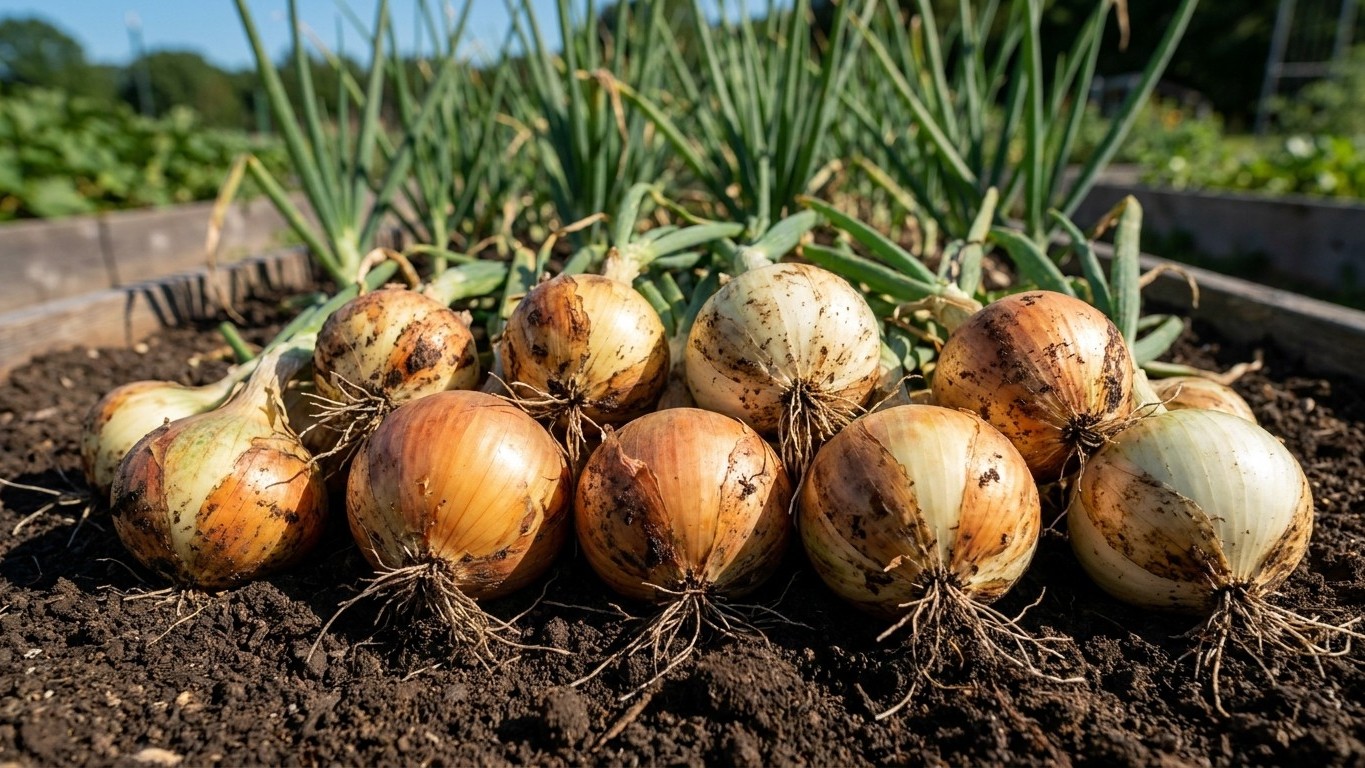

Delaware gardeners searching for an onion pest list will come up short: University of Delaware Cooperative Extension does not document a single insect species that specifically feeds on onion in this state. The nine pests tracked across the state’s vegetable gardens all target other crops. That absence isn’t a gap in the data. It traces back to the same volatile sulfur compounds that make an onion sting your eyes and keep it fresh in storage, a chemical defense most chewing insects avoid.
Which pests attack onion in Delaware
University of Delaware Cooperative Extension documents nine insect species across the state’s vegetable gardens: Colorado potato beetle, cucumber beetles (spotted and striped), harlequin bug, imported cabbageworm, Mexican bean beetle (Epilachna varivestis), squash beetle, squash bug, squash vine borer, and tomato hornworm. That’s the full documented list for this state, and it’s worth sorting through it crop by crop before assuming any of it applies to a row of onions.
Colorado potato beetle feeds on potato foliage and other nightshade leaves; it has no reason to visit an allium bed. Cucumber beetles, both the spotted and striped forms, chew cotyledons and leaves on cucumbers, squash, and melons, and they matter mainly because they spread bacterial wilt between cucurbit vines. Harlequin bug pierces the sap of cabbage, kale, and other brassica leaves, while imported cabbageworm chews the same cole-crop foliage from the caterpillar stage. Mexican bean beetle strips bean pods and leaves. Squash beetle, squash bug, and squash vine borer all live and feed on squash and pumpkin tissue, from leaf surface to hollow stem. Tomato hornworm defoliates tomato plants and their nightshade relatives.
None of those nine host plants share much with an onion’s structure. There’s no broad leaf blade to skeletonize, no vine to bore into, no pod to chew open. None of the nine species University of Delaware Cooperative Extension tracks feeds on onion, and that lines up with the plant’s own chemistry: onion tissue is loaded with volatile sulfur compounds that double as pest deterrent and storage preservative. A gardener who sees any of these nine insects in the yard should look toward the potato patch, the squash hill, or the tomato cage, not the onion row.
When each one shows up, and what it does first
Because none of the documented species target onion, there’s no onion-specific calendar to give. What’s useful instead is understanding why the timing never overlaps. Colorado potato beetle adults emerge from overwintering soil once it warms in spring and head straight for potato foliage. Cucumber beetles show up as soon as cucurbit seedlings unfold their cotyledons, feeding on that tender first growth. Harlequin bug and imported cabbageworm arrive on transplanted brassicas early in the season, while Mexican bean beetle waits for bean plants to germinate before settling in. Squash bug and squash vine borer both track squash vine development through mid-summer, and tomato hornworm doesn’t appear in force until tomato plants have built out full foliage, usually later in the season.
An onion crop in Delaware follows a different clock entirely. It spends its early weeks building leaves, then shifts into bulb formation once day length approaches the trigger point for the variety planted. Bulbing in short-day types starts near 12 hours of daylight, while long-day types wait for 14 to 16 hours — and at the state’s reference latitude of 39.67 degrees north, the longest day of the year tops out at 14 hours 49 minutes. That ceiling matters for variety choice, but it also explains the pest gap: onion’s leaf-growth and bulbing stages simply don’t coincide with the feeding windows of potato, cucurbit, brassica, bean, or tomato pests, because those crops are planted, germinate, and mature on different schedules in a different part of the garden.
What a Delaware gardener actually notices first on an onion, when something is amiss, tends to be cosmetic: a leaf tip browning, a bulb splitting, a plant looking thinner than its neighbors. None of that traces back to the nine species above. It’s a signal to look at growing conditions before assuming an insect is responsible.
Telling the damage apart from everything else
Most onion trouble reported in Mid-Atlantic gardens isn’t insect feeding at all, it’s water, nutrients, disease, or handling. That matters more in Delaware than in states with a documented onion-specific pest, because there’s no obvious insect culprit to rule in or out first.
| Symptom | Likely cause | What distinguishes it |
|---|---|---|
| Yellowing leaf tips, spreading down the blade | Nitrogen deficiency or inconsistent watering | Shows up across the whole bed, not on isolated plants; no chew marks or holes present |
| Water-soaked or collapsing leaves | Fungal disease favored by humid spring weather | Lesions or fuzzy growth on the leaf surface, not ragged edges from chewing |
| Split or misshapen bulbs | Irregular soil moisture or physical bruising | No feeding damage visible; correlates with heavy rain after a dry stretch |
| Stunted, thin growth | Compacted soil or crowding | Root and bulb development lags evenly; no visible insects at the base of the plant |
Check for the insect itself, not just the damage, before deciding a pest is involved. If a gardener does find something actually chewing on onion leaves or bulbs, that’s notable precisely because it falls outside the nine species this state’s extension service tracks for other crops, and it’s a case worth reporting rather than guessing at.
What actually works here, and what is a waste of time
With no documented onion-specific insect in Delaware, the smartest move is putting effort where the real risk sits: growing conditions, not pest control. Even spacing, good drainage, and consistent watering do more for an onion crop here than any barrier or spray program aimed at insects that aren’t documented on this plant.
Skip a pesticide program aimed at pests that aren’t documented on this crop here — it wastes money, and it can knock back the beneficial insects that keep aphids and other generalist feeders in check elsewhere in the garden. Row covers, often useful against early-season insects on other crops, aren’t a standard practice for onion in this state, since there’s nothing in the documented list that a cover would need to exclude.
What does pay off: thinning onions to give each bulb room, which improves airflow and cuts down on the humid, still conditions that favor foliar disease in Delaware’s summers; mulching to reduce weed pressure, since weeds are what actually harbor whatever generalist insects wander through; and matching planting time to the season length rather than trying to stretch it. None of that is pest control in the traditional sense, but on this crop, in this state, it’s the work that matters.
Where to check this for your own county
Everything above comes from University of Delaware Cooperative Extension’s statewide documentation, and a statewide list is a starting point, not a guarantee about any single backyard. Insect presence shifts across a state even one as compact as Delaware, conditions in a Sussex County field aren’t identical to a New Castle County backyard, and a documented absence at the state level doesn’t rule out a stray insect showing up in one particular garden.
If something is actually feeding on onion leaves or bulbs, the next step is a call or visit to the local county extension office under University of Delaware Cooperative Extension, not a guess based on a photo search. Bring a live sample or a clear, close-up photo of the insect itself, not just the leaf damage, since damage alone rarely identifies the culprit. That’s especially true here, where whatever’s found wouldn’t match any of the nine species this state already has on record.