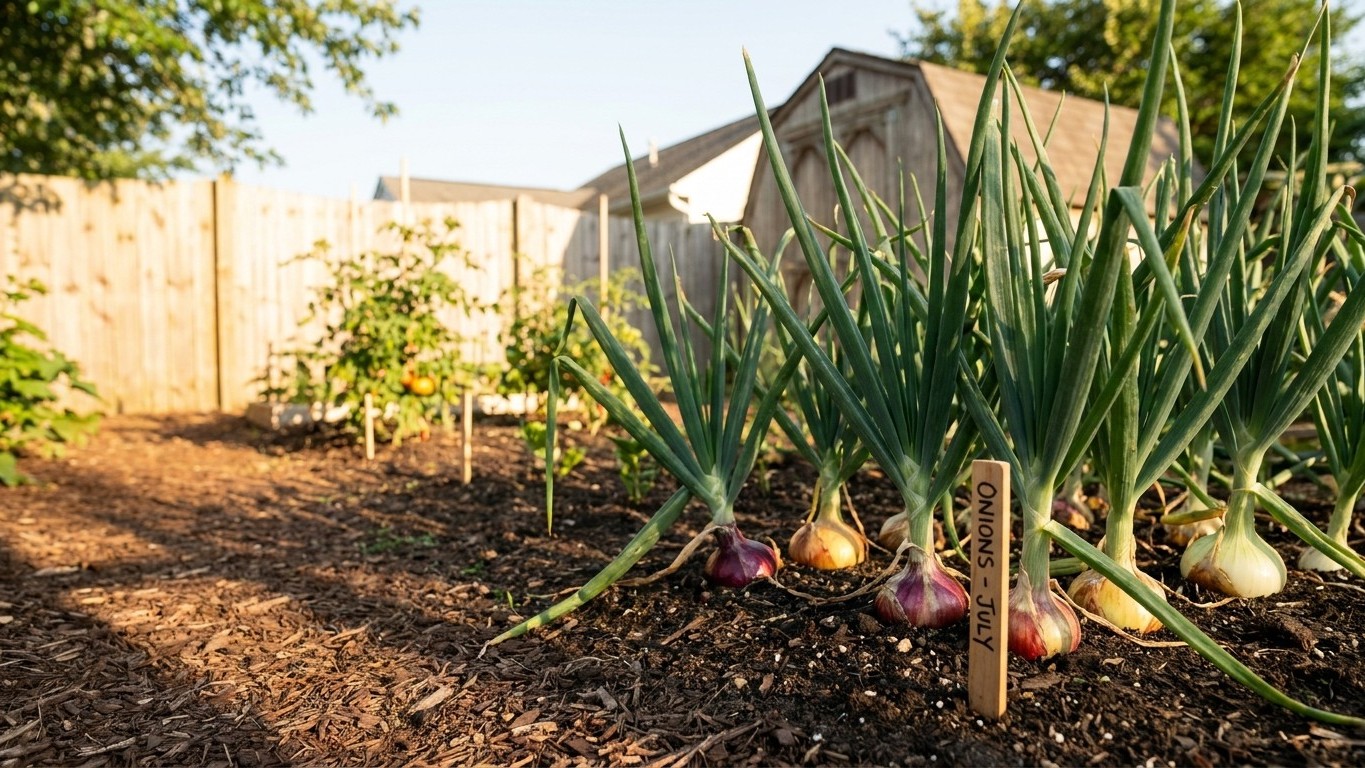

Delaware sits at 39.67 degrees north latitude, measured at Dover, where the longest day of the year delivers 14 hours and 49 minutes of daylight. That number puts the state squarely between intermediate-day and long-day onion territory, ruling out short-day varieties entirely and opening the door to a specific, documented list of both intermediate and long-day types.
The short answer for Delaware

An onion doesn’t care how hot your July gets. It cares how long the sun stays up. Bulbing starts when day length crosses a variety’s threshold, and at Dover’s 14 hours 49 minutes on the summer solstice, Delaware lands in the overlap zone where both intermediate-day and long-day onions have enough daylight to trigger bulb formation before the plant runs out of growing season.
Eighteen of the varieties documented on this site have a published latitude range that covers 39.67N, and they split into two groups. The long-day varieties suited here are Ailsa Craig, Barolo, Blush, Bridger, New York Early, Patterson, Rossa di Milano, and Walla Walla Sweet. The intermediate-day varieties are Cabernet, Calibra, Candy, Elsye, Expression, Monastrell, Red Long of Florence, Red Long of Tropea, Scout, and Sierra Blanca.
Both groups work because Delaware’s daylight hours fall inside the window each type needs to switch from making leaves to making a bulb. Intermediate-day onions typically respond somewhere around 12 to 14 hours, and long-day types wait for 14 to 16 hours. Dover’s 14 hours 49 minutes clears the intermediate threshold with room to spare and satisfies most long-day varieties too, which is why the state supports such a wide bench of options rather than forcing a single choice.
Two more varieties sit right at the edge of their published range here: Frontier (long-day, listed 40-50N) and Red Carpet (long-day, 40-45N). Both may bulb in Delaware, but the state’s reference latitude falls just below their documented starting point, so treat them as a gamble rather than a sure thing.
What will not work here
Planting the wrong day-length group isn’t a minor setback. It’s the difference between a harvest and a compost pile. Two groups fail in Delaware, and they fail for opposite reasons.
Short-day onions are built for latitudes far south of Dover, where the days never get particularly long even in summer. Planted in Delaware, they hit their 12-hour trigger while the plant is still small, so bulbing starts before the onion has built enough leaf mass to feed a large bulb. The result is a small, undersized onion, not a failed one, but it’s still a variety mistake worth avoiding when better options exist:
- Gabriella (short-day, rated for 20-35N), bulbs too early in Delaware, staying small
- Madalyn (short-day, rated for 20-35N), same early-trigger problem, undersized bulbs
- Red Rock (short-day, rated for 30-36N), closer to Delaware’s range but still triggers before the plant is ready
- White Castle (short-day, rated for 30-38N), the nearest of the four, but still below Dover’s latitude
The opposite failure comes from long-day varieties bred for latitudes well north of Delaware, where summer days stretch past 15 or 16 hours. These onions never see enough daylight here to trigger bulbing at all. The plant just keeps making leaves all season, then rots in the ground or in storage without ever forming a bulb:
- Powell (long-day, rated for 43-47N), day length in Delaware never reaches its trigger point
- Redwing (long-day, rated for 43-65N), built for far-northern summers, not mid-Atlantic ones
- Safrane (long-day, rated for 42-50N), leaves all season, no bulb
- Talon (long-day, rated for 42-50N), same outcome, wasted growing space
Neither failure is a feeding problem. More fertilizer or water won’t fix a day-length mismatch. The plant is responding to the sun, not the soil.
What changes across Delaware
Delaware runs roughly 1.4 degrees of latitude from north to south, from the Pennsylvania border near Wilmington down to Fenwick Island on the Atlantic coast. That’s a small state, but it’s not a single point, and the daylight difference between its northern and southern tips is real even if modest.
Dover, at 39.67N, sits close to the geographic middle of the state, which makes it a reasonable reference for most gardeners. But a reader gardening near Wilmington, closer to 39.8N, gets a touch more daylight on the summer solstice than Dover does, which nudges the borderline long-day varieties like Frontier and Red Carpet a bit more into reliable territory. A reader near Georgetown or Selbyville, closer to 38.5N, gets slightly less daylight at the peak of summer, which favors leaning toward the intermediate-day side of the list rather than pushing long-day varieties that are already near their southern limit.
| Location | Approximate latitude | Day length, longest day | What it changes |
|---|---|---|---|
| Northern Delaware (Wilmington area) | ~39.8N | Slightly more than 14h49 | Frontier and Red Carpet more likely to bulb reliably |
| Dover (reference station) | 39.67N | 14h49 | Baseline recommendations for the state |
| Southern Delaware (Georgetown, Selbyville) | ~38.5N | Slightly less than 14h49 | Intermediate-day varieties are the safer bet |
None of this changes the exclusions. Short-day varieties still bulb too early anywhere in Delaware, and the far-north long-day varieties still won’t see enough daylight even at the state’s northern edge. The state’s small size limits how much variety the geography itself introduces, but it doesn’t erase it.
Sweet now, or onions that last
Every onion gardener eventually runs into the same trade-off, and it’s chemistry, not chance. The volatile sulfur compounds that give an onion its bite are the same compounds that protect it from breaking down in storage. According to University of Missouri Extension, sweet onion varieties don’t store as well as more pungent types, precisely because they carry fewer of those protective compounds.
Delaware’s position in the overlap zone means gardeners here aren’t locked into one side of that trade. Walla Walla Sweet and Candy lean toward the mild, short-keeping end, best eaten within weeks of harvest rather than tucked away for winter. Patterson, Ailsa Craig, and the intermediate-day Cabernet carry more of those sulfur compounds, which means sharper flavor at the cutting board but a bulb that holds up in a cool, dry pantry for months.
What that means in practice: a gardener who plants only Walla Walla Sweet will have nothing left by January, sweet onions simply don’t hold that long. A gardener who mixes in Patterson or a similar keeper will still have firm, usable bulbs in March, even if they’re sharper on the tongue than what came out of the ground in July. Delaware’s climate doesn’t force a choice between the two, it just means the choice has to be made on purpose, by planting some of each rather than defaulting to whichever variety looked good on the rack.
Checking this against your own garden
Dover’s numbers are a starting point, not a guarantee for every yard in the state. A garden 20 miles away can behave differently, especially near the state’s northern or southern edges. Before committing a season to any of the varieties above, it’s worth confirming a few things specific to your own plot:
- Look up your own latitude if you garden well north of Wilmington or south of Selbyville, since even small shifts change where borderline varieties like Frontier and Red Carpet land
- Check your local average last spring frost date, since onion transplants and sets go in the ground based on that date, not on a fixed calendar day
- Contact your county’s Cooperative Extension office (New Castle, Kent, or Sussex County) for soil test recommendations and local pest pressure specific to your area
- Watch your own soil drainage, since onions bulb properly only in loose, well-drained beds regardless of which variety or day-length group you plant
These checks take an afternoon, and they turn a state-wide estimate into a plan that actually fits the ground you’re working.