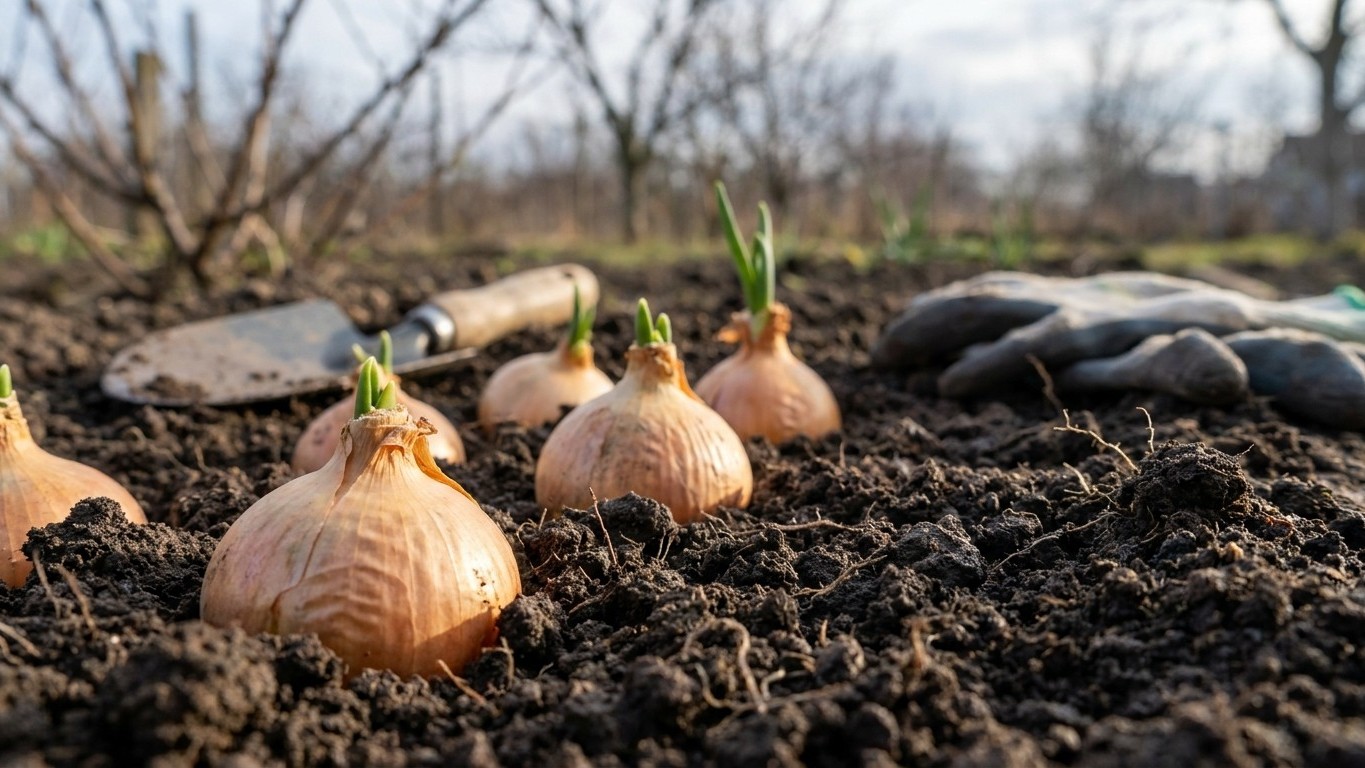

Delaware sits at 39.67 degrees north, measured at the Wilmington weather station, and on the longest day of the year the sun gives that spot 14 hours and 49 minutes of daylight. That number rules out short-day onions and puts the state squarely in long-day and intermediate-day territory. For timing, that means planting in late winter to early spring, well before the soil warms, rather than the fall planting some southern states rely on.
The short answer for Delaware

Onions don’t care how warm it is. They care how long the day is. Once daylight crosses a threshold that’s specific to each variety group, the plant stops putting energy into leaves and starts putting it into the bulb. At Wilmington’s 39.67N, the longest day tops out at 14 hours and 49 minutes of daylight, which is nowhere near the 12-hour trigger for short-day varieties (per Clemson Cooperative Extension’s HGIC onion guidance) but sits comfortably inside the 14-to-16-hour window that long-day and intermediate-day types need.
That day-length ceiling is why Delaware growers plant in late winter to early spring rather than in fall, the way growers in the Deep South do. In mild-winter states, short-day onions go in the ground in October or November, spend the cold months quietly building roots and a few leaves, and bulb up as spring days lengthen past 12 hours. Delaware’s winters are colder, and its day length never gets short-day onions to the size they’d need before bulbing kicks in anyway. So the calendar flips: sets or transplants go in as early as the ground can be worked, giving the plant the whole spring to build leaf mass before summer’s long days trigger bulbing.
The practical target is a planting window that opens in late February in the mildest pockets of the state and runs through March almost everywhere else, always aimed at getting transplants or sets established before the soil gets warm enough to rush the plant toward bolting instead of bulbing. This isn’t a fixed date on a calendar so much as a race against day length: every week of leaf growth before the trigger hits adds size to the eventual bulb, and there’s no way to add that growth back once bulbing starts.
Because the whole state sits close to that 39.67N reference point, the same long-day and intermediate-day recommendation holds almost everywhere in Delaware, with only minor timing shifts between the northern and southern edges, covered below.
What will not work here
Variety choice matters more than soil prep or fertilizer here, and getting it wrong doesn’t produce a smaller harvest, it produces no harvest at all in one direction and pointless tiny bulbs in the other.
Short-day varieties are bred for latitudes well south of Delaware, where the 12-hour trigger arrives while the plant is still small. Plant them here and the same trigger still fires on schedule, only now the plant hasn’t had the extra weeks of long Delaware spring days to build size first. The bulb that forms is whatever the plant managed to grow by that point, and that’s a fraction of what a longer-season variety would deliver:
- Gabriella (short-day, rated for 20-35N), bulbs far too early for Delaware’s day length, leaving tiny onions.
- Madalyn (short-day, rated for 20-35N), same early trigger, same undersized result.
- Red Rock (short-day, rated for 30-36N), closer to Delaware’s latitude but still triggers before the plant is grown.
- White Castle (short-day, rated for 30-38N), the closest of the group, still an early, small bulb here.
The opposite mistake is worse. Varieties bred for latitudes north of 39.67N need summer days longer than anything Delaware ever produces. The plant waits for a trigger that never arrives, keeps making leaves through the whole growing season, and eventually rots in the ground without ever forming a bulb:
- Powell (long-day, rated for 43-47N) : Delaware’s day length never reaches its threshold.
- Redwing (long-day, rated for 43-65N), needs a summer day length Delaware simply doesn’t have.
- Safrane (long-day, rated for 42-50N), leaves all season, no bulb.
- Talon (long-day, rated for 42-50N), same outcome, no exceptions.
The timing version of this mistake is planting late. A gardener who gets transplants in the ground three weeks behind schedule doesn’t get a harvest three weeks later, they get a smaller harvest on the same day. Day length triggers bulbing on its own timetable regardless of how big the plant has gotten, so whatever size the onion is when that trigger fires is the size it stays.
What changes across Delaware
Delaware is a small state, but it isn’t a single point on a map. It runs from roughly 38.45N near Fenwick Island and Selbyville on the Maryland line up to about 39.84N near the Pennsylvania border, a spread of a little under a degree and a half. That’s modest compared to states that stretch across five or six degrees, but it’s still enough to shift the planting calendar by a week or two between the two ends of the state.
| Location | Latitude | Longest-day daylight | What it changes |
|---|---|---|---|
| Wilmington (reference city) | 39.67N | 14 h 49 min | Baseline for the long-day/intermediate-day recommendation above. |
| Southern tip (near Fenwick Island/Selbyville) | ~38.45N | Slightly under 14 h 49 min | Earlier spring warm-up allows planting a little sooner; day length still favors the same variety groups. |
The practical takeaway: a gardener near the Pennsylvania border should treat the Wilmington figures as their own and follow the timing described above without adjustment. A gardener near the southern coast can generally start a week or two earlier, since the ground warms sooner there, even though the day-length trigger itself barely changes across such a short latitude range.
Two varieties sit right at the edge of what’s documented for this latitude and deserve a caution rather than a flat yes or no: Frontier (long-day, rated for 40-50N) and Red Carpet (long-day, rated for 40-45N). Both are rated for latitudes just above Wilmington’s 39.67N. They may bulb successfully in the northernmost sliver of Delaware, but a gardener anywhere else in the state is better served by a variety solidly rated for 39.67N rather than one at the edge of its published range.
Sweet now, or onions that last
Delaware’s position in the intermediate-day and long-day zone gives gardeners a real choice, and it comes down to chemistry rather than luck. The compounds responsible for an onion’s bite are volatile sulfur compounds, and those same compounds are what protect the bulb from decay in storage. A variety bred to be mild has fewer of them. It tastes better raw in July, and it starts going soft in the pantry by the time the holidays roll around.
University of Missouri Extension puts it plainly: sweet onions do not store as well as the more pungent types. That’s not a marketing distinction, it’s the same trait showing up in two places at once. Grow a mild, sweet intermediate-day variety like Candy, Sierra Blanca, Scout, Elsye, or Expression, and expect a great onion for late-summer eating that won’t make it to spring in the crisper drawer.
Grow a sharper long-day type instead, something like Patterson, Bridger, or New York Early, and the trade flips. These onions won’t be the ones you slice raw for a burger without noticing, but they’re the ones still solid in a root cellar or a cool garage in March, months after the sweet varieties from the same garden have gone soft.
Most Delaware gardeners split the difference, planting a row of something sweet for summer eating and a row of something pungent for the pantry that has to last through winter. Given Delaware’s latitude, both choices are viable at once, which isn’t true everywhere. Further south, the sweet, short-keeping option is close to the only one available; further north, the long-keeping pungent types dominate because summer days there run even longer.
Checking this against your own garden
Everything above is built on Wilmington’s 39.67N and its 14 hour, 49 minute longest day. That’s a solid reference for most of Delaware given how compact the state is, but it’s still one point, not a guarantee for every backyard between the Pennsylvania line and the Atlantic coast.
- Look up your own latitude if you garden near either edge of the state, particularly south of Dover or north of Newark, since a degree of difference can shift both timing and variety choice.
- Confirm your average last spring frost date locally rather than assuming a statewide number, since coastal and inland spots in Delaware don’t always warm at the same pace.
- Check soil temperature before planting sets or transplants; onions tolerate cold air better than cold, waterlogged ground.
- Contact your county’s Cooperative Extension office (part of the University of Delaware Cooperative Extension system) for planting dates calibrated to your exact location.
- Re-check a variety’s published latitude range before buying, especially for anything near the 39-40N boundary discussed above.
If you follow the almanac, here is when to plant onions by the moon. It is a tradition, not a proven method.